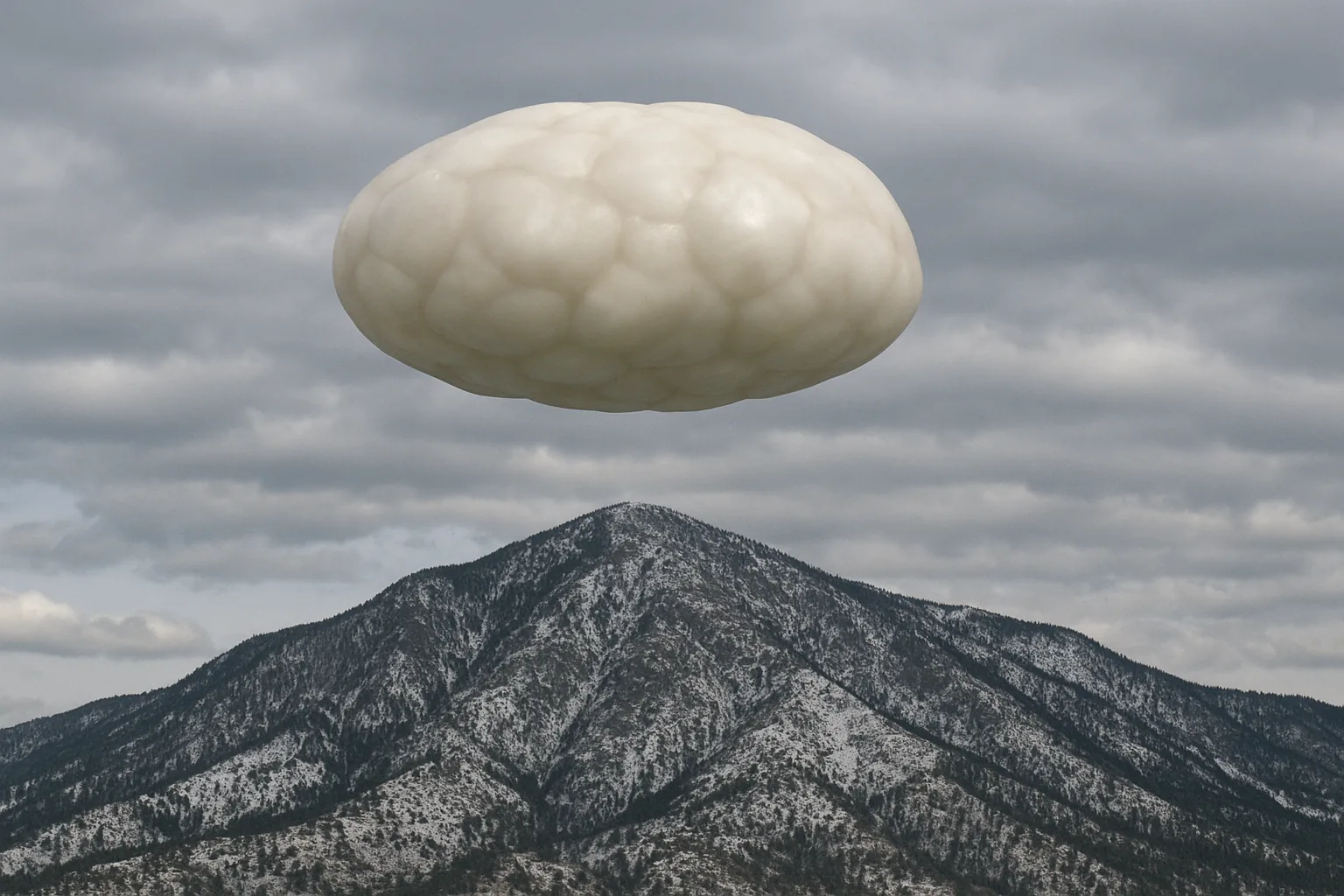
Five U.S. Army soldiers near Fort Carson, Colorado, were watching Cheyenne Mountain on a winter afternoon in 2022 when they saw something that shouldn’t have been there: a mystery potato hovering over Colorado’s most famous granite peak. It was large, oddly shaped, and shimmering white—a creamy, opalescent object that seemed to hang motionless before vanishing from sight. One of the witnesses, a former Army intelligence officer, later told the FBI that its surface moved in slow, irregular waves while the object itself stayed perfectly still. Then, after about two minutes, it blinked out as if cloaked rather than flown away. That sighting, from 15 February 2022, is now part of the Pentagon’s third official dump of UFO files, released on Friday under a White House executive order. The analysts have a theory. They don’t much like it.
The mystery potato hovering over Cheyenne Mountain
The incident, logged as a “Unresolved UAP Report,” sits among 72 documents, images, and recordings the Pentagon uploaded to its portal. Five service members reported seeing an object over Cheyenne Mountain, the iconic Cold War bunker dug deep into the rock, while they were operating near Fort Carson. According to the initial report, it hovered for up to three minutes, shimmering white and translucent, with a panel-like surface that slowly changed shape. No aircraft or balloons were operating in the area at the time, and subsequent checks found no evidence that the object was a known vehicle or a threat.
A separate FBI document goes further. In an interview with one of the witnesses, the object is described bluntly as “potato-shaped.” The witness, a former Army intelligence officer, recalled a creamy white colour and irregular panels that moved in slow waves while the potato itself stayed rigid. The object then disappeared instantly, as if it had “cloaked.” The FBI later produced an artistic interpretation—a digital rendering that looks like a cross between a lumpy cloud and a badly peeled egg. That image, derived from the witness’s first-hand narrative, now circulates alongside the Pentagon’s more sober analysis.
Sunlight, snow, and low confidence
That’s a crucial admission. Low confidence is what you say when you’d rather not be quoted. It means the backscattering idea is plausible on paper but flimsy in practice. The witnesses described a shape—a potato—that changed its surface texture while remaining perfectly stationary, then vanished all at once. A diffuse reflection off clouds does not typically produce crisp, geometric illusions that evolve for minutes before winking out. The report’s own language betrays the gap: “investigators said they have low confidence in that conclusion.” As of this month, the case remains officially unresolved.
Does the mystery potato hovering over Colorado have a natural explanation?
The low-confidence label invites a harder question: if a group of trained U.S. Army personnel can stare at a mountain for three minutes and still not agree on what they saw, how useful is a remote desk analysis that arrives months later? The backscattering hypothesis is, in essence, a weather guess applied to a sensory anomaly. It leans on the absence of other evidence—no radar hits, no aircraft in the area—rather than any positive identification. That’s standard procedure for unexplained aerial phenomena, but it feels especially thin when the witnesses include an intelligence officer accustomed to interpreting what he sees.
Atmospheric optics can produce startling illusions, from the Brocken spectre to complex mirages. Yet those phenomena are typically transient and do not generate reports of a solid, slowly morphing object that remains fixed for minutes. The report itself acknowledges the uncertainty, noting that without better meteorological data and precise sighting angles, the backscattering explanation is a filler, not a finding. The Pentagon has effectively said: we don’t know what it was, but here’s one way it might have looked like something. For an agency that prides itself on threat assessments, that’s a remarkably hand-wavy posture.
The transparency blitz and its limits
The potato sighting is not the strangest item in the third release. The files include orb sightings from 2023 in the western U.S., where federal agents reported glowing lights that “accelerated instantly and maneuvered with perfect, smooth coordination.” One agent recalled his partner asking, “Are you seeing this?” as a bright orange light expelled smaller orbs like grapes from a basketball. Another video, shot in the northeastern U.S. in 2025, shows two bright lights moving in tandem, described by witnesses as silent and smooth, flying in formation. A 2008 CIA report on a UFO above Harare airport in Zimbabwe, with rotating lights and emitted beams, put the area on high alert.
But the Colorado potato is notable precisely because it has been assigned an explanation, however feeble. Most UAP cases in the Pentagon’s growing corpus remain unresolved, often because the data are too poor. This one drew a specific physical hypothesis, and it still couldn’t stick the landing. That pattern mirrors a declassified CIA panel from 1952–53, included in the same release, which advised that flying saucers posed no physical threat but recommended an official policy of “debunking” to strip the subject of its mystery. The panel warned that a “morbid national psychology” around UFOs could be exploited by adversaries. Seventy years later, the Pentagon is still trying to straddle the line between transparency and the institutional instinct to shoo away hard questions.
What the files don’t say
President Trump’s executive order demanding more UFO disclosure has forced a pace the Pentagon may not have chosen on its own. Defense Secretary Pete Hegseth called the release “unprecedented transparency.” It is unprecedented in volume, certainly. But the files are heavier with narratives than with evidence: interviews, artistic renderings, and summary analyses that often conclude with a shrug. No radar data accompanies the Colorado case, no multispectral imagery, no calibrated measurements. The FBI rendering is not a photograph; it’s a digital sketch based on a memory.
In Europe, the situation is even quieter. No EU agency maintains a public UAP office. Germany’s aerospace centre, DLR, has no standing programme to analyse anomalous sightings, and the European Space Agency’s interest stops at near-Earth objects of the asteroidal kind. When a potato-shaped anomaly appears over Colorado, the U.S. at least publishes a file. When one appears over rural Bavaria, it probably ends up as a local newspaper oddity and a Facebook thread. Transparency is relative, and right now the American version is a messy, contradictory, and occasionally unsatisfying affair. But it’s the only official game in town.
The potato over Cheyenne Mountain remains unresolved. The Pentagon’s analysts say they have low confidence in their own explanation. That’s less a conclusion than a placeholder—a notation for a file that may never close.
Sources
- UFO Files, Release 03 (Pentagon, 13 June 2026)
- FBI-UAP-D002, FD-1057 Unresolved UAP Report, Colorado Springs, 2022
- ICA-UAP-D001 Analysis of the Colorado Springs UAP Incident
- CIA-UAP-002 Scientific Advisory Panel on Unidentified Flying Objects Report (1952–1953)




Comments
No comments yet. Be the first!