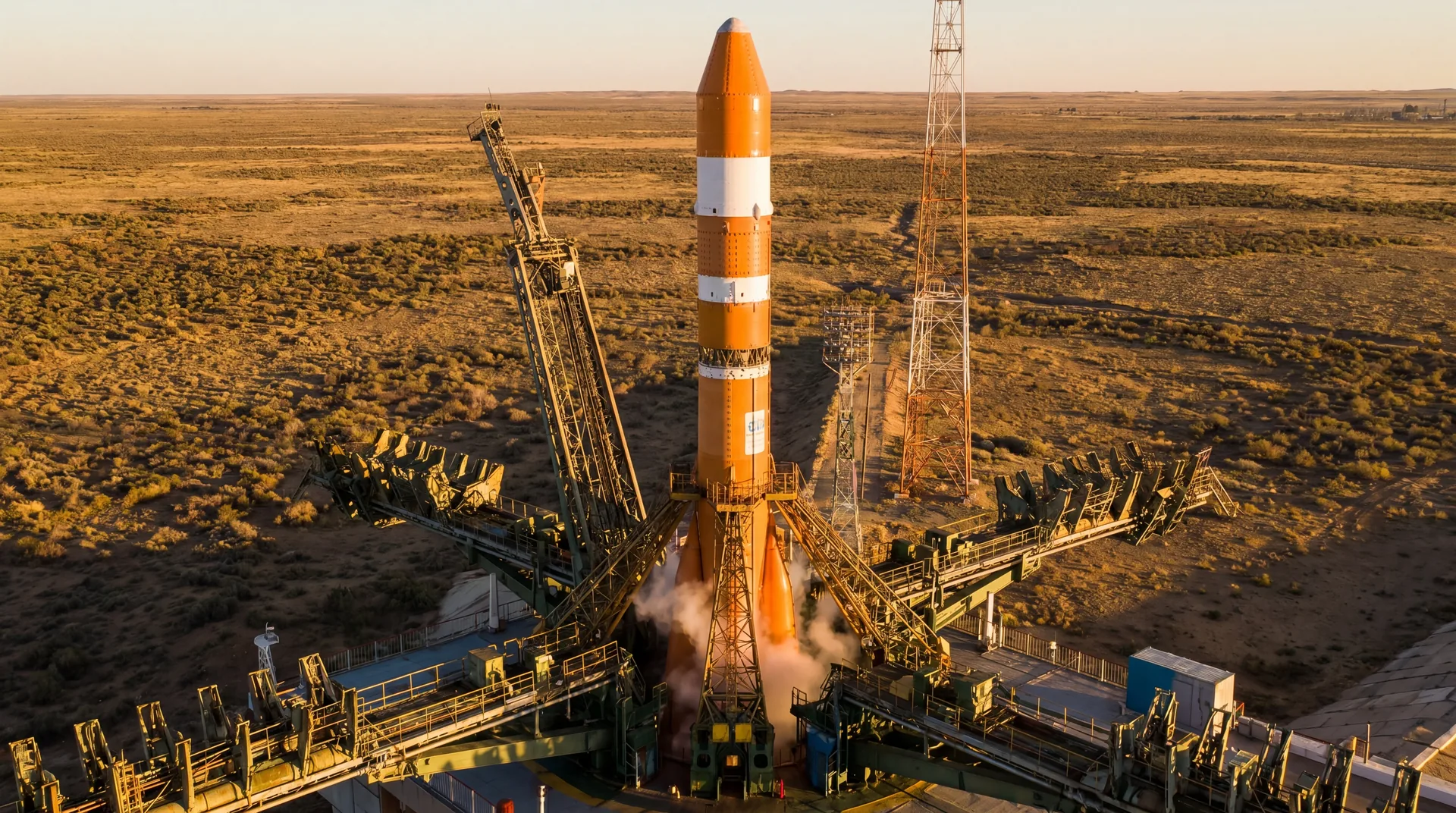

At sea level, the RD-171MV engine pushes out over 800 tons of thrust. Russian engineers routinely cite it as the most powerful liquid-fueled engine in the world. But the sheer brute force of the hardware masks a much more delicate reality: Roscosmos had to build it because its international supply chains collapsed.
For decades, the Russian space programme relied on the Zenit family of rockets, heavily dependent on components manufactured outside its borders. Geopolitical isolation severed those ties entirely. Now, scheduled for a maiden flight from Kazakhstan on 30 April 2026, the Soyuz-5 represents Moscow's attempt to engineer its way out of a procurement crisis. It is a 17-ton payload lifter born of absolute necessity.
A Monolithic Solution to a Procurement Crisis
While the European Space Agency continues to carefully balance the multi-national supply networks of Ariane 6 across member states, Russia’s industrial strategy has been forced into strict autarky. The Soyuz-5, known internally as Irtysh, abandons the complex, four-booster "tulip" configuration of the legacy Soyuz-2. Instead, engineers opted for a streamlined, monolithic cylindrical design.
To achieve an entirely domestic build, the manufacturing process relies on friction stir welding to construct a chassis free of imported alloys. The architecture is powered by a liquid oxygen and kerosene (RG-1) mix, designed to eventually succeed the aging Proton-M fleet and its highly toxic hypergolic fuels. By carrying 17 metric tons to Low Earth Orbit (LEO), the vehicle slots neatly between the legacy Soyuz-2 and the massive Angara-A5.
The Baiterek Compromise
While the manufacturing is strictly Russian, the launch real estate remains a cross-border compromise. The Soyuz-5 will lift off from the Baikonur Cosmodrome under the Baiterek project, a joint venture between Russia and Kazakhstan. The initiative is explicitly designed to repurpose the abandoned Zenit launch pads for the new hardware.
It is a highly pragmatic move. By keeping the medium-to-heavy lift infrastructure in Baikonur rather than shifting operations entirely to the newer Vostochny Cosmodrome in Russia's Far East, Roscosmos saves capital it desperately needs for spacecraft development. The streamlined single-core design also simplifies ground processing, potentially increasing the launch cadence if commercial demand ever returns.
Waiting for Orel
If the 2026 flight profile succeeds, the Soyuz-5 is slated to become the primary launch vehicle for the Orel (PTK NP), Russia’s next-generation crewed capsule. Strategic roadmaps even suggest strapping multiple Soyuz-5 first stages together in a modular configuration to create a super-heavy lift vehicle for lunar exploration.
But those ambitions remain firmly on paper. The immediate focus is surviving the April 2026 maiden flight, which will trigger a series of qualification launches stretching late into the decade. Moscow clearly has the thrust. Now it just has to prove it can maintain the supply chain to match.
Sources
- Roscosmos





Comments
No comments yet. Be the first!