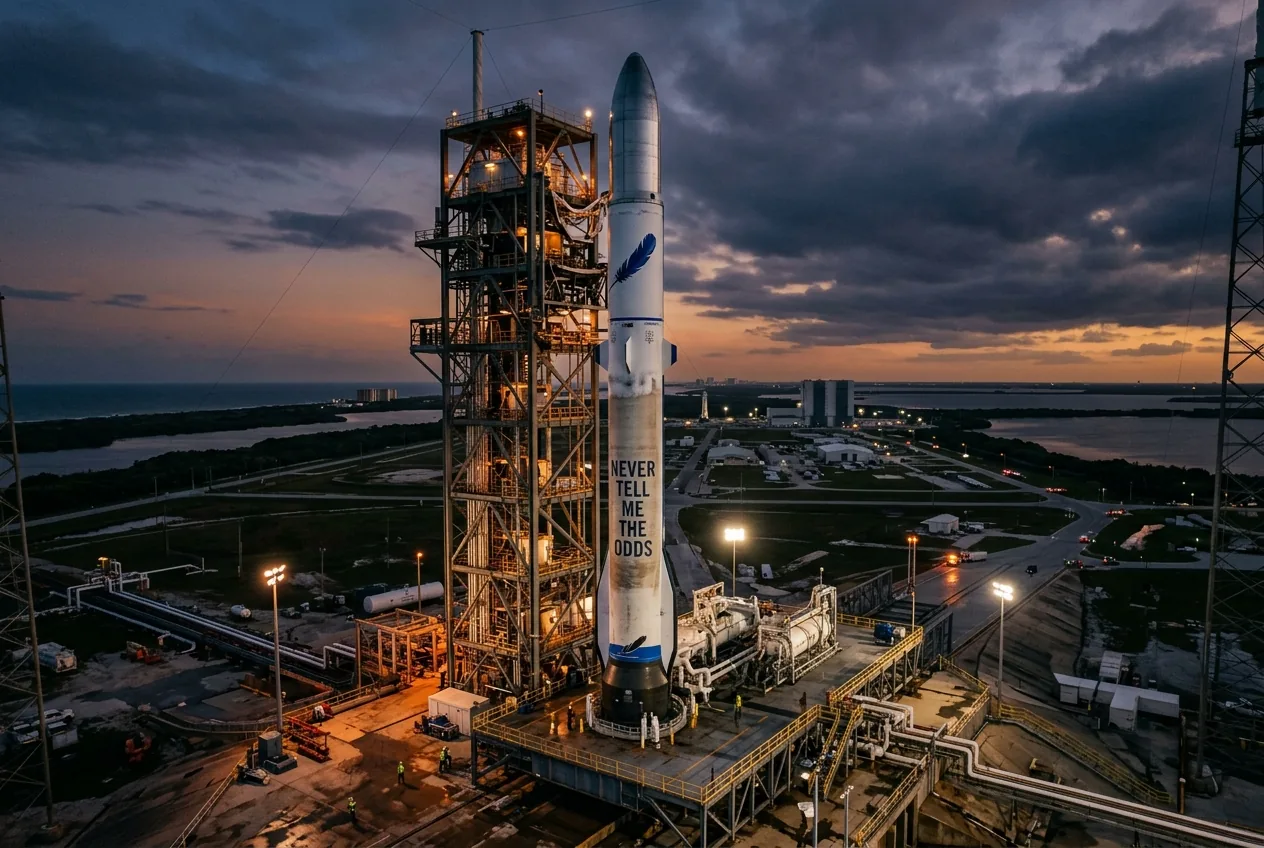
The booster, a 3.5-meter-wide pillar of aerospace engineering nicknamed “Never Tell Me the Odds,” returned to the deck of the drone ship Jacklyn with the smug precision of a valet-parked car. It was the first time Blue Origin had successfully reused and recovered its massive first stage on an orbital mission. For a few minutes on Sunday, it looked as though Jeff Bezos had finally found the cadence to match his rival in South Texas. Then the telemetry from the upper stage arrived, and the celebration in Kent, Washington, died in the throat.
An underperforming BE-3U engine during the second orbital burn left AST SpaceMobile’s BlueBird 7 satellite in a uselessly low orbit, destined to become a very expensive shooting star. The Federal Aviation Administration (FAA) has since grounded the New Glenn fleet, triggering a mishap investigation that halts Blue Origin’s momentum just as the company was attempting to prove it could provide a viable alternative to the SpaceX hegemony. For a global launch market already choked by a lack of heavy-lift capacity, the grounding is more than a company setback; it is a structural failure in the Western world’s space supply chain.
The high cost of 'underperformance'
The BE-3U is a liquid hydrogen-liquid oxygen engine, a high-efficiency choice that Blue Origin has bet its future on. Unlike the kerosene-gulping Merlin engines that power SpaceX’s Falcon 9, hydrogen engines provide higher specific impulse but are notoriously difficult to manage. They require complex plumbing, vacuum-jacketed lines, and a mastery of cryogenic fluid dynamics that can humble even the most veteran engineering teams. The failure of a single engine on the third flight of a new vehicle suggests that the transition from the suborbital success of the New Shepard program to the orbital demands of New Glenn is proving steeper than the company’s “Step by Step, Ferociously” motto implies.
The loss of BlueBird 7 is a blow to AST SpaceMobile’s plans for a space-based cellular broadband network, but the payload was insured. The real uninsured loss is time. Blue Origin has spent over a decade developing New Glenn, often under a shroud of secrecy that fueled skepticism in the industry. This mission was supposed to be the commercial proof of concept that would unlock a backlog of launches for the U.S. Space Force and Amazon’s own Project Kuiper. Instead, the company must now wait for the FAA to pick through the debris of its flight data.
The regulatory bottleneck and the Starship contrast
When an FAA mishap investigation begins, the clock does not just stop; it resets. The agency’s role is not to help Blue Origin fly again quickly, but to ensure that the next failure doesn’t involve a rocket falling on a populated area or a sensitive piece of infrastructure. This process can take weeks if the data is clean and the fix is a simple software patch, or months if the BE-3U requires a hardware redesign. For Blue Origin, which has historically favored a slow, deliberate development cycle over the “blow it up and learn” philosophy of SpaceX, this regulatory pause is particularly painful.
There is a quiet irony in the timing. SpaceX’s Starship has faced its own share of FAA groundings, but Elon Musk has built a production line that treats rockets as iterative prototypes. Blue Origin treats New Glenn as a finished product. When a Starship fails, it is often framed as a planned test of the system’s limits. When New Glenn fails on its first commercial outing, it looks like a failure of the manufacturing process. The FAA’s oversight will now scrutinize not just the engine’s performance, but the quality control systems at Blue Origin’s massive Florida production facility.
Industry insiders have long whispered that Blue Origin’s biggest hurdle is its culture—a mix of high-end engineering talent and a lack of the operational urgency that defines a startup. Dave Limp, a former Amazon executive brought in to fix this, now faces his first major crisis. He has to prove that Blue Origin can move through a mishap investigation with the agility of a tech company, rather than the plodding pace of a traditional defense contractor.
A European headache in a global vacuum
From a European perspective, the New Glenn grounding is a reminder of a dangerous dependency. The European Space Agency (ESA) has spent years navigating the “launch crisis”—the period between the retirement of the reliable Ariane 5 and the delayed debut of Ariane 6. During this gap, Europe was forced to buy rides from SpaceX, a bitter pill for proponents of European “strategic autonomy.” New Glenn was viewed as a potential release valve, a way to prevent a total SpaceX monopoly on the commercial market.
If New Glenn remains grounded for an extended period, the queue for SpaceX launches will only grow longer and more expensive. For European satellite operators and the European Commission’s IRIS² secure communications constellation, this is a procurement nightmare. There are simply not enough heavy-lift rockets in the Western world to meet the demand of the next three years. United Launch Alliance’s Vulcan Centaur is still ramping up its flight cadence, and Ariane 6 has a years-long backlog of institutional missions to clear before it can reliably serve the broader commercial market.
The industrial policy implications are clear: the West has allowed its launch infrastructure to become a series of single points of failure. In Cologne and Brussels, the conversation is already shifting toward whether the EU needs to de-risk its space strategy by doubling down on domestic micro-launcher startups, rather than waiting for the American billionaires to solve the heavy-lift problem. But micro-launchers cannot carry the multi-ton payloads that New Glenn was designed for. We are stuck in a world where the physics of heavy lift is increasingly controlled by a few square miles in Florida and Texas.
The NSSL pressure cooker
The Space Force is notoriously risk-averse. While they are willing to fund new entrants, they do not have the patience for perpetual “learning experiences” when the payload is a billion-dollar reconnaissance satellite. The BE-3U failure puts the propulsion system under the microscope. If the investigation reveals a systemic issue with the engine’s turbomachinery or its ability to handle thermal cycles, Blue Origin may have to reconsider its entire production schedule for the coming year.
This isn’t just about one engine; it’s about the BE-4 engines as well. While the BE-3U powers the upper stage, the massive BE-4 powers the New Glenn booster and ULA’s Vulcan rocket. Any whiff of a broader manufacturing or design flaw across Blue Origin’s engine families would send shockwaves through the entire U.S. launch industry. For now, the focus remains on the second stage, but in the interconnected world of aerospace procurement, a small crack in one program often reveals a larger fissure in the company’s foundation.
Jeff Bezos has the capital to wait out a long investigation, but the market does not. The success of the booster recovery proves that Blue Origin can build a reusable machine that works. The failure of the upper stage proves that they haven't yet mastered the art of getting to work. It is progress, certainly, but it’s the kind of progress that doesn't fit neatly onto a slide deck for impatient shareholders or nervous generals.
Blue Origin has the engineers and the hardware. It just hasn’t decided yet if it wants to be a rocket company or a very expensive hobby. The FAA will likely help them make that choice.




Comments
No comments yet. Be the first!