When the U.S. Securities and Exchange Commission (SEC) receives an S-1 filing, the leaden prose usually sticks to GAAP compliance, risk factors, and EBITDA projections. It does not typically reference Nikolai Kardashev, the Soviet astronomer who, in 1964, categorized hypothetical extraterrestrial civilizations by their ability to consume the total energy output of a star. Yet, in the countdown to what promises to be the largest initial public offering in history, SpaceX has written the Kardashev scale into its financial DNA, asserting that its merger with xAI and the deployment of a million-satellite “orbital data center” will spark one of the galaxy’s most advanced civilizations.
For those in the European space sector, watching from the offices of the European Space Agency (ESA) in Paris or the DLR in Bonn, the filing reads like a provocation. While Europe struggles to maintain sovereign access to space through the delayed and over-budget Ariane 6 programme, SpaceX is effectively declaring itself an independent superpower. The question is no longer whether SpaceX can launch; it is whether the SEC will permit a company to sell shares based on a roadmap that requires the energy equivalent of a Dyson sphere.
The thermal bottleneck of an orbital server farm
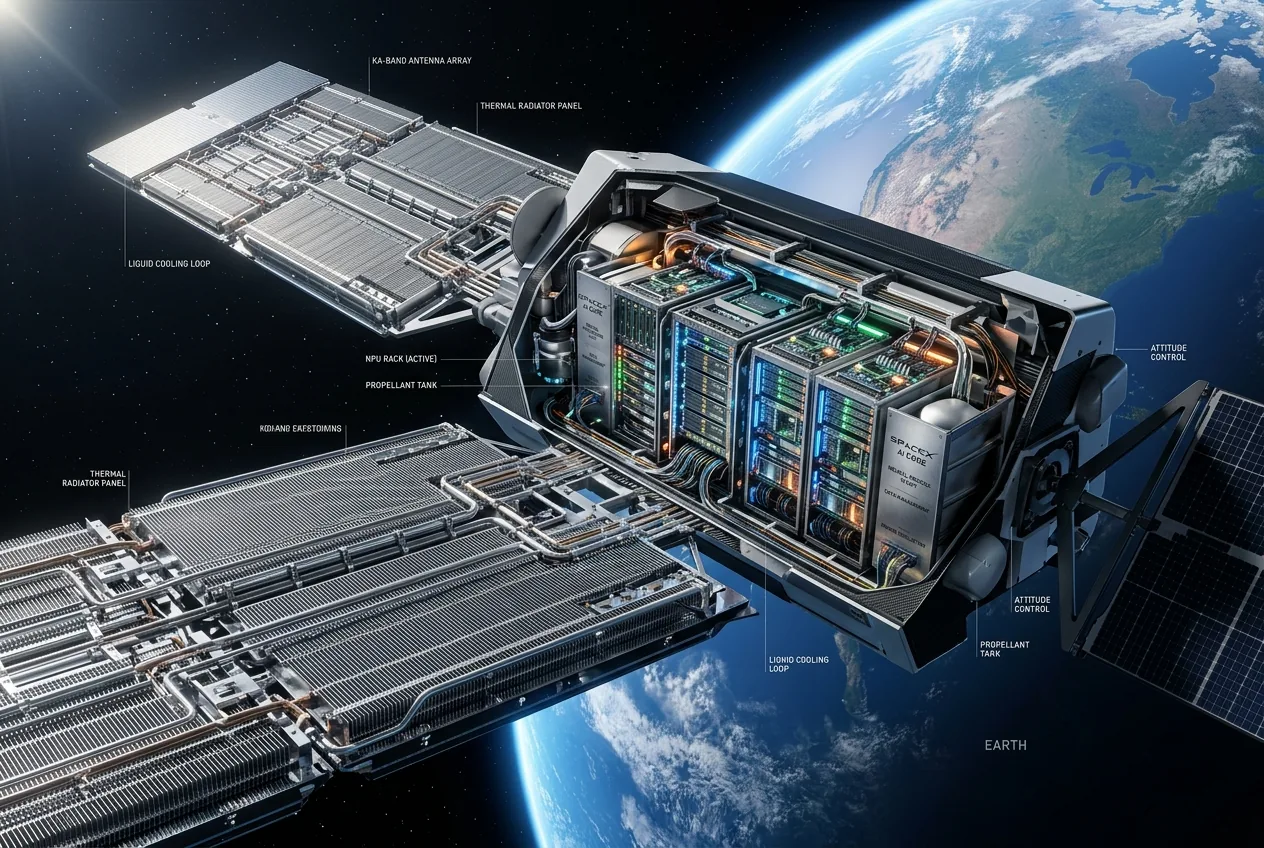
Engineers familiar with the Starlink architecture know that the current V2 Mini satellites already push the limits of small-sat thermal envelopes. Scaling this to a million units, each packed with high-performance AI silicon from xAI, suggests a constellation that would glow brilliantly in the infrared spectrum. This is where the Kardashev II claim becomes particularly strained. A Type II civilization, by definition, harnesses the entire energy output of its host star—roughly 4 × 10^26 watts. Earth currently sits at roughly 0.73 on the scale, still struggling to transition to a Type I civilization that can use all the energy reaching the planet from the Sun.
Claiming that an orbital data center brings us closer to Type II status is like saying a flashlight brings you closer to becoming a supernova. It is a category error dressed as a mission statement. For investors, the concern isn't the physics; it is the materiality. If a company claims its infrastructure will enable a civilizational leap to justify its valuation, the SEC is legally obligated to ask if that claim is “materially misleading.” If the physics don't hold up, the financial projections shouldn't either.
Brussels and the threat of a private space superpower
Within the European Union, the reaction to the SpaceX IPO filing is less about the Kardashev scale and more about the shift in industrial gravity. The EU’s IRIS² constellation—Europe's answer to Starlink—is already mired in the kind of procurement politics that Musk routinely mocks. The project, intended to provide secure communications for the bloc, has been slowed by disagreements over which member states' companies get the largest share of the contracts. While Brussels argues over workshare percentages, SpaceX is moving to monopolize the entire orbital value chain, from the rocket to the AI model running on the satellite.
German industrial policy, particularly the recent focus on “technological sovereignty,” finds itself in a difficult position. Germany has some of the world’s best small-satellite manufacturers and component suppliers, but they are increasingly becoming sub-suppliers to a single American hegemon. The SpaceX filing emphasizes a “high urgency” to make life multi-planetary before a potential World War III. This apocalyptic framing serves a dual purpose: it justifies the rapid, often reckless, pace of development, and it positions any regulatory oversight as a threat to human survival.
Can the SEC referee speculative futurism?
The SEC is historically ill-equipped to judge the merits of speculative physics. Their expertise lies in auditing balance sheets, not checking the math on Dyson-adjacent structures. However, the S-1 filing is a legal document. If SpaceX uses the “Kardashev II” terminology to imply a specific level of future technological capability or market dominance, they must be able to support it. As Brian Hurley of the New Space Economy think tank has noted, the issue is whether the statement is supportable in the context of the offering.
If the SEC demands a clarification, we may see the first legal definition of what constitutes a “galactic civilization” in a financial prospectus. It is a moment of peak absurdity that highlights the current state of the tech industry: when reality becomes too boring for venture capital, you start selling the stars. The risk of a “doomsday dive” mentioned in internal circles refers to the financial strain of maintaining such a massive constellation. A million satellites would require a launch cadence that even Starship might struggle to maintain, especially if the business model relies on AI services that have yet to turn a profit on the ground, let alone in the thermosphere.
The gap between ambition and the launchpad
Musk’s vision for Mars as a “haven” for humanity is a compelling narrative for an IPO, but the timelines remain stubbornly tethered to the reality of rocket science. The 2028 target for the million-satellite constellation assumes a level of Starship reliability and throughput that is currently aspirational. Every delay in the Starship test flight programme at Boca Chica compounds the financial risk. Unlike Starlink, which found a ready market in rural internet users and the military, an orbital AI data center is a product looking for a problem.
The irony of the Kardashev II claim is that a society capable of harnessing a star’s energy would likely have moved beyond the need for a quarterly earnings report. For now, SpaceX remains a Type 0.7 civilization company, subject to the same gravity, thermal limits, and securities laws as everyone else. The filing is a brilliant piece of marketing that attempts to turn physics into a financial moat, but the SEC may yet decide that the Milky Way is outside their jurisdiction.
As the IPO moves forward, the disconnect between the technical reality and the cosmic marketing will only widen. Investors are being asked to fund a bridge to the future, but they might find they are just paying for the most expensive server rack in history. Europe will continue to watch, skeptical of the hype but wary of the lead SpaceX is opening. In the end, the company might not spark a Kardashev II civilization, but it has certainly mastered the art of the Kardashev-level sales pitch.
SpaceX has the vision. Now it just needs to find a way to cool the processors without melting the satellites. It is a minor engineering detail, but the kind that usually determines whether a company reaches Mars or merely the bankruptcy courts. Brussels will likely wait for the first infrared scan of the constellation before they start worrying about the Dyson sphere.




Comments
No comments yet. Be the first!