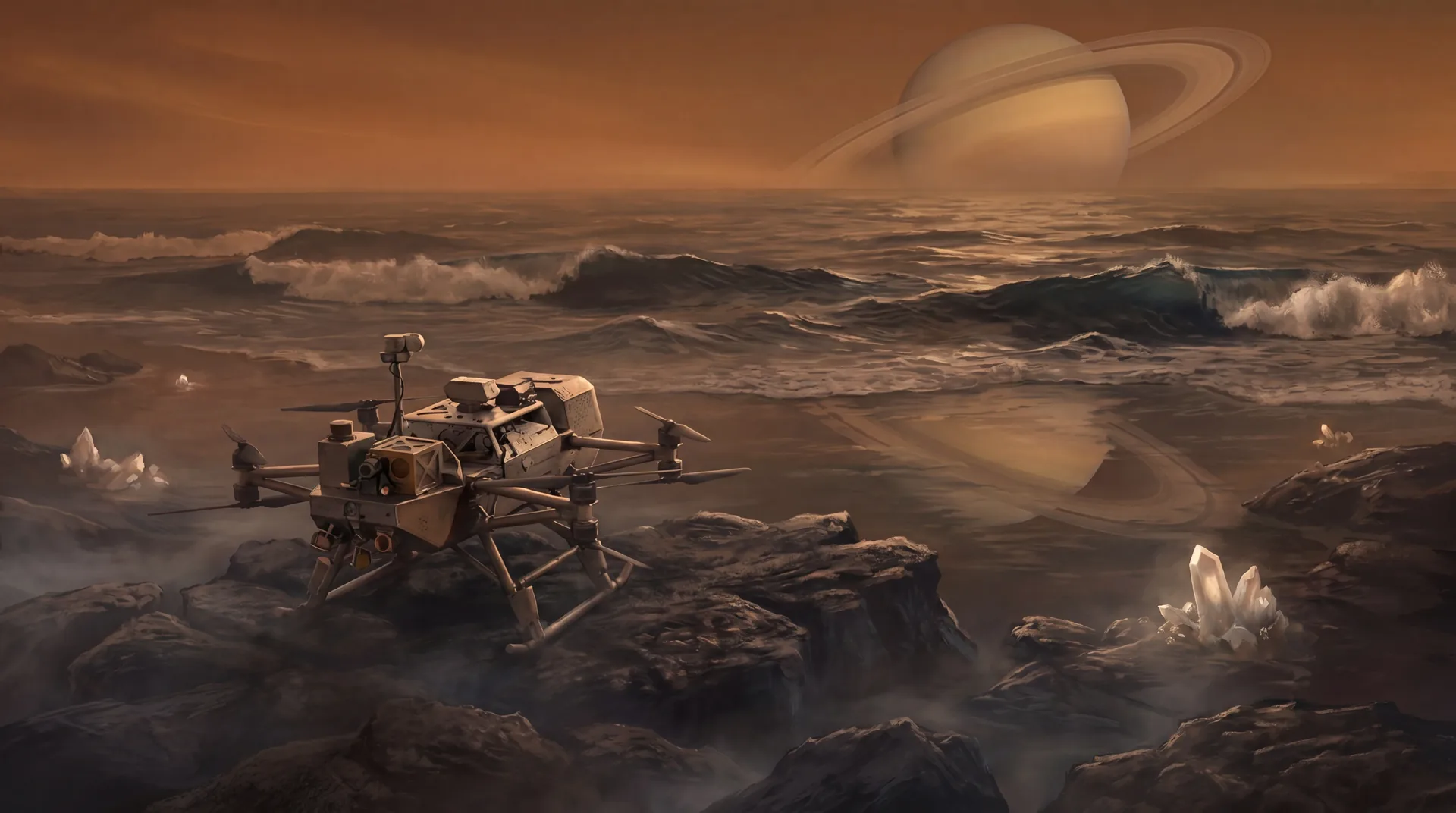

A light breeze blowing across Kraken Mare, a sea hundreds of feet deep and sitting at minus 290 degrees Fahrenheit, doesn't create ripples. According to new computational fluid dynamics models run by NASA, wind hitting the hydrocarbon lakes of Saturn's largest moon pulls up towering, heavy swells of liquid methane that crash in agonizing slow motion.
This is not just an exercise in mapping extraterrestrial surf conditions. Understanding the bizarre fluid dynamics of Titan is an operational necessity. NASA is preparing to launch a nuclear-powered rotorcraft called Dragonfly later this decade, and plotting safe flight paths means knowing exactly how the dense local atmosphere pushes, pulls, and interacts with the alien surface below.
Drag, density, and a 1.4-bar sky
The physics of a coastline on Titan operate under completely different rules to our own. Gravity on the moon is roughly one-seventh of Earth’s, yet the atmospheric pressure is 1.5 times higher, pressing down at a heavy 1.4 bar. The vast northern basins—including Ligeia Mare and Kraken Mare—are filled with low-density liquid ethane and methane.
When wind hits that specific chemical mix, it faces less resistance from gravity but significantly more drag from the thick, nitrogen-rich air overhead. The result is a surreal physical environment. The wind easily lifts the light hydrocarbons into tall, undulating crests, while the dense atmosphere forces the wave energy to propagate at a crawl, entirely unlike the fast-moving whitecaps of terrestrial oceans.
A deep freeze of early Earth
Titan holds a unique status in the solar system. It is the only other world we know of with an active hydrological cycle, complete with rivers, estuaries, and evaporation. It just happens to rain natural gas instead of water.
For astrobiologists, this makes the moon a planetary-scale laboratory. The interaction between the thick atmosphere and the hydrocarbon seas creates a chemical environment that closely mirrors the early Earth, right before the emergence of biology. While the brutal cold rules out life as we understand it, the complex organic molecules churning in these slow-rolling waves represent a snapshot of prebiotic chemistry.
Navigating a hydrocarbon weather system
NASA’s upcoming Dragonfly mission isn't a submarine. When the autonomous lander eventually arrives, it will hunt for chemical biosignatures by flying between solid geological sites, including dunes and impact craters.
But a flying machine still needs a highly accurate weather forecast. The simulations mapping Titan's sluggish waves double as a detailed profile of atmospheric drag. By modelling exactly how the thick air interacts with the liquid surface, mission planners can predict the wind sheer and density Dragonfly will face as it covers tens of miles in a single flight.
When you are flying a relocatable laboratory a billion miles from Earth, understanding the local breeze is the difference between a successful mission and a very expensive crash.
Sources
- National Aeronautics and Space Administration (NASA)





Comments
No comments yet. Be the first!