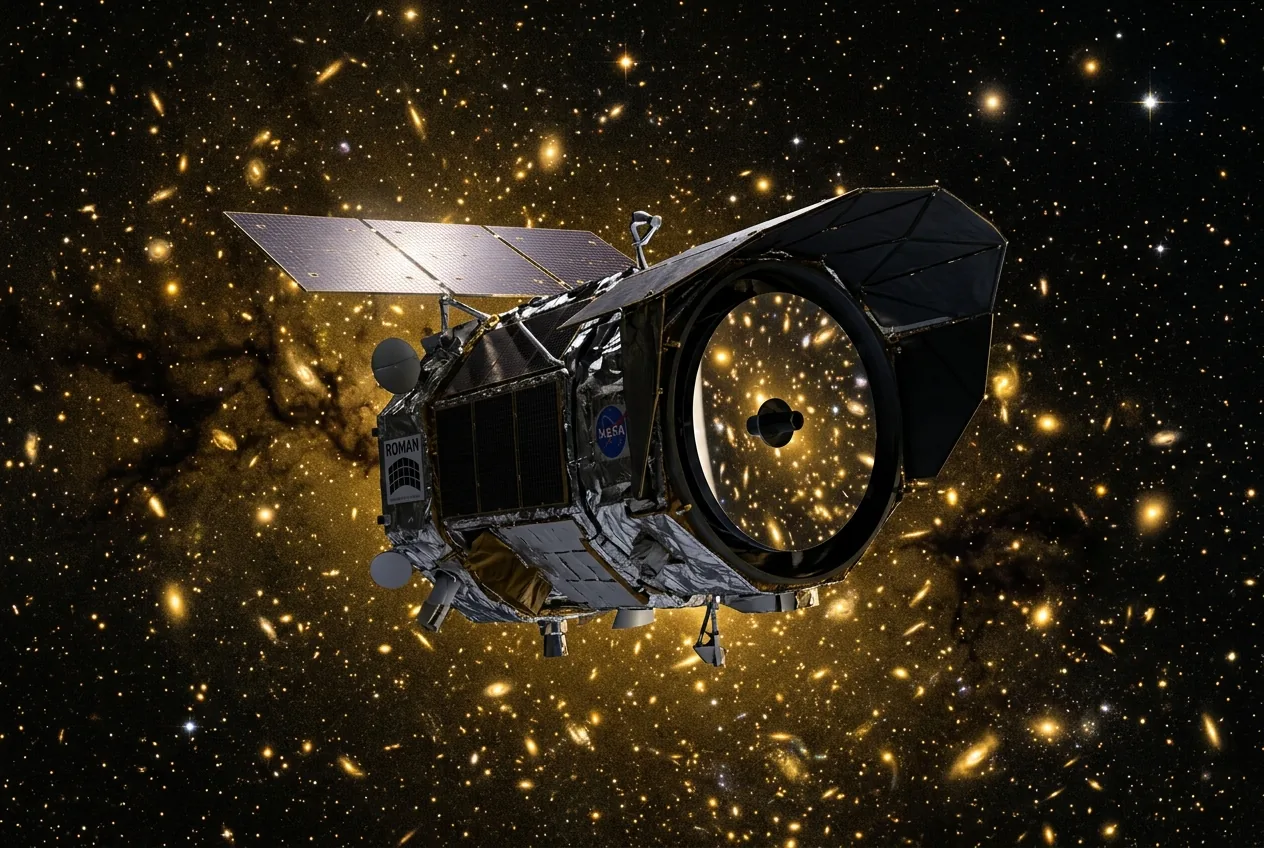
Inside a pressurized clean room in Greenbelt, Maryland, a 40-foot-tall stack of high-precision glass and gold has finally stopped moving. Engineers at NASA’s Goddard Space Flight Center have spent the better part of a decade—and millions of hours of "actual, actual math"—piecing together the Nancy Grace Roman Space Telescope. It is a machine built for a singular, existential purpose: to find out why the universe is flying apart at a speed that makes our current laws of physics look like a rough draft.
Named after the woman who convinced a skeptical government that the Hubble Space Telescope was worth the risk, the Roman observatory is not just an upgrade. It is a paradigm shift. While Hubble changed our view of the cosmos by zooming in on specific, breathtaking pinpricks of light, Roman is designed to step back and look at the whole picture. It is the difference between looking at the universe through a needle’s eye and watching it on an IMAX screen. The sheer scale of its data collection is so vast that NASA scientists are already warning we aren't ready for what happens next.
If you wanted to map the sky using Hubble with the same level of detail Roman will provide, you would need to keep Hubble operational for another hundred years. Roman intends to finish that same job in about thirty days. It is a hundred-year shortcut that aims to solve a problem that has been brewing since 1998, when astronomers realized that the expansion of the universe wasn't slowing down under the weight of gravity—it was hitting the accelerator. Something is pushing the cosmos outward, and we have absolutely no idea what it is.
The hundred-year shortcut
The telescope’s mirror is the same size as Hubble’s, measuring 2.4 meters across. But that is where the similarities end. The camera inside Roman has a field of view 100 times larger than its predecessor. This isn't just about taking bigger photos; it’s about statistics. If you want to understand how a forest grows, you don't look at one tree for a century; you look at the entire forest across different seasons. Roman will scan large portions of the sky at once, capturing the positions and shapes of hundreds of millions of galaxies.
This wide-field survey capability is the key to identifying the cracks in our current cosmological theories. For years, scientists have relied on the Standard Model of the universe—a mathematical framework that explains how everything from atoms to galaxies behaves. But as our measurements have become more precise, the math has started to fail. There is a growing tension in the scientific community because different ways of measuring the expansion of the universe are giving different answers. Roman is the tie-breaker.
Why the math of the universe doesn't add up
Everything you have ever seen, touched, or tasted—every star, planet, and person—makes up only about five percent of the universe. The rest is a cocktail of dark matter and dark energy. Dark matter is the invisible glue that holds galaxies together, providing the extra gravity needed to keep them from spinning apart. Dark energy is the opposite: it is the mysterious pressure that is driving the universe’s expansion to go faster and faster.
The problem is that dark energy is perfectly invisible. We only know it’s there because we can see what it does to the things we *can* see. It’s like watching the leaves of a tree move and deducing the existence of wind. But unlike wind, dark energy doesn't seem to weaken over time. It appears to be a property of space itself. As the universe expands and creates more space, there is more dark energy, which causes more expansion. It is a runaway feedback loop that will eventually leave our galaxy isolated in a cold, dark void.
The legacy of the ground-based pioneers
Roman doesn't have to start from scratch. It is picking up the baton from ground-based experiments like the Dark Energy Spectroscopic Instrument (DESI). DESI recently completed its initial five-year mission, having mapped 30 million galaxies with a massive robotic array in Arizona. DESI’s results have already started to shake the foundations of physics, suggesting that dark energy might not be a constant force, but something that evolves over time.
If dark energy changes, it means our current understanding of physics is missing a massive piece of the puzzle. It would be as if we discovered that the laws of gravity only worked on Tuesdays. Roman will take the hints dropped by DESI and look deeper into the past, seeing the universe as it was when it was only a few billion years old. By comparing the 3D maps made by DESI with the high-resolution data from Roman, astronomers will be able to see the entire history of the cosmic tug-of-war between gravity and dark energy.
This isn't just academic curiosity. Understanding dark energy is essentially the quest to find out how the story of the universe ends. If dark energy keeps accelerating, the "Big Rip" could literally tear atoms apart in the distant future. If it fades, the universe might collapse back on itself in a "Big Crunch." We are currently flying a plane without knowing if it’s going to land, crash, or head into orbit forever. Roman is the flight recorder that might give us the answer.
Staring into the glare of a billion suns
While dark energy is the headline act, the Roman telescope has a second, equally difficult mission: finding Earth 2.0. To do this, it is carrying an instrument called a coronagraph. In the past, we found planets around other stars by watching for the "dip" in light when a planet passed in front of its sun. It was like trying to spot a moth flying in front of a stadium floodlight from three miles away. It’s effective, but it doesn't let us see the planet itself.
Roman’s coronagraph is designed to block the light of the star entirely, allowing us to see the tiny, faint speck of a planet orbiting it. NASA engineers compare it to trying to see a firefly hovering next to a lighthouse from across the Atlantic Ocean. It requires a level of stability that has never been achieved in a space telescope before. The mirrors inside the coronagraph have to be adjusted by increments smaller than the width of a strand of DNA to cancel out the starlight.
If it works, Roman will be able to take direct images of giant planets around other stars and, more importantly, analyze their atmospheres. It will look for the chemical signatures of water, methane, and oxygen. It is the first step toward finding a world that looks like our own. By the time the mission is over, Roman is expected to have discovered tens of thousands of new exoplanets, turning our map of the galaxy from a collection of guesses into a detailed atlas.
The completion of the telescope’s construction marks the end of the engineering phase and the beginning of the journey to the launch pad. It is a machine born of millions of hours of labor, designed to answer questions that humans have been asking since we first looked at the stars. We are about to find out exactly what the universe is made of, even if the answer proves that everything we thought we knew was wrong.




Comments
No comments yet. Be the first!