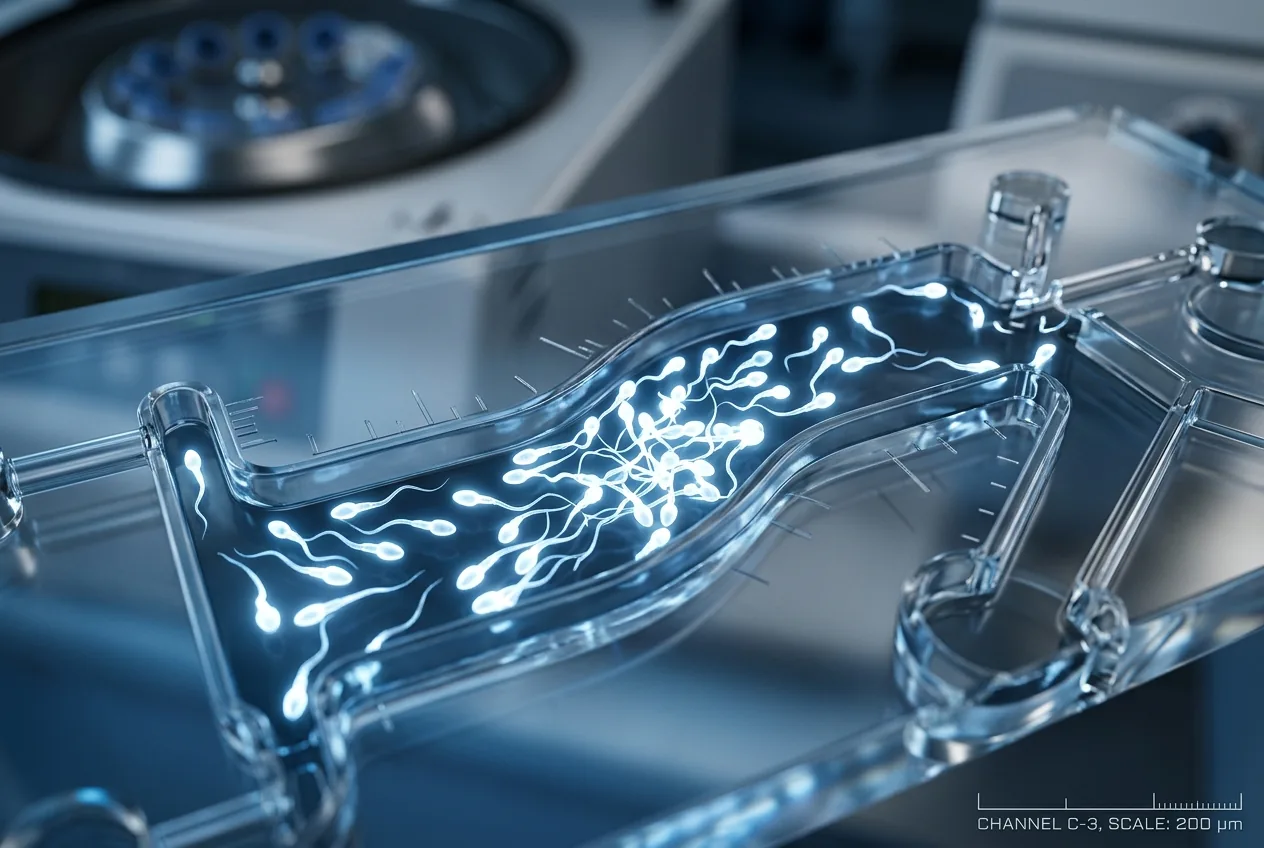
Inside a 20-millimetre microfluidic channel in a laboratory in Sydney, the future of human expansion into the solar system just hit a biological wall. For four hours, researchers watched as human, porcine, and murine sperm cells attempted to navigate a fluid current under simulated microgravity. In a standard 1G environment, these cells are remarkably disciplined, swimming against the flow—a behaviour known as rheotaxis—to find their way toward an egg. But under the conditions of spaceflight, that internal compass breaks. The cells do not just slow down; they get lost, swimming in aimless circles or tumbling through the medium like debris.
The stakes for this disorientation are significantly higher than a failed lab experiment. As the European Space Agency (ESA) pushes its "Moon Village" concept and NASA’s Artemis programme inches toward a permanent lunar presence, the conversation has largely focused on the physics of heavy lift rockets and the chemistry of life support. We have agonized over the structural integrity of the Ariane 6 and the shielding required for the Lunar Gateway, but we have largely ignored the most basic requirement for a multi-generational presence in space: the ability to make more humans. New data published in Communications Biology suggests that biology, rather than rocket science, might be the ultimate bottleneck.
The fluid dynamics of failure
This is not a problem that can be solved with a better radiation shield or a more efficient solar panel. It is a fundamental mismatch between the mechanical requirements of human reproduction and the environment of the vacuum. Evolution spent several billion years perfecting the internal fluid dynamics of mammals under a constant 9.8 m/s² of downward pull. Remove that, and the machinery of life begins to malfunction at the cellular level.
The policy of biological denial
There is a curious silence in the halls of Brussels and Bonn regarding these findings. If you look at the procurement priorities of the DLR (German Aerospace Center) or the ministerial mandates for ESA, you will find hundreds of millions of euros allocated to "In-Situ Resource Utilization"—learning how to bake bricks out of Moon dust. You will find almost nothing dedicated to the first nine months of human life. This reflects a persistent engineering bias in space policy: we treat the human body as a payload to be protected rather than a biological system that needs to function.
The industrial logic is clear. It is easier to sell a parliament on a new satellite constellation or a reusable booster than on the messy, uncertain science of reproductive biology. But if the goal is truly "settlement" rather than mere "visitation," the lack of investment in space-based embryology is a strategic oversight. The Americans, via NASA, have conducted some limited studies with frozen sperm on the International Space Station, but the results have been mixed and often shielded by the PR-friendly veneer of "exploring the frontiers." The European approach, typically more cautious and regulatory-focused, should be the one sounding the alarm. If we cannot ensure a safe first trimester in 1/6th gravity (the Moon) or 1/3rd gravity (Mars), the entire industrial roadmap for space colonization is built on sand.
Moreover, the Sydney study highlights a competitive disadvantage for long-duration missions. If the biological cost of spaceflight includes a significant hit to fertility, the recruitment pool for lunar or Martian bases becomes restricted. We are looking at a future where "astronaut" is a career path that requires not just physical fitness, but the potential sacrifice of reproductive health—a trade-off that has yet to be addressed in any space agency’s ethics guidelines.
Can IVF save the Mars colony?
The immediate counter-argument from the techno-optimist camp is that we will simply move reproduction into the lab. If natural fertilization is too difficult in microgravity, we can utilize In Vitro Fertilization (IVF). However, the Australian data suggests this is a naive hope. The study’s observation of reduced blastocyst formation indicates that the problems don't end once the sperm meets the egg. The early stages of cell division—mitosis—appear to be sensitive to the gravitational environment as well.
In a microgravity environment, the cytoskeleton—the structural framework of a cell—behaves differently. This affects how chromosomes are pulled apart during division. In a lab on Earth, gravity provides a consistent background force. In orbit, the lack of this force can lead to errors in genetic distribution. If a Mars colony relies on a centrifuge-based IVF clinic just to maintain its population, the energy and infrastructure costs of "staying human" in space become astronomical. It turns a settlement into a high-maintenance biological intensive care unit.
There is also the matter of the "quiet failures" in the data. The Australian researchers noted that while some sperm cells still moved, their velocity was significantly altered. In the competitive race for fertilization, velocity is everything. By slowing down the vanguard, microgravity might be inadvertently selecting for different genetic traits than Earth-based reproduction would, a form of unintended evolutionary pressure that we are nowhere near understanding.
The gap between ambition and reality
The aerospace industry is currently obsessed with "sovereign access to space." In Europe, this means desperate attempts to catch up with SpaceX's launch cadence and securing supply chains for gallium nitride semiconductors used in satellite radar. These are quantifiable, bankable engineering goals. Reproductive biology, by contrast, is a field of "known unknowns" that most agencies would prefer to leave for the next generation of administrators.
But the Sydney study serves as a necessary corrective to the glossy brochures of NewSpace. The biological reality is that our bodies are Earth-tuned machines. The fluid dynamics of a single cell are just as critical to our survival as the heat shield on a re-entry capsule. If we cannot solve the navigation problem of a sperm cell in a 20-millimetre channel, we have no business talking about multi-generational starships or Martian cities.
Current space law and international treaties, such as the Artemis Accords, are busy carving up the Moon for mining rights and landing zones. They haven't even begun to tackle the liability or ethical frameworks for a child born with developmental issues caused by a lack of gravity. For now, the Australian research suggests that the most effective form of birth control in the universe isn't a pill or a procedure—it’s simply leaving the planet.
Europe has the engineers to build the rockets. It just hasn't decided if it wants to fund the doctors who will tell them why the rockets might be carrying a dying lineage.




Comments
No comments yet. Be the first!