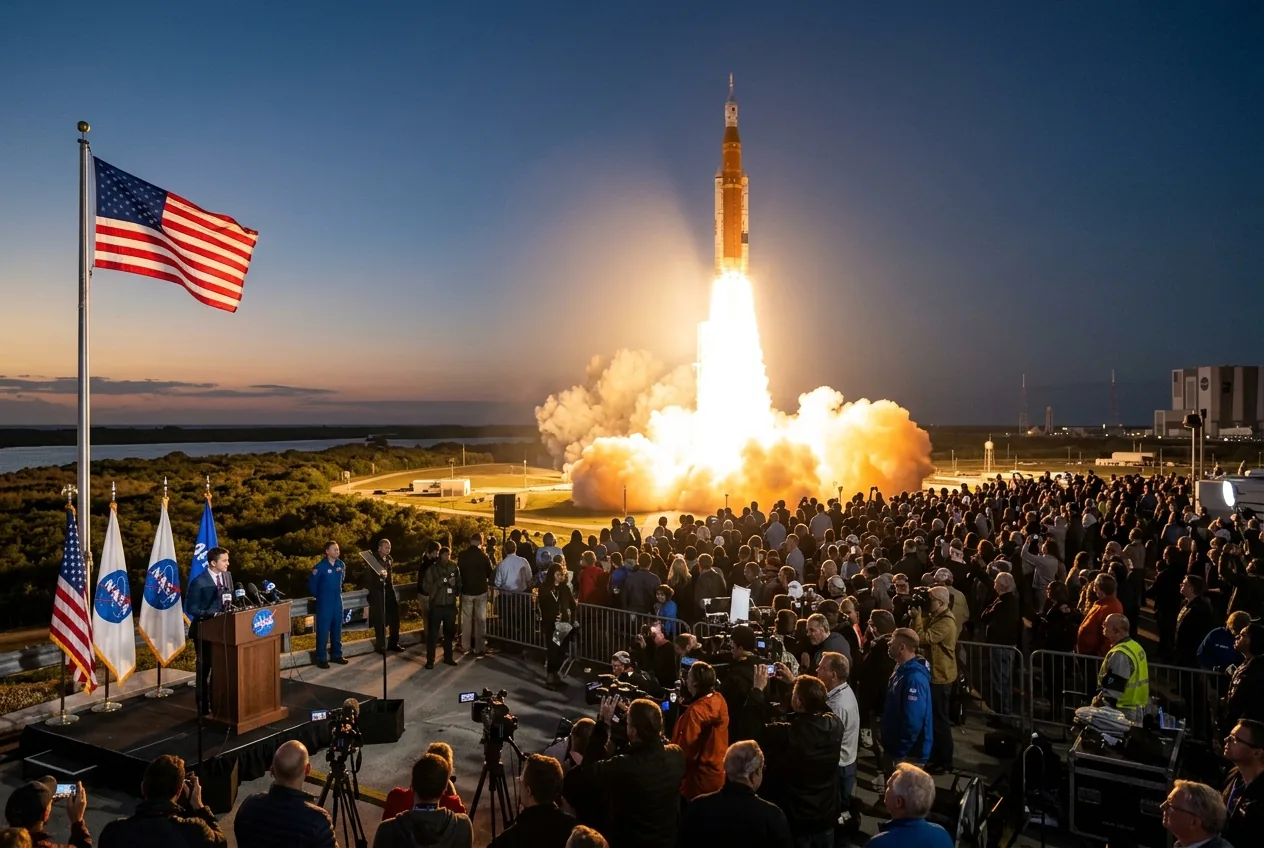
To understand the current state of the lunar race, look closely at the plumbing. Before NASA can safely push a crew toward the Moon, engineers must fully master the notoriously fragile liquid-hydrogen loading process that repeatedly stalled early tests of the Space Launch System (SLS).
Washington insists the United States is on track to beat China to a crewed surface landing before the decade is out. But stripping away the political rhetoric reveals a highly precarious sequence of dependencies. Reaching the lunar south pole in the late 2020s relies on unproven commercial landers, multi-billion-dollar expendable rockets, and a European supply chain that moves at its own methodical pace.
The Calendar Arithmetic
China has explicitly circled 2030 for its own crewed lunar landing. To stay ahead, NASA has continually adjusted its Artemis schedules, aiming to insert lander demonstrations and docking practices into a tight window in the late 2020s.
The American approach is deliberately heavier than the Apollo missions. Instead of simple surface visits, the architecture demands power grids, navigation demonstrations, and in-situ resource experiments intended to make the presence sustainable. Planners want a near-monthly cadence of robotic deliveries beginning as early as 2027.
This infrastructure-first strategy is a calculated risk. It leverages a broad network of commercial contractors, but requires entirely new, highly complex hardware to perform flawlessly in deep space on its first attempt.
Expendable Rockets and Unproven Landers
A 32-story rocket cannot be willed into orbit on political momentum alone. While the SLS is a physical reality, it remains a punishingly expensive, expendable vehicle. There are unresolved questions regarding how often it can actually be flown at tempo without spiralling costs draining the wider science budget.
Beyond the launchpad, the mission architecture hands the hardest jobs to commercial partners. The lunar landers tasked with ferrying crews to the surface are currently either late-stage prototypes or digital models still waiting for physical integration.
These systems must independently handle deep-space docking, crew mobility, and precision landings. A single technical bottleneck in any of these commercial development programmes could easily cascade into multi-year delays.
European Hardware in the Critical Path
If the United States beats China to the Moon, it will do so by relying heavily on European industrial capacity. The Orion capsule's propulsion, power, and life support are entirely dependent on the European Service Module (ESM), managed by the European Space Agency and integrated in Bremen.
This transatlantic reliance effectively tethers American urgency to European procurement realities. ESA funding is strictly consensus-driven, geographically distributed across member states to satisfy domestic industrial interests, and bound by complex technology export controls.
It is an industrial base designed for diplomatic stability and shared technical risk, not necessarily for a geopolitical sprint against Beijing. A plausible path to a late-2020s landing exists, provided schedule optimism finally aligns with engineering reality.
Washington can mandate the destination. Bremen controls the oxygen.
Sources
- National Aeronautics and Space Administration (NASA)
- European Space Agency (ESA)




Comments
No comments yet. Be the first!