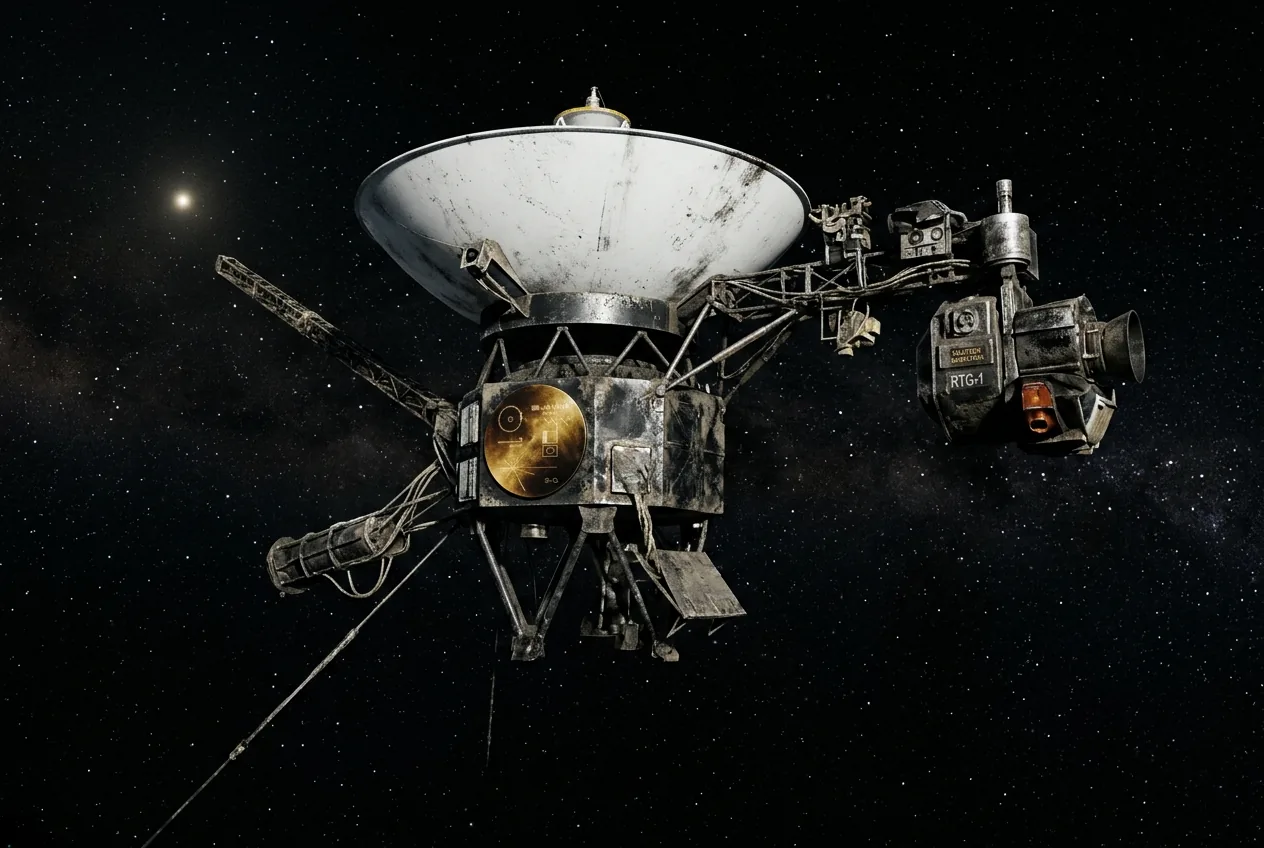
On April 17, 2026, an engineer at the Jet Propulsion Laboratory (JPL) sent a command to a machine that has been out of warranty for nearly half a century. Then they waited. For twenty-three hours and fifteen minutes, the signal crawled through the vacuum at the speed of light, headed toward a point 15 billion miles away where Voyager 1 is currently screaming through the interstellar medium. When the reply finally flickered across the monitors in California, it confirmed a bittersweet success: the Low Energy Charged Particle (LECP) instrument, which had been operational since the Carter administration, was finally powered down. This wasn’t a failure of hardware, but a calculated sacrifice to buy the spacecraft another twelve months of relevance.
To understand the Voyager mission in 2026 is to understand a slow-motion funeral where the guest of honor refuses to stop talking. The two probes, Voyager 1 and Voyager 2, were launched in 1977 with a design life of five years. They were supposed to look at Jupiter and Saturn and then, essentially, disappear. Instead, they have become humanity's longest-running engineering achievement by accident and sheer stubbornness. But as we approach the 50th anniversary of their launch, the engineering team is running out of things to turn off. The mission has moved from a grand tour of the planets to a desperate exercise in thermodynamic triage.
The four-watt annual tax
The problem is that these instruments aren't just consumers of power; they are part of a delicate thermal ecosystem. When you turn off an instrument, you lose the heat it generates. If the surrounding hardware drops below a certain temperature, the fuel lines for the thrusters could freeze, or the 1970s-era electronics could simply crack. Engineers are now forced to play a high-stakes game of planetary-scale Tetris, trying to balance the heat map of a spacecraft that was never meant to be operated in this crippled state.
The assembly code archaeology
From a technical perspective, Voyager is a haunting reminder of how much we have traded longevity for complexity. The spacecraft's three onboard computers have a combined memory of about 68 kilobytes. For comparison, the digital image of the Golden Record that resides on a modern smartphone takes up more space than the entire operating system of the craft carrying the physical record into the void. This lack of complexity is, ironically, why they are still alive. There are no software updates to bloat the system, no background processes to hang, and no sophisticated operating systems to crash. It is bare-metal assembly code written by people who are, for the most part, no longer in the workforce.
This became a crisis in late 2023 and early 2024 when Voyager 1 began sending back a repeating pattern of ones and zeros that made no sense. For months, the mission felt over. The fix required a level of forensic engineering that modern "agile" development cycles aren't designed to handle. JPL engineers had to dig through decades-old paper documentation to understand the specific memory address of a corrupted chip in the Flight Data System (FDS). They eventually solved it by moving the affected code to a different part of the memory — a feat of digital surgery performed on a patient 23 light-hours away. It was a reminder that when you are dealing with 1977 hardware, you aren't just a programmer; you are an archaeologist.
The European procurement paradox
As a reporter based in Cologne, I often look at Voyager through the lens of European industrial strategy. The European Space Agency (ESA) is currently managing the JUICE (JUpiter ICy moons Explorer) mission, a magnificent piece of engineering that represents the peak of modern multi-state cooperation. But JUICE, like most modern missions, is built within the constraints of the 21st-century procurement cycle. Every component is the result of a delicate balance of "geographical return" — ensuring that the country paying for the sensor gets the contract to build it. While this keeps the EU's industrial base healthy, it creates a layer of bureaucratic complexity that makes 50-year missions nearly impossible to plan.
Voyager was built in a different era, one of vertically integrated ambition. It was a product of a NASA that had just finished the Apollo program and possessed a surplus of both funding and institutional confidence. There is a specific kind of American industrial arrogance in the Voyager design — a belief that if you build it sturdy enough, it will simply keep going. Today, the space industry, including the burgeoning European sector, focuses on "serviceable" satellites and constellations with five-to-seven-year lifespans. We have traded the long-distance runner for a relay race of cheaper, more replaceable hardware. Voyager suggests that we might have lost the recipe for institutional patience along the way.
Is the science still worth the effort?
Critics occasionally point to the diminishing returns of the mission. The data rate from Voyager 1 is currently 160 bits per second — slower than a dial-up modem from the 1980s. The instruments remaining are low-resolution by modern standards. However, this misses the fundamental point of the Interstellar Mission. Voyager is not just measuring space; it is measuring the *boundary* of our existence. It is currently in the "very local interstellar medium," a region where the solar wind has completely given way to the particles and magnetic fields of the galaxy at large.
The data being returned now is literally irreplaceable. No other spacecraft is currently on a trajectory to reach this region for decades. When the LECP instrument was shut down in April, it was a loss, but the magnetometer is still providing the only direct measurements of the shape of the heliosphere. We are learning that the bubble of our solar system is much more "dented" and dynamic than we previously thought. To stop the mission now because it is "difficult" would be to close our only window into the neighborhood we are moving through.
NASA is currently preparing for what they call the "Big Bang" plan — a more radical attempt to shuffle power between heaters and instruments that will be trialed first on Voyager 2. It involves bypassing voltage regulators that have been active for 49 years. It is the engineering equivalent of hot-wiring a vintage car while it's moving at 38,000 miles per hour. If it works, we might see both probes reach 2030. If it fails, they will continue their silent journey as dead monuments.
The Golden Record attached to each craft contains greetings in 55 languages and a selection of Earth's sounds. It is a time capsule aimed at a future that likely won't find it. But the real record is the code running on the FDS and the triage logs at JPL. They tell a story of an era that built things to last, not because it was cost-effective, but because they didn't know how to do it any other way. By the time Voyager 1 finally goes silent, likely sometime in the next three years, it will have outlasted the careers of the people who built it and the geopolitical certainties of the world that launched it. We are watching the end of an era of engineering, one watt at a time.
NASA will celebrate the 50th anniversary in 2027. The budget will be approved. The engineers will hold a ceremony in Pasadena. But the plutonium will keep decaying, and the cold of the interstellar void will eventually win. It is progress, just the kind that doesn't fit on a venture capital slide deck.




Comments
No comments yet. Be the first!