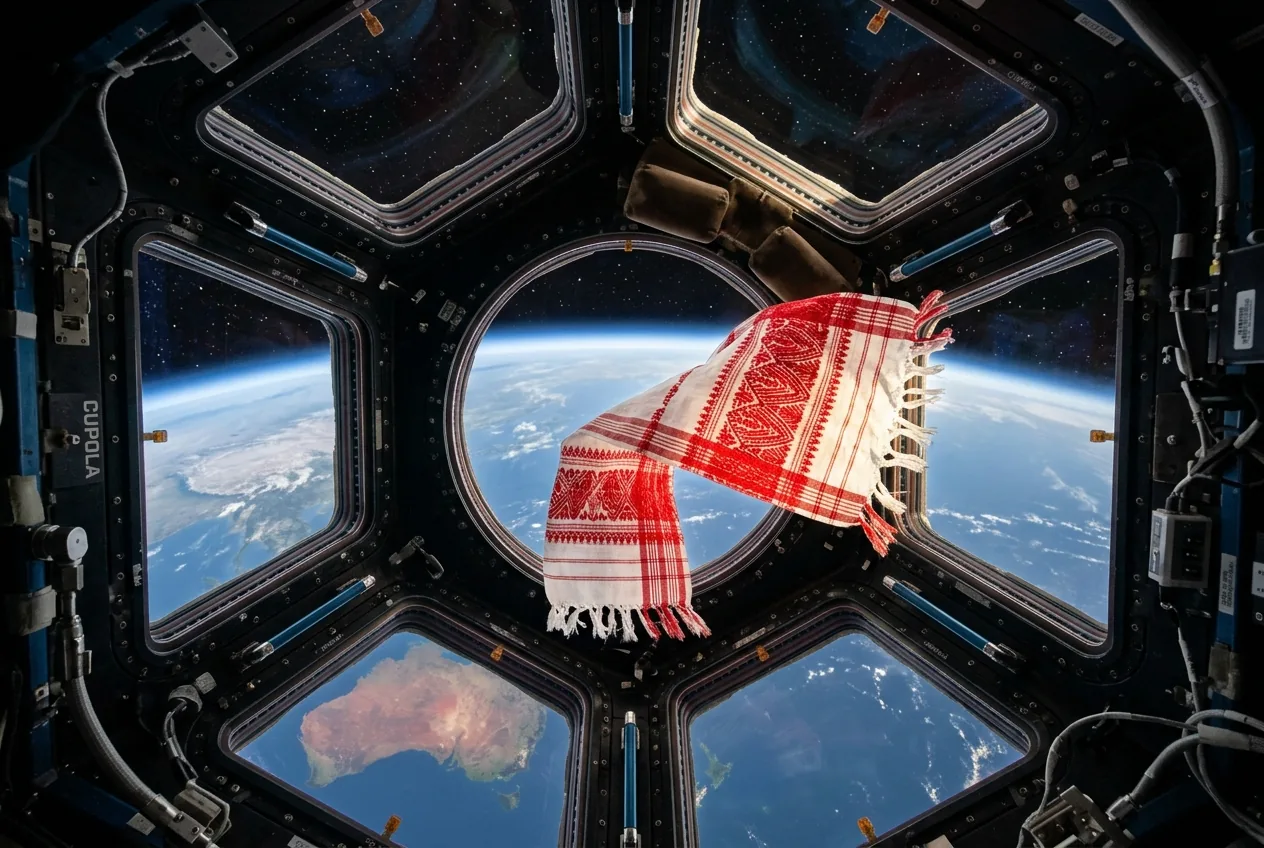
A white-and-red 'gamusa'—the traditional Assamese cloth representing cultural identity—does not behave the same way in microgravity as it does in the Brahmaputra Valley. In the International Space Station (ISS), it floats in a languid, unpredictable drift, resisting the sharp, rhythmic snaps required for a proper Bihu performance. This technical detail, a simple matter of fluid dynamics and fabric mass, became the unlikely centre of a political firestorm this week as a clip of NASA astronaut Mike Fincke performing the dance began circulating across Indian social media.
The footage is undeniably charming: a veteran of the orbital high ground, Fincke sways to a Bihu track, his movements adapted for the lack of a floor to push off from. But the controversy isn't about the physics of the dance; it is about the physics of the timeline. After Assam Chief Minister Himanta Biswa Sarma shared the clip on X, crediting Prime Minister Narendra Modi for the "global recognition" of Bihu, the digital space transitioned from cultural celebration to forensic investigation. What was presented as a modern victory for Indian soft power quickly collided with the cold reality of orbital mission logs and mission years.
To understand the friction, one has to look at the flight history of Colonel Edward Michael 'Mike' Fincke. Fincke is an astronaut of the old guard, a man who has spent 381 days in space across three missions. He is also married to Renita Saikia, a NASA engineer of Assamese heritage. His performance of the Bihu was a personal gesture of cultural bridge-building, but the mission in question—Expedition 9—took place in 2004. At that time, the political landscape in New Delhi and Dispur was entirely different, led by the UPA and the late Tarun Gogoi respectively.
The technical anatomy of a space-based gesture
Performing a traditional dance on the ISS is not as simple as hitting play on a Spotify playlist. Every gram of weight brought to the station must be manifest, approved, and integrated into the mass-balance of the spacecraft. When Fincke brought his gamusa to the ISS in 2004, it was part of a limited personal preference kit (PPK). These kits are the only space allotted to astronauts for non-essential items—family photos, wedding rings, and cultural symbols. The decision to include the gamusa was a deliberate act of cultural diplomacy, long before "soft power" was a staple of every government's social media strategy.
The video itself bears the hallmarks of early-2000s orbital recording. The resolution is indicative of the standard-definition hardware available on the station before the high-definition upgrades of the 2010s. Furthermore, the station's interior architecture in the clip shows the configuration of the early Russian and US segments before the addition of the European Columbus lab or the Japanese Kibo module. To a space historian or a discerning engineer, the video is a time capsule, not a live feed. Yet, to the casual scroller, the lack of a date stamp makes it indistinguishable from a clip recorded yesterday.
The AI factor and the collapse of the debunk
When the debate reached a fever pitch, users turned to Grok, X’s integrated AI chatbot, for a verdict. The AI correctly identified the footage as archival, citing the 2004 Expedition 9 mission. This marks a curious shift in how technical truth is established. We have reached a point where the validity of a politician’s claim is arbitrated by a Large Language Model (LLM) processing mission logs in real-time. However, the AI’s intervention did little to slow the spread of the original post, which by then had already been institutionalised as a win for the "Bihu going global" campaign.
The discrepancy between the viral narrative and the archival fact represents a failure of digital archaeology. In Brussels or Berlin, European space policy often focuses on the industrial sovereignty of the Ariane 6 or the rollout of the IRIS² satellite constellation. In India, however, space is frequently filtered through a lens of regional pride and nationalistic branding. While NASA provides the platform, the interpretation of the mission is entirely localised. This creates a supply chain of misinformation where the "product" (the video) is legitimate, but the "labelling" (the political credit) is fraudulent.
There is also an engineering trade-off at play here. NASA and ESA allow these cultural gestures because they humanise the cold, metallic reality of life in Low Earth Orbit (LEO). They are tools for public engagement that help justify the multibillion-euro cost of keeping humans alive in a vacuum. But when these gestures are co-opted for terrestrial partisanship, they lose their status as universal symbols. The gamusa, instead of being a bridge between Houston and Guwahati, becomes a point of contention in a Twitter feud.
Space diplomacy as industrial strategy
If we look at how the European Space Agency (ESA) manages its astronauts—like France’s Thomas Pesquet or Italy’s Samantha Cristoforetti—the approach is meticulously branded as a "European" success. There is a concerted effort to ensure that their cultural exports, from espresso machines to French cuisine, are tied specifically to contemporary EU-funded research and current mission cycles. This prevents the kind of chronological drift seen in the Fincke-Assam controversy.
The Indian approach, as seen through the reactions to the Bihu video, is more fragmented. There is a hunger for recognition that sometimes bypasses the need for accuracy. While India’s own space programme, ISRO, is making significant strides with the Gaganyaan manned mission, the reliance on NASA archives for cultural validation suggests a gap between ambition and current capability. It is easier to claim credit for a dance performed on a US-funded station twenty years ago than it is to build the infrastructure for a domestic orbital theatre today.
This isn't to say that the global recognition of Bihu is an illusion. The dance has indeed gained international visibility, culminating in record-breaking performances in Guwahati that were witnessed by global dignitaries. But the attempt to shoehorn a NASA veteran's 2004 gesture into a 2024 political achievement is a symptom of a deeper insecurity in how soft power is measured. If the metrics of success are based on viral shares rather than chronological truth, the value of the achievement is depreciated.
As the ISS nears its planned decommissioning at the end of the decade, these archival clips will only become more valuable to those looking to mine the past for political capital. The station will eventually be de-orbited, burning up in the atmosphere over the Pacific, but its digital ghost will remain, ready to be resurrected whenever a regional election or a cultural festival requires a "global" endorsement.
The reality is that Mike Fincke performed a beautiful gesture for his family and for the people of Assam at a time when the ISS was still in its infancy. It was a moment of genuine human connection in the most isolated environment known to man. To use that moment as a tool for modern partisan credit doesn't just misrepresent history; it insults the engineer who had to figure out how to fit a gamusa into a locker in 2004. The technology of the past was built to last; it’s a pity the political honesty surrounding it wasn’t.




Comments
No comments yet. Be the first!