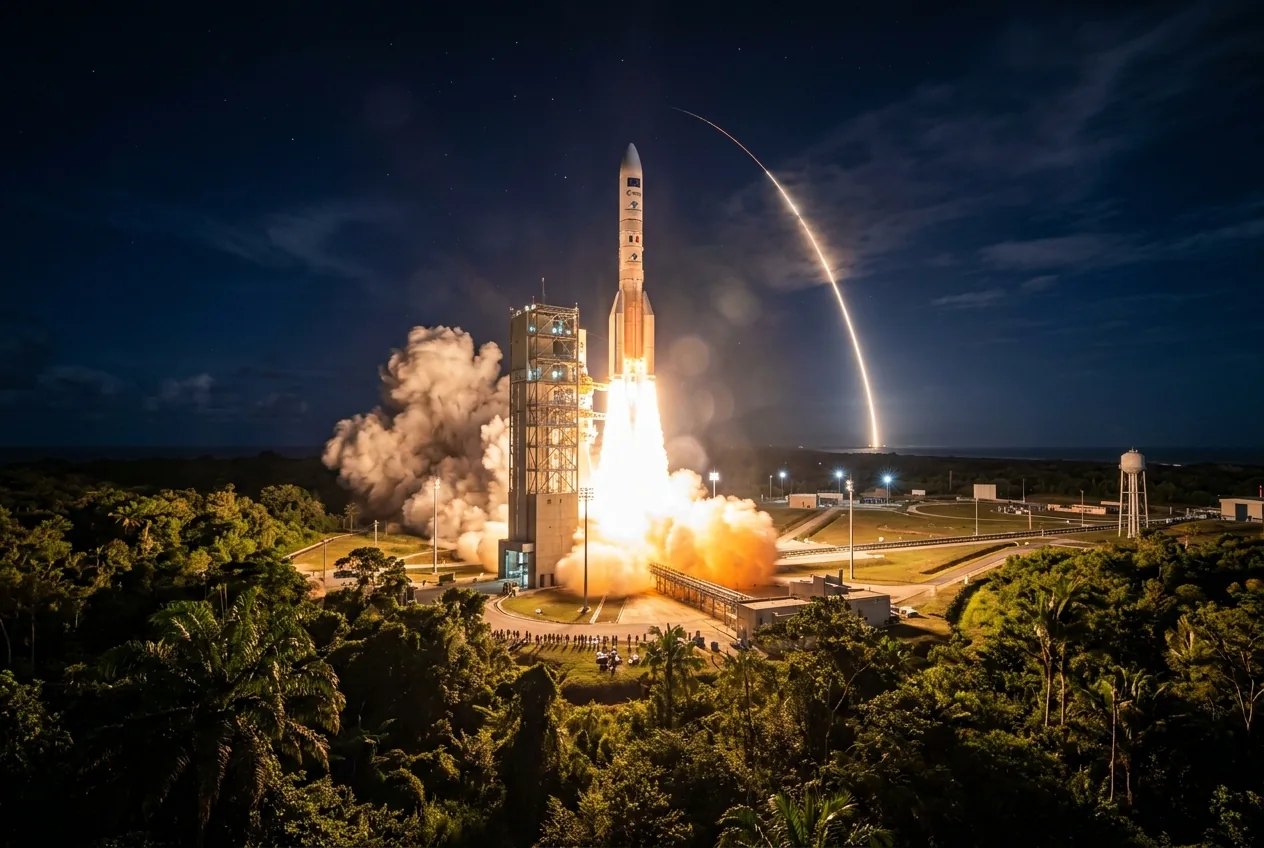
The countdown in Kourou reached zero at 03:00 local time, sending a dull roar through the humid air of the Guiana Space Centre. On the pad at ELA-4, the Ariane 6 rocket—Europe’s long-delayed answer to the American dominance of the launch market—ignited its Vulcain 2.1 core engine and two solid rocket boosters. This wasn't a test flight for the European Space Agency (ESA) or a deployment for the continent’s Galileo navigation system. Instead, the cargo was 32 broadband satellites belonging to Project Kuiper, the multi-billion-dollar satellite internet gamble by Seattle-based Amazon.
For Arianespace, the company that markets the rocket, the success of mission VA267 is a necessary exhale. After a decade of development and a debut flight in July that was more about proving the vehicle could survive the ascent than doing useful work, the Ariane 6 is now officially open for business. But the business it is doing reveals a curious shift in the geopolitical landscape of space: the rocket built to ensure European "launch sovereignty" is currently serving as a high-priced delivery van for an American cloud provider desperate to catch up with Elon Musk.
The Seattle-Brussels procurement paradox
This reliance on Amazon isn't just about the money; it’s about the optics of industrial survival. Europe spent years in a self-inflicted "launch gap." Between the retirement of the reliable but expensive Ariane 5 and the arrival of the Ariane 6, the continent was effectively grounded. It was a period of deep embarrassment for Brussels, where officials had to watch as European weather and navigation satellites were launched on SpaceX Falcon 9 rockets—the very competitor the Ariane 6 was designed to undercut. Now that the hardware is functional, the pressure is on to prove that the European industrial model, which distributes manufacturing across dozens of member states to satisfy political quotas, can actually compete with the vertically integrated efficiency of Hawthorne, California.
Can the Vinci engine handle the workload?
Technically, this mission tested the rocket’s most important new feature: the Vinci upper stage engine. Unlike the HM7B engine used on the Ariane 5, which could only be ignited once, the Vinci is designed to be relighted multiple times. This is not just a neat engineering trick; it is the fundamental requirement for building satellite constellations like Project Kuiper. To deploy 32 satellites effectively, the upper stage must move through different orbital planes, dropping off batches of hardware and then moving again to ensure they don't collide or drift into useless trajectories.
The Vinci engine’s ability to relight also solves a mounting regulatory problem in Brussels. At the end of the mission, the engine must ignite one last time to push the upper stage back into the atmosphere to burn up over the ocean. This "de-orbiting" maneuver is the only way to comply with increasingly strict international space debris guidelines. During the Ariane 6 debut in July, the upper stage suffered a minor technical glitch that prevented this final burn, leaving the debris in orbit. Engineers at ArianeGroup, the prime contractor, spent the intervening months poring over telemetry data to ensure that VA267 would not repeat the mistake. Initial reports suggest the Vinci performed exactly as advertised this time around, a relief for an agency that cannot afford a reputation for polluting the very orbits it seeks to commercialize.
However, the engineering trade-offs remain stark. The Ariane 6 is an expendable rocket. Every time one launches, millions of euros of sophisticated European machinery are dropped into the Atlantic Ocean. Meanwhile, SpaceX is landing boosters on barges and flying them again weeks later. The European argument has always been that reusability only makes sense if you have a massive volume of launches. With the Amazon contract in hand, that volume finally exists, but the rocket to handle it was designed for a world that didn't yet believe in the turnaround times Musk made routine.
The industrial policy of 'anyone but SpaceX'
While the technical success of the launch is being celebrated from Paris to Berlin, the underlying economics of the Ariane 6 remain a point of contention. The rocket is not cheap. To keep it competitive, ESA member states recently agreed to a subsidy package of up to €340 million per year. Critics in the German Bundestag have frequently questioned why Berlin should continue to bankroll a French-led project that seems perpetually one step behind the private sector in the US. The answer, as always in European aerospace, is less about profit and more about the supply chain.
The Ariane 6 supports thousands of high-tech jobs across Germany, Italy, Spain, and France. The solid rocket boosters are built in Italy; the fairings come from Switzerland; the structural elements are German; the final assembly is French. It is a masterpiece of bureaucratic coordination, but that same coordination is what makes the rocket slow to evolve. In the time it took to move from the drawing board to this first commercial Amazon launch, the satellite market shifted entirely toward massive constellations. The Ariane 6 was designed to carry two large, heavy telecommunications satellites to high orbit. Now, it is being asked to carry dozens of small ones to low orbit—a task for which it is slightly oversized and structurally over-engineered.
Still, for Amazon, the Ariane 6 is exactly what they need: a non-SpaceX rocket with a massive payload capacity. The 32 satellites launched today bring the Kuiper constellation to just over 300 units. It is a drop in the bucket compared to the thousands of Starlink satellites already in operation, but it represents the start of a genuine commercial ramp-up. For the first time, Amazon has a reliable ride to orbit that doesn't involve handing a check to the man trying to put them out of the satellite business.
The reality of European space flight in 2025 is a marriage of convenience. Europe has the rocket but lacks the indigenous mega-constellations to fill it; Amazon has the satellites and the cash but lacks a domestic rocket fleet that isn't owned by its competitor. This launch proves that the Ariane 6 can do the job, even if it is doing it four years late and for a customer that cares more about the schedule than the European flag on the fuselage. The mission was a success, but the victory feels more like a relief than a triumph. Europe has the engineers and the launchpad; it just hasn't decided which American billionaire it wants to subsidize next.




Comments
No comments yet. Be the first!