In July 2019, the Galileo satellite navigation system—Europe’s €10 billion answer to the American GPS—quietly went dark for six days. The cause was a technical failure in a ground-based timing station, but for a week, the continent’s dream of "strategic autonomy" felt like a hallucination. There were no riots, mostly because mobile phones defaulted back to the US-controlled GPS network. But inside the Berlaymont and the European Space Agency (ESA), the incident served as a controlled-environment demonstration of a terrifying reality: the modern economy is a house of cards built on a 10.23 MHz signal coming from a few dozen boxes of electronics orbiting 23,000 kilometres above our heads.
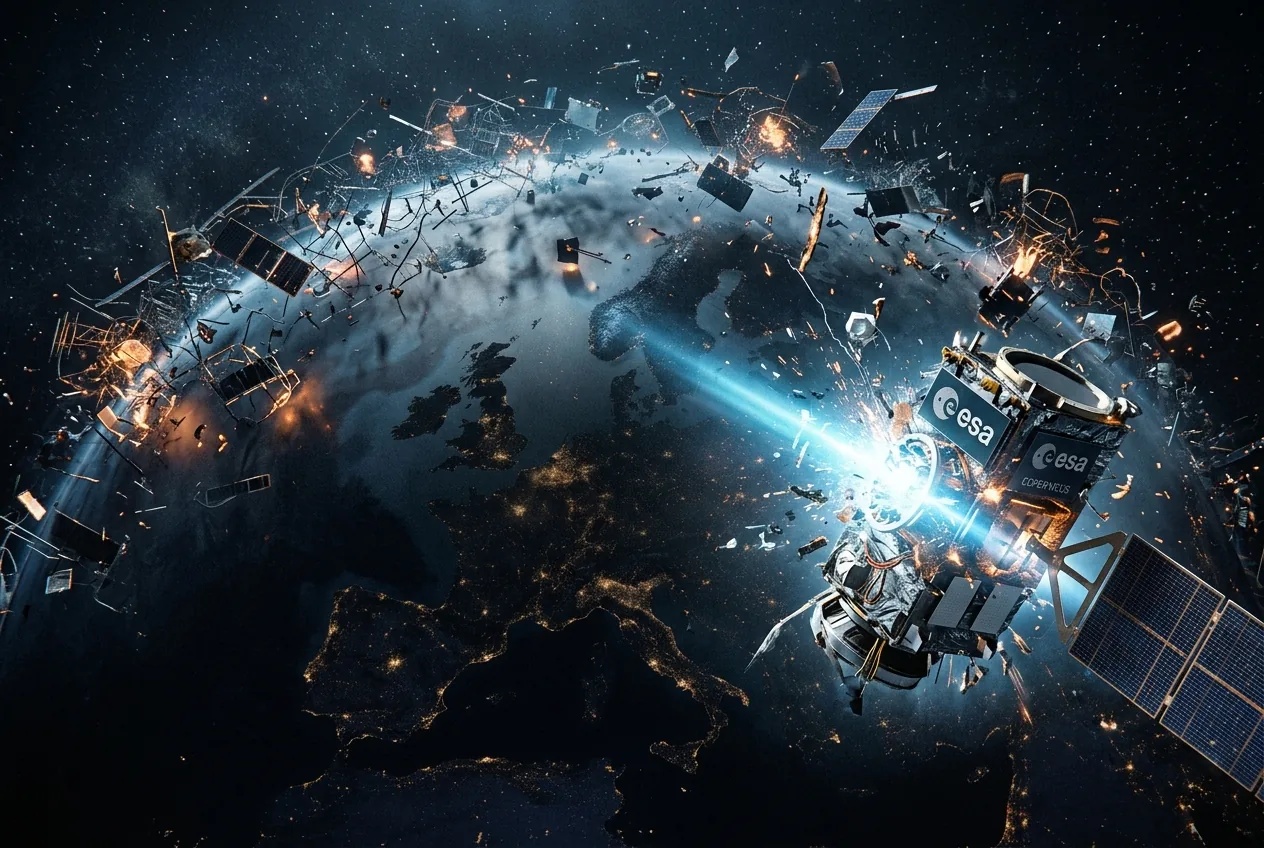
Now, the threat is no longer a software bug in a ground station. Recent warnings from US Space Command regarding Russian nuclear anti-satellite (ASAT) capabilities have shifted the conversation from theoretical debris management to the prospect of deliberate, irreversible orbital destruction. If a nuclear device were detonated in Low Earth Orbit (LEO), it would not just be an act of war against a single nation; it would be an act of environmental vandalism that could effectively close the door to space for a generation. For a European Union currently obsessed with its "Digital Decade" and the green transition, the stakes are not merely about losing Google Maps; they are about the immediate collapse of the industrial and financial systems that sustain the bloc.
The silence of the atomic clocks
The most misunderstood aspect of satellite dependency is that we do not just use them for location; we use them for time. Every major financial exchange in Frankfurt, London, and New York relies on the nanosecond-precise atomic clocks aboard GPS, Galileo, and Glonass satellites to timestamp trades. In high-frequency trading, where microseconds represent millions of euros, the loss of a synchronized timing signal would lead to an immediate, automated shutdown of the markets to prevent catastrophic flash crashes. It is the ultimate kill switch for global capitalism, hiding in plain sight.
Beyond the trading floors, the European power grid depends on these same signals to synchronize the phase of electricity across thousands of kilometres of high-voltage lines. Without this timing, the grid becomes unstable. Engineers can resort to local oscillators, but these drift. Within hours, the risk of massive, cascading blackouts increases exponentially. This is the irony of 21st-century infrastructure: the more "smart" we make our cities—the more we rely on 5G, automated logistics, and smart grids—the more we tether our survival to a layer of the atmosphere that is increasingly being treated as a shooting range.
The indiscriminate physics of a nuclear ASAT
When General Stephen Whiting of US Space Command warns of a Russian nuclear threat in space, he is not talking about a precision strike. In the vacuum of space, there is no blast wave because there is no air. Instead, a nuclear explosion releases a massive burst of X-rays and gamma radiation. This creates an electromagnetic pulse (EMP) that fries the internal circuitry of any satellite within a direct line of sight. But the real long-term killer is the creation of a new, artificial radiation belt.
The Earth’s magnetic field would trap the high-energy electrons from such an explosion, creating a zone of intense radiation that every satellite in LEO would have to pass through several times a day. Even "hardened" military satellites are not designed to survive that kind of constant bombardment for long. Within weeks or months, the solar panels would degrade, the processors would suffer bit-flips, and the entire orbital shell would become a graveyard of dead, tumbling metal. For Europe, this would be a double blow. Our current flagship projects, like the IRIS² multi-orbital constellation designed to provide secure communications, would be born into a lethal environment for which they were never budgeted.
The tragedy of such a weapon is its lack of a signature. Unlike a kinetic missile that hits a specific target, a nuclear-enhanced radiation belt is an equal-opportunity destroyer. It would kill Russian satellites just as effectively as American or European ones. It is the orbital equivalent of poisoning the only well in a desert to spite your enemy, only to realize you also have to drink from it.
The debris trap and the Kessler nightmare
European industrial policy is particularly vulnerable here. The EU’s Chips Act and its drive for semiconductor sovereignty are designed to feed a high-tech economy that assumes data flows freely from the sky. If LEO becomes a debris-choked wasteland, the thousands of sensors being deployed across European farms for "precision agriculture"—which reduces fertilizer use by up to 20%—suddenly become expensive lawn ornaments. The Green Deal’s reliance on satellite-derived methane tracking and carbon monitoring would vanish, leaving the bloc blind to its own environmental targets.
Furthermore, Europe’s launch capability is currently in a state of embarrassing fragility. With the retirement of Ariane 5, the delays of Ariane 6, and the loss of access to Russian Soyuz rockets, the European Space Agency is in a position where it cannot even replace its own weather satellites if they were to fail today. We have the engineers and the ambitions, but we have outsourced our lift capacity to Elon Musk. In a space war scenario, waiting for a spot on a Falcon 9 manifest is not a viable national security strategy.
Can we build a terrestrial backup?
The obvious question for Brussels is why we haven't built a plan B. The answer is cost and physics. To replicate the coverage of the Galileo network using ground-based transmitters (a technology known as eLoran) would require thousands of towers and billions in investment for a system that is less accurate and easily jammed. While the UK and some EU member states have toyed with the idea of terrestrial backups, the funding has always been diverted to more visible projects. We have traded resilience for efficiency, and the dividend of that trade is now being threatened by geopolitical actors who realize that the West’s greatest strength—its hyper-connectivity—is also its most accessible jugular.
If the satellites were to go today, the first thing you would notice is the silence of your phone's GPS. Then the ATMs would stop dispensing cash. Then the grocery stores, which rely on satellite-linked logistics for just-in-time delivery, would start showing empty shelves within 48 hours. It wouldn't be a return to the 19th century, as some alarmists suggest; it would be a 21st-century society attempting to run on 19th-century systems it no longer knows how to operate. The manual for the world we built is stored in a cloud that requires a satellite to access.
Europe has the regulations, the directives, and the white papers to manage a crisis. It just hasn't decided which member state is willing to pay for the spare rockets to fix one in orbit.




Comments
No comments yet. Be the first!