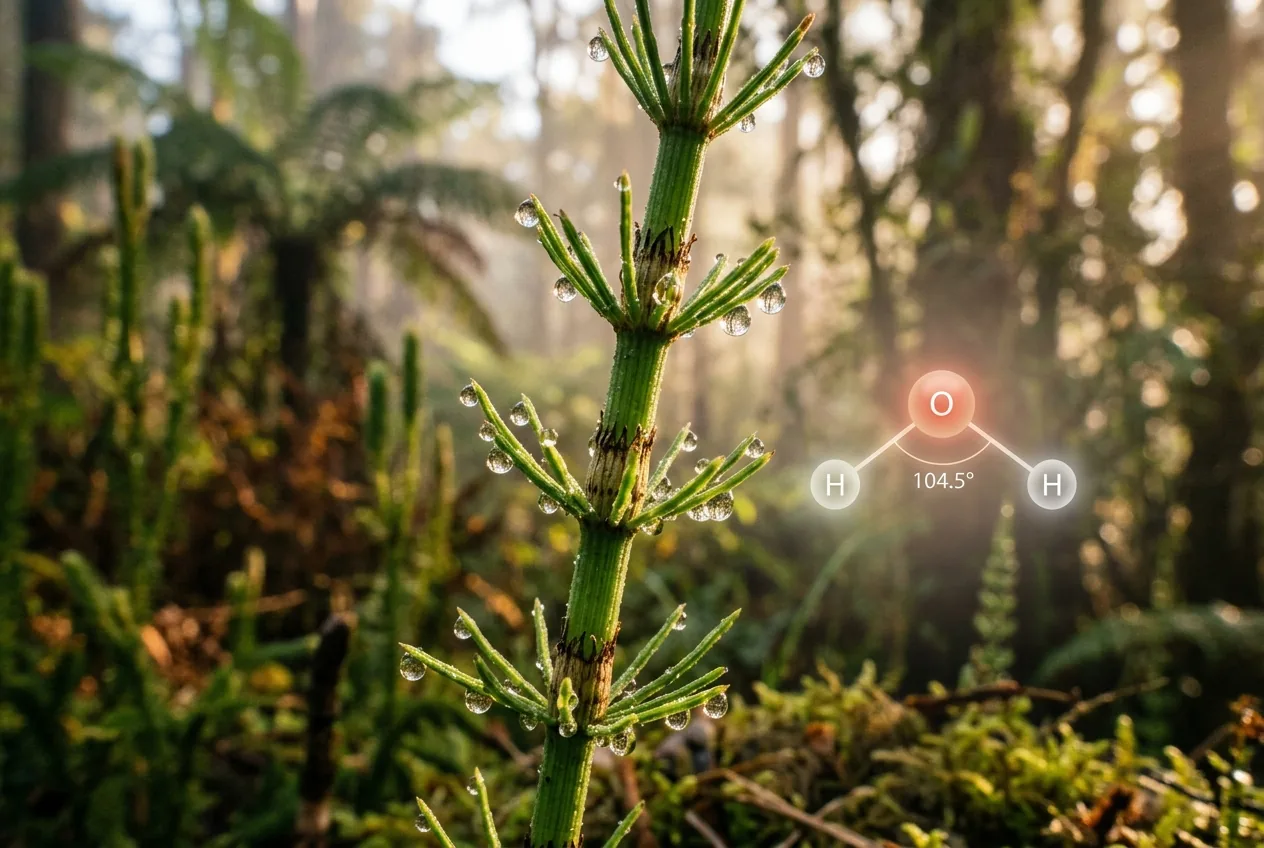
The horsetail, or Equisetum, is not just another weed you pull out of your garden path. It is a living fossil, a botanical survivor that has remained largely unchanged for over 400 million years. While the rest of the world’s flora evolved complex flowers and intricate leaf systems, the horsetail stuck to its guns: a hollow, jointed stem and a reproductive strategy involving spores. Now, it turns out this ancient survivor has been hiding a sophisticated piece of chemical engineering that challenges our understanding of how Earth’s water moves through the biosphere.
A chemical signature from the stars
To understand why this water is so weird, you have to look at the oxygen atoms themselves. Not all oxygen is created equal. Most of the oxygen we breathe and drink is Oxygen-16, the light, common version. But there are heavier versions—isotopes called Oxygen-17 and Oxygen-18—that carry extra neutrons. These heavy isotopes are like the sluggish cousins of the oxygen family; they don’t like to move as fast, and they certainly don’t like to evaporate as easily as the light stuff.
Normally, when water evaporates from a lake or a puddle, the light Oxygen-16 escapes into the air first, leaving the heavier isotopes behind. This process creates a predictable chemical "fingerprint" that scientists use to track everything from ancient rainfall to the migration of animals. But the horsetail plant takes this process and cranks it to eleven. Sharp noted that if he had been presented with the water from the tip of a horsetail without knowing its source, his professional diagnosis would have been immediate: "I would say this is from a meteorite."
The 400-million-year survival strategy
Why does a plant that predates the dinosaurs need to act like a chemical refinery? The answer lies in the horsetail’s unique architecture. These plants are built around a hollow central canal. As moisture rises from the roots, it doesn't just sit there. The stem walls are porous enough that evaporation happens continuously along the entire length of the plant. It is a slow, methodical stripping away of the light water molecules.
This survival mechanism has served the Equisetum lineage well since the Devonian period. While other plants developed broad leaves that lose water rapidly, the horsetail’s vertical, reed-like structure and internal water-management system allowed it to persist through mass extinctions and radical shifts in the global climate. It is a reminder that evolution doesn't always favor the most complex solution; sometimes, it favors the one that is chemically most resilient.
Why our climate models are probably wrong
The real tension in this discovery isn't just about the water itself—it’s about what the water leaves behind. Inside the tissues of the horsetail, the plant deposits silica, creating tiny glassy structures called phytoliths. Because these silica "stones" are incredibly durable, they survive in the fossil record for millions of years. For decades, paleontologists have used the oxygen trapped in these phytoliths to estimate what the humidity and temperature were like in the distant past.
Sharp’s data revealed a massive problem: the oxygen fingerprint in the silica did not match the water moving through the stem. There is a chemical mismatch, a biological bias that we haven't been accounting for. If we look at a 200-million-year-old fossilized horsetail and try to read its oxygen levels to guess the weather, we are likely getting a distorted picture. We might be looking at the results of the plant’s internal distillation process rather than the actual climate of the ancient world.
This realization is a bit of a nightmare for climate modelers. It means that some of our assumptions about prehistoric humidity might be fundamentally flawed. We’ve been assuming that the plant is a passive recorder of its environment, like a thermometer left out in the rain. Instead, the horsetail is an active editor of the data. To get the real story of Earth's past, we now have to learn how to "un-edit" the chemical signals left behind by these ancient plants.
A lesson in messy nature
The discovery wasn't the result of a multi-million dollar corporate R&D project, but rather a summer course at the University of New Mexico. Sharp led a group of 14 students into the field to collect stems and then back to the lab to run them through mass spectrometers. It is the kind of science that happens when you stop looking at the screen and start looking at the weeds. The team utilized the Center for Stable Isotopes in Albuquerque, using electron microscopes to verify the silica growth inside the plants.
The boundaries of terrestrial water
We often think of the water on Earth as a closed, well-understood system. We know the water cycle from primary school: rain falls, it runs into the sea, it evaporates, and it starts again. But Sharp’s work shows that the cycle has extremes we haven't even begun to map. By stretching the known range of oxygen isotopes fivefold, the horsetail has redefined the limits of what is possible in a living system.
The fact that a common plant can produce a signature identical to a meteorite suggests that we need to be much more careful when we look for signs of life or water on other planets. If we found these levels of Oxygen-17 on Mars, we might assume it was the result of some exotic, non-biological process. Now we know that life on Earth has been doing it for 400 million years just to get a drink of water in a dry breeze.
As we move forward, the challenge will be to see which other "living fossils" are hiding similar chemical secrets. The horsetail has survived four mass extinctions, the rise and fall of the dinosaurs, and the arrival of humans. It has done so by mastering the physics of its environment in a way that we are only just beginning to decode. It turns out that the most alien thing on Earth might just be growing in the ditch behind your house.




Comments
No comments yet. Be the first!