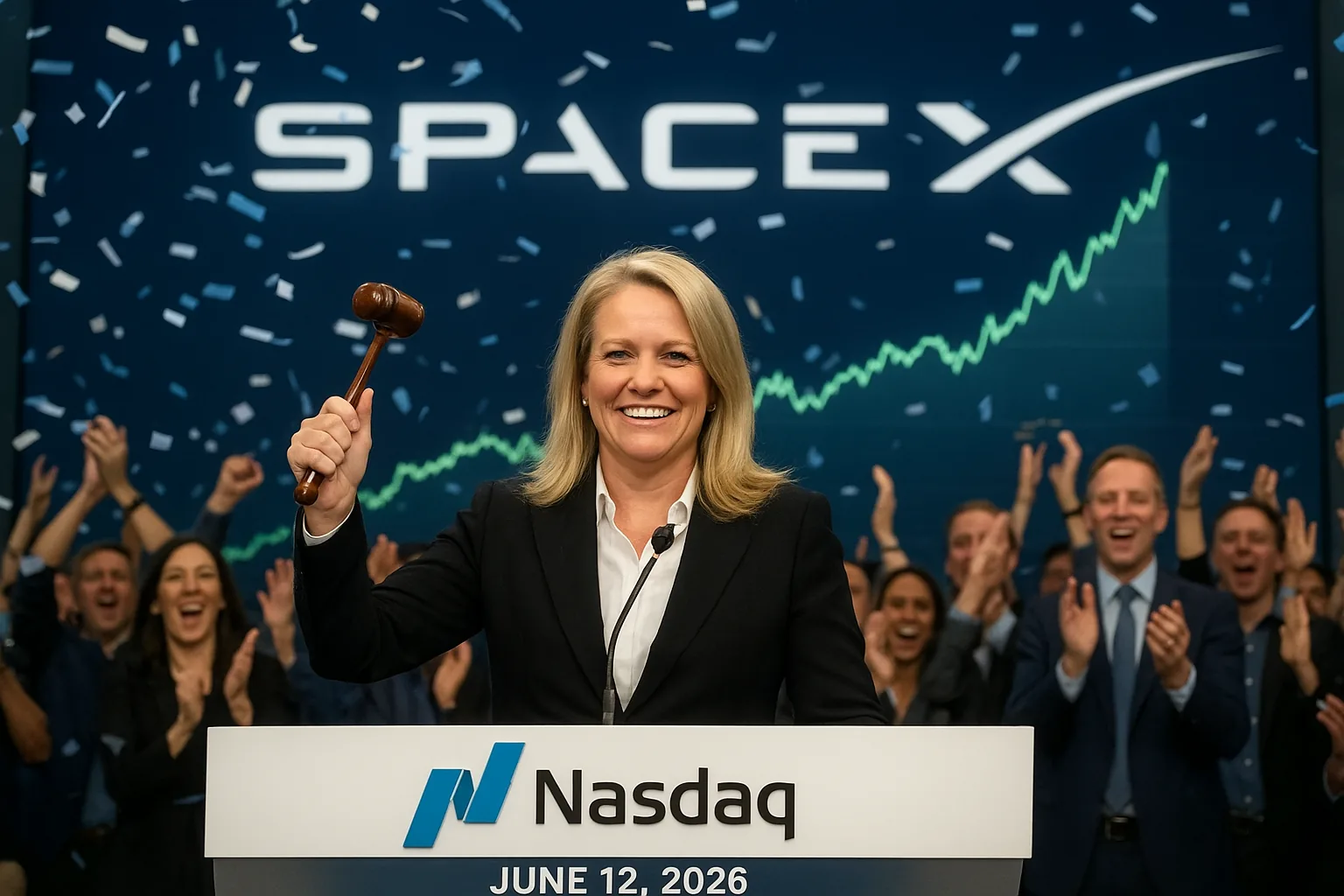
At 11:32 a.m. on Friday, traders at the Nasdaq market site in Times Square stared at screens displaying a number they'd never seen before: $150. That was the opening price for SpaceX, and it was only the beginning. Within minutes, the ticker SPCX was swinging wildly, turning Elon Musk into the world's first trillionaire before lunch.
The stock closed at $161.11, up 19% from the $135 IPO price, giving the rocket and satellite company a market capitalisation of roughly $2.1 trillion. More than 500 million shares changed hands, eclipsing every other IPO this year combined. It wasn’t a trading session—it was a coronation.
SpaceX stock rises after the largest IPO in history
Retail investors, often sidelined in mega-listings, received a 20% allocation—far more than average. That meant hundreds of thousands of Musk fans who had ridden Tesla’s rollercoaster could finally own a slice of the space company. “Some people were celebrating a single share,” one broker noted. Platforms like Robinhood, Fidelity, and Schwab all offered access, though many buyers were forced to chase the stock in the open market after their orders were only partially filled.
The debut didn’t just benefit Musk. SpaceX’s 13,000 employees hold significant equity stakes, and the company is now expected to create thousands of millionaires and at least a dozen billionaires. Tom Mueller, a founding SpaceX employee and now CEO of Impulse Space, called watching the IPO “almost surreal.” He joined when the company “was just some sketches on paper.”
SpaceX stock rises after record-breaking day, but analysts warn of turbulence
For all the euphoria, not everyone is convinced. Morningstar analysts valued SpaceX at $780 billion—less than half the IPO price—based on discounted cash flows. CFRA initiated coverage with a sell rating. The company posted a net loss of $5 billion in 2025 and recorded $18.7 billion in revenue, meaning its price-to-sales ratio exceeds 110. That’s a sky-high multiple even by the frothy standards of the current market.
“This is not a name you're buying based on fundamentals,” said Nancy Tengler, CEO of Laffer Tengler Investments. “If the stock drops to $100, that's not ideal, but it wouldn't change our long-term view. We want to participate.” Other investors drew comparisons to Amazon’s early days, when losses masked a generational reshaping of commerce.
The tension between SpaceX’s story and its numbers will dominate the coming weeks. Options are expected to begin trading soon, with the “greenshoe” option—an extra 83 million shares—likely to be exercised, adding another $11.2 billion to the pot. Then come lockup expirations, when early investors can sell. Musk himself holds 42% of the economic interest and 82% of the voting power through a dual-class structure, making him unassailable. That concentration has drawn sharp criticism from governance watchdogs.
Inside the trillionaire math: what SpaceX stock means for Musk’s wealth
The math works like this: Musk owns roughly 4.8 billion SpaceX shares—about 42% of the company—and 350 million options struck at $8.39. At the $135 IPO price, that stake was valued at $648 billion. Add his holdings in Tesla, xAI, Neuralink, and other ventures, and the total breached $1 trillion. Each dollar move in SpaceX stock adds about $5.2 billion to his net worth.
The dual-class share structure ensures Musk controls SpaceX regardless of the public float. Class B shares carry 10 votes to Class A’s one, and only Class B holders can remove Musk as CEO, CTO, or chairman. Critics argue this setup concentrates far too much power in one individual. Supporters counter that it protects the company’s long-term vision from quarterly earnings pressure.
When SpaceX stock rises, other space stocks bleed. On Friday, Redwire fell 11%, Rocket Lab dropped 10%, and the Procure Space ETF shed 7%. That rotation reflects a simple market reality: large funds must now allocate capital to SpaceX, likely selling smaller names to make room. With fast-track inclusion in the Nasdaq 100 expected within a month, passive funds tracking the index will become forced buyers, sustaining demand even if the price looks stretched.
The road ahead: more mega-IPOs and a shifting market landscape
SpaceX’s debut is merely the opening act of a historic season for public listings. AI darlings Anthropic and OpenAI have confidentially filed for IPOs, and market watchers worry that a flood of new supply could cool the broader market. For now, though, the mood is buoyant. Goldman Sachs stock rose 2% on its role as lead underwriter, and the Nasdaq composite ended the day higher, helped by relief over a potential U.S.-Iran deal.
Gwynne Shotwell, SpaceX’s president and COO, admitted on CNBC that she “wasn’t sure we would go public.” But she said the moment “actually feels like the right time.” With Starlink’s satellite internet business generating cash and the Starship programme inching toward orbit, the company is now a sprawling conglomerate that includes xAI, its artificial intelligence subsidiary. SpaceX’s own filing pegged its addressable market at $28.5 trillion—a number it calls the largest in human history.
Whether the stock can justify that optimism remains to be seen. For now, the market has delivered its verdict: a $2 trillion-plus company born in a single trading day, and a founder whose wealth has entered the realm of economic legend. The coming weeks will test whether this was a stable orbit or a brief, dazzling flare.
Sources
- SpaceX amended S-1 filing with the U.S. Securities and Exchange Commission
- Nasdaq listing data for SPCX
- Morningstar equity research report on SpaceX
- CFRA analyst initiation note
- Oxfam reaction statement




Comments
No comments yet. Be the first!