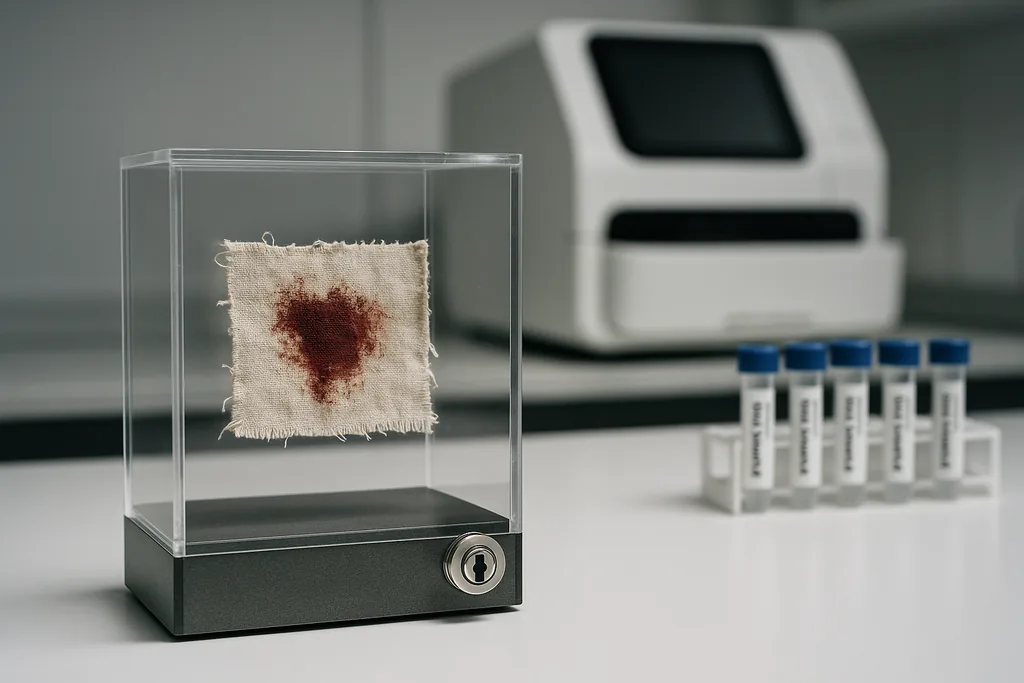
Researchers say they verified a small, bloodstained swatch of fabric as coming from Adolf Hitler and have now sequenced DNA recovered from it, a team reports in a new documentary. The analysis, led publicly by geneticist Turi King of the University of Bath, identifies a variant in the PROK2 gene that the researchers say is associated with Kallmann syndrome — a rare disorder that can delay puberty — and also reports elevated polygenic risk scores for several psychiatric conditions. The claims have reverberated through scientific and public circles because the work has been released first in a media format rather than through an open scientific dataset and peer-reviewed publication.
researchers say they verified the sample: provenance and sequencing
The disputed physical evidence began its postwar journey in 1945 when US Army Col. Roswell P. Rosengren removed a ragged swatch from a bloodstained couch in the bunker where Hitler died. That patch later entered private hands and was acquired by a museum in the United States. In the documentary "Hitler's DNA: Blueprint of a Dictator," Turi King and collaborators describe comparing DNA from blood on that fabric with DNA from a living male-line relative of Hitler to establish a match. The match, the team says, comes from Y-chromosome markers and provides the basis for asserting the blood belonged to Hitler.
King and colleagues report that extracting and sequencing ancient or degraded DNA took more than four years of laboratory work. They say the resulting data included enough human DNA to call specific variants, notably in the PROK2 gene, and to compute genome-wide polygenic risk scores. But the documentary release has so far not included the raw sequence reads, coverage statistics, or standard contamination and authenticity metrics that geneticists typically publish for historical DNA work. That gap is the central technical reason other researchers have urged caution in accepting the team’s claims at face value.
Context and historical clues
The genetics the team highlights is not being offered in isolation; the documentary pairs the molecular findings with archival medical notes and eyewitness accounts. A prison medical record from Hitler’s 1923 incarceration reportedly documented a right-side cryptorchidism — an undescended testicle — a physical sign that can co-occur with hormone-related developmental conditions. Historians and the documentary’s advisors point out that such records make a genetic interpretation plausible, or at least worth investigating.
Kallmann syndrome is a congenital condition in which patients often have low levels of sex hormones due to disrupted development of certain neurons that control puberty. In boys, it can delay the onset of puberty and sometimes coincide with undescended testes; a minority of cases are associated with a smaller-than-average penis. The presence of a PROK2 variant is consistent with known causes of Kallmann syndrome, but genetic diagnosis ordinarily requires careful correlation of variant type, zygosity, and clinical history — details not yet available publicly for this case.
researchers say they verified genetic markers: PROK2 and polygenic risk
The most headline-grabbing molecular claim is the identification of a variant in PROK2, a gene implicated in Kallmann syndrome and congenital hypogonadotropic hypogonadism. If that particular variant is pathogenic and was present in Hitler, it could plausibly account for delayed puberty and some of the physical signs recorded in archival medical notes. The research team also presented polygenic risk score calculations that, when compared with tens of thousands of contemporary genomes, placed this reconstructed genome at the high end of risk for conditions such as schizophrenia, autism spectrum disorder and bipolar disorder.
Polygenic risk scores aggregate thousands of tiny genetic effects across the genome and can indicate relative risk at a population level. As psychiatric genetics experts in the documentary and elsewhere emphasize, these scores are not diagnostic for individuals. They describe probabilities and distributions, not deterministic outcomes, and their predictive value depends strongly on the reference population and the quality of the underlying genotype calls. Those caveats are why several geneticists have urged restraint in interpreting elevated scores in a single historical individual.
Scientific reception and methodological caveats
Independent experts have welcomed careful historical genomics while warning that the current presentation falls short of customary scientific transparency. Senior researchers at institutions such as the Francis Crick Institute have pointed to key missing information: raw sequence data, measures of contamination, read depths at called sites, and independent replication. Without those details, other laboratories cannot assess whether the PROK2 call is robust or whether modern human contamination influenced the polygenic risk calculations.
Those scientists also recommended that the research team publish the results in a peer-reviewed journal or at least deposit a preprint and the sequence data in public repositories. Doing so would allow the broader community to apply standard authenticity tests used in ancient or degraded DNA studies — for example, patterns of DNA fragmentation and damage that distinguish old DNA from recent contamination — and to test how sensitive the polygenic scores are to missing data or sequencing errors.
Ethics, public impact, and why it matters
The project raises a set of ethical questions that go beyond laboratory technique. Historical DNA work touches on privacy for descendants, the responsibilities of museums that steward forensic artifacts, and the social consequences of genetic narratives. Several commentators have warned that publicly linking violent historical behavior to genetics risks stigmatizing people who carry similar variants or who live with psychiatric diagnoses today.
Researchers involved in the documentary emphasize that genetics is a small, not sufficient, explanation for complex behaviors and that many social, political and historical forces created the conditions for genocide and dictatorship. Still, the choice to present these findings first through a film rather than through open scientific channels has prompted debate about the proper balance between popular engagement and scientific rigor. Responsible publication would include data and methods that let others confirm or refute the claims and would provide fuller context about the limits of genetic inference.
What remains unsettled
Key questions remain: how complete and authentic is the reconstructed genome, whether the PROK2 variant is definitely pathogenic in this individual, and how robust the polygenic comparisons are to the fragmentary nature of historical DNA. The team behind the documentary says the work has been submitted to a high-profile journal, and its members have framed the film as part narrative and part academic report. Until independent scientists can inspect the sequence reads and perform their own analyses, claims that someone’s actions flowed from particular genetic variants will stay scientifically provisional.
For historians, geneticists and the public, the larger lesson is a methodological one: DNA can illuminate obscure biographical details, but it cannot explain moral responsibility or the social dynamics that produce atrocity. This episode underscores the need for transparent data, cautious interpretation, and an ethical framework for studying the genomes of famous or infamous historical figures.
Sources
- University of Bath (Turi King, geneticist)
- Francis Crick Institute (ancient genomics group)
- Aarhus University (psychiatric genetics)
- PubMed (literature on PROK2 and Kallmann syndrome)
- Gettysburg Museum of History (artifact provenance)




Comments
No comments yet. Be the first!