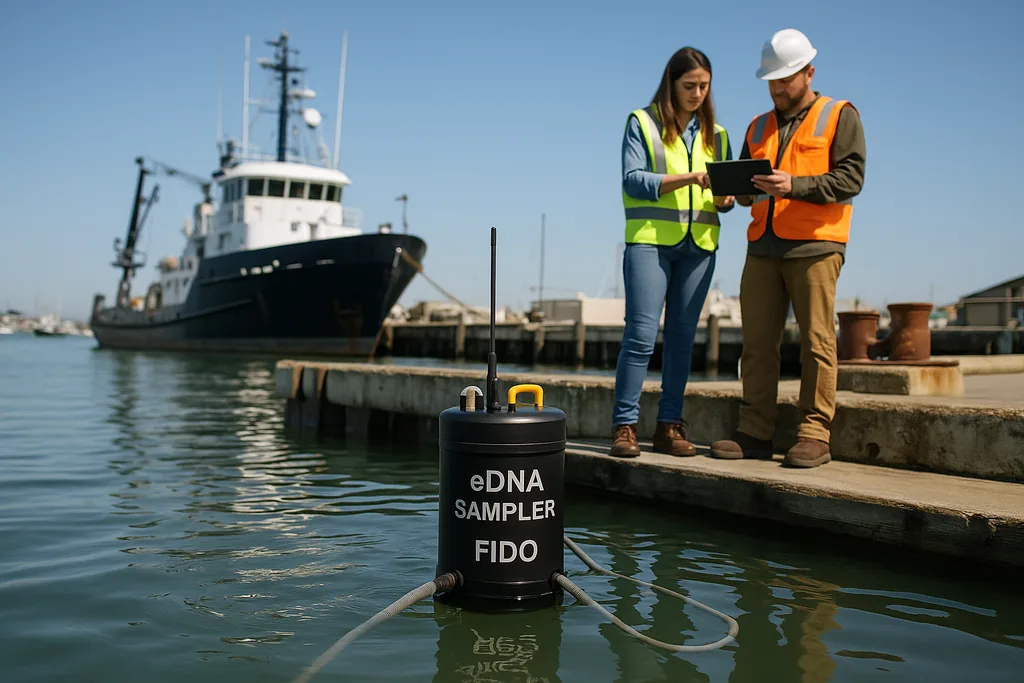
Harbor trials and a new tool for biosurveillance
On December 9–10, 2025, two compact sampling robots slipped from a small launch into the calm waters of Moss Landing harbor as staff from the Monterey Bay Aquarium Research Institute walked USGS READI‑Net participants through a hands‑on training and deployment exercise. The robots, known as FIDO (Filtering Instrument for DNA Observation), are built to collect environmental DNA — microscopic genetic traces left by fish, mussels, snails and other aquatic organisms — and preserve them for laboratory analysis. The U.S. Geological Survey announced on January 28, 2026 that the training was the first practical test of the next‑generation eDNA autonomous sampler that READI‑Net plans to deploy for early detection of biological threats.
Filtering Instrument for DNA Observation (FIDO)
FIDO is designed around two interlocking goals: increase sampling throughput while keeping the system portable and affordable. According to READI‑Net materials, a single FIDO can collect and preserve up to 144 discrete samples; it is light enough to be carried by one person; it supports remote control and monitoring; and it is designed for relatively low‑cost production. Teams at MBARI and USGS collaborators also produced a user manual during the Moss Landing session to accelerate training as READI‑Net scales testing.
Those design choices reflect an operational logic: early detection programs work best when they can sample frequently and broadly. Traditional biological surveys — nets, trawls, snorkel surveys or diver counts — are time consuming and often miss low‑density or cryptic invaders. Environmental DNA methods amplify sensitivity by recovering tiny fragments of genetic material organisms shed into water, sediment or biofilms. Automating sample capture, filtration and preservation with a device like FIDO promises to extend that sensitivity across more places and times than human teams alone can cover.
READI‑Net’s role and strategy
READI‑Net — the Rapid environmental (e)DNA Assessment and Deployment Initiative & Network — is a USGS program that supports the Department of the Interior’s National Early Detection and Rapid Response Framework. The initiative develops autonomous samplers, standardized sampling protocols and analytical tools so resource managers can design detection programs that meet local priorities. In its announcement, USGS emphasized that READI‑Net teams will use FIDO tests to refine protocols for deploying autonomous samplers in a range of real‑world settings.
Planned trials follow a staged approach. The program will run laboratory tests this winter to validate sample handling and preservation workflows, then move to broader field tests next summer. Field sites will include fixed USGS stream gauging stations, research vessels and areas identified as invasive species corridors — locations where early interception could prevent establishment and reduce ecological and economic damage.
How eDNA sampling fits into early response
Environmental DNA is a powerful surveillance input: tiny amounts of genetic material captured from a liter or two of water can reveal the presence of a species even when individuals are not directly observed. For managers, that sensitivity translates into a chance to detect invaders at the very edge of establishment, when targeted eradication or containment is still feasible and relatively inexpensive.
READI‑Net teams plan to use FIDO to gather time‑series data at high temporal resolution — daily or hourly samples in some deployments — which improves the probability of catching transient or rare signals. Real‑time or near‑real‑time monitoring also supports rapid decision cycles: a positive eDNA detection can trigger confirmatory surveys, focused removals, targeted closures or other management actions in a narrow window of opportunity.
Technical realities and limits of interpretation
Automating eDNA collection does not remove scientific constraints around what genetic detections actually mean. eDNA assays detect fragments of DNA; they cannot directly distinguish living, reproducing populations from transient DNA transported on currents, in ballast water or attached to equipment. False positives from contamination and false negatives from degraded DNA or sampling gaps remain practical concerns.
READI‑Net and MBARI are testing protocols for filtration, preservation and chain‑of‑custody that reduce contamination risk and standardize downstream analysis. But turning a molecular hit into a management action requires thresholds and verification steps: laboratory confirmation, counter‑surveys with traditional gear, and ecological risk assessment to establish whether the organism detected represents an imminent threat.
Laboratory throughput and data interpretation are additional bottlenecks. Collecting hundreds of automated samples is only useful if laboratories can process and analyze them fast enough to inform action. READI‑Net’s work with regional eDNA laboratories aims to align sampling designs with analytical capacity and to develop decision frameworks that account for uncertainty in detection.
Operational challenges: deployment, cost and scale
- Logistics and maintenance: Even a portable sampler needs regular servicing — filter replacement, battery charging, firmware updates and decontamination routines. READI‑Net will evaluate how frequently field teams must visit units and how maintenance affects long‑term surveillance costs.
- Networked monitoring: FIDO units are remotely controlled and monitored, but scaling to hundreds of samplers across large basins raises questions about communications infrastructure, data management and cybersecurity.
- Standardization: For surveillance data to be comparable across jurisdictions, states and federal partners, protocols for sample volume, filtration, preservation and metadata collection must be harmonized. READI‑Net’s testing phase is explicitly intended to build those shared practices.
- Costs and production: The USGS release notes design emphasis on relative affordability and producibility. Manufacturing at scale, procurement rules, and lifecycle costs will determine whether FIDO becomes a broadly distributed tool for land managers and water agencies.
Testing timeline and next steps
Following the December training, READI‑Net reported that laboratory testing will begin this winter to validate sample handling and preservation, and that expanded field trials are planned for the following summer. Those tests will exercise FIDO in environments ranging from small tributaries instrumented with USGS stream gages to coastal monitoring from research vessels and targeted deployments in known invasive corridors. Results from these staged trials will inform whether FIDO moves from a research prototype to an operational piece of the early‑detection toolkit.
Ecosystem and management implications
If autonomous samplers like FIDO meet expectations, managers could gain a new class of sentinel devices that increase the spatial and temporal reach of eDNA surveillance. That matters for multiple reasons: preventing establishment of nonnative fishes and invertebrates protects native biodiversity; catching pathogens or harmful algal blooms early can reduce risks to human recreation and water supplies; and timely detection can save public and private dollars by avoiding costly eradication programs later.
The USGS statement emphasized that the development and testing of FIDO is a collaborative effort involving multiple USGS centers and partners, and that any product names are used for descriptive purposes without endorsement. Researchers and managers will be watching the upcoming lab and field trials closely to see whether FIDO can translate promise into reliable early warning.
Sources
- U.S. Geological Survey (USGS) — READI‑Net news and program materials
- Monterey Bay Aquarium Research Institute (MBARI) — FIDO development and training materials
- USGS Ecosystems Mission Area
- Northern Rocky Mountain Science Center (NOROCK) — READI‑Net coordination and deployment




Comments
No comments yet. Be the first!