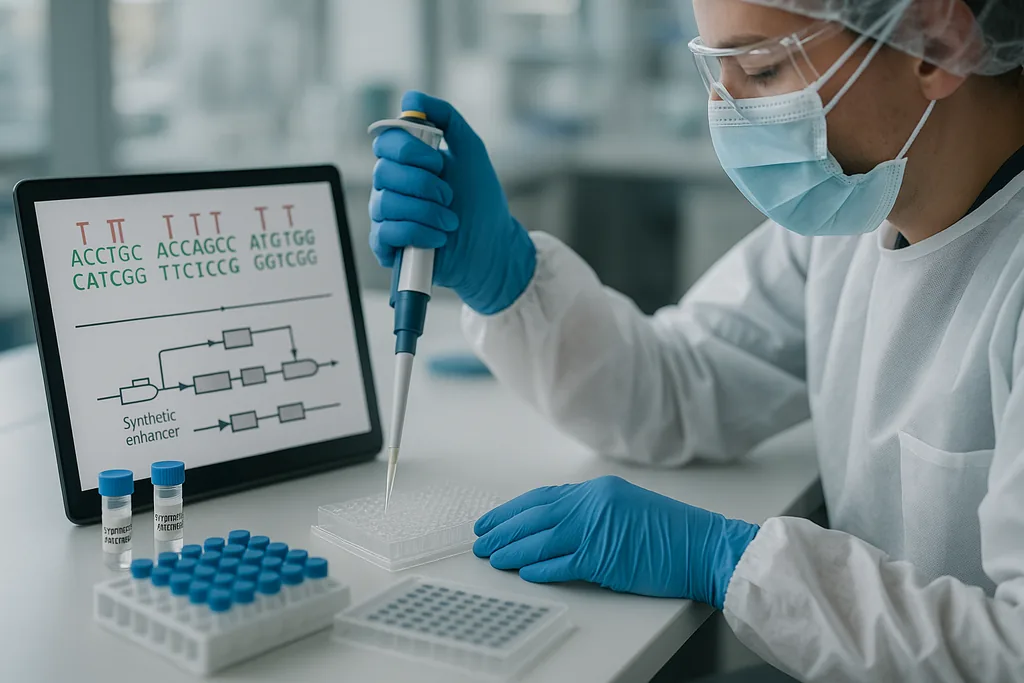
On 8 May 2025 a team at the Centre for Genomic Regulation in Barcelona published a paper in Cell showing that an artificial intelligence system can design short, synthetic DNA regulatory sequences that act as cell‑type specific switches inside healthy mammalian cells. Less than a year later, a separate group at Rice University announced in Nature a complementary advance—an experimental platform called CLASSIC that maps millions of complete genetic circuits to cellular outputs and feeds those measurements to machine‑learning models so they can predict function across vast untested design space. Together these papers mark a rapid shift: algorithmic imagination of DNA sequences is moving from toy examples to real molecules that reliably change gene activity in living cells, and industry and policy groups are racing to adapt manufacturing and oversight to match.
A new class of synthetic enhancers
The Cell paper from the Barcelona group describes a generative AI trained on massive measurements of how short DNA fragments — enhancers — influence gene expression during blood‑cell development. Enhancers are non‑coding stretches of DNA that recruit transcription factors and determine when and where genes are expressed. The CRG team synthesized more than 64,000 variants designed to test combinations and arrangements of binding motifs for dozens of transcription factors, then measured activity across multiple stages of hematopoiesis. From those data the model learned design rules and proposed sequences that had never existed in nature but behaved as intended when introduced into primary mouse blood progenitors: some acted as graded dials, others produced near binary on/off behaviour, and many showed striking cell‑type specificity.
Massive libraries and mapping genetic circuits with CLASSIC
CLASSIC exposed two practical lessons for designers. First, circuits are often not single‑solution problems — many different designs can achieve the same output — giving engineers flexibility to trade between robustness, strength and resource cost. Second, mid‑strength parts often outperform the most extreme components; in other words, biology has its own Goldilocks zones. Crucially, the pipeline was validated by synthesizing and testing predicted designs: dozens of AI‑chosen circuits matched lab readouts, showing models can generalize beyond their training sets when those sets are large and carefully measured.
From in silico designs to living cells
Both lines of work emphasize a tightly coupled design‑build‑test loop. In Barcelona the AI proposes short enhancer sequences; researchers synthesize those 250‑base fragments, package them into delivery vehicles, and insert them into living mammalian cells to read out activity across cell states. In Houston and at collaborating labs the CLASSIC strategy produces libraries of complete circuits, reads out outputs across thousands or millions of cells, and returns those results to an ML model that recommends the next round of candidates.
The practical upshot is speed and creativity. Where classical genetic engineering required iterative debugging and expert intuition over months, AI plus massively parallel measurement lets teams explore combinatorial spaces at scales that were previously impossible. That accelerates discovery of functional DNA switches for therapeutic promoters, lineage‑restricted expression cassettes, and more elaborate logic gates in cells.
Manufacturing at AI speed: cell‑free synthesis and supply chains
Design outpaces supply if synthesis and production cannot keep up. Industry groups and some startups are already adapting: cell‑free DNA synthesis workflows — which assemble linear IVT‑ready templates without cloning in bacteria — eliminate sources of contamination (endotoxins, host DNA) and avoid recombination problems that make long homopolymers, such as encoded poly(A) tails, unstable in plasmids. Those advantages matter for AI cycles because models iterate rapidly and demand many different, bespoke templates on tight timelines.
Cell‑free templates also reduce downstream variability in poly(A) tail length and sequence integrity, improving reproducibility of in‑vitro transcription products. When AI proposes hundreds or thousands of candidate sequences, a fast, automation‑friendly supplier chain that delivers synthesis, QC and IVT templates becomes a rate‑limiting step — and that means companies, contract manufacturers and academic core facilities are retooling around cell‑free approaches to match the pace of computation.
Applications, constraints and early limits
But there are real constraints. The regulatory genome is vast and context dependent: the CRG study profiled only a subset of transcription factors and cell states, and the Rice CLASSIC demonstrations were performed in model cell lines for proof of principle. Translating a sequence that works in a dish into a safe, durable, and effective therapeutic in humans will require extensive preclinical validation. Models generalize best when training data reflect the target context; gaps in training sets remain a major source of failure.
Risks, governance and human oversight
Rapid design and cheap synthesis raise security and governance questions that the synthetic‑biology community has been wrestling with for years. A review in npj Biomedical Innovations framed this as a convergence problem: AI reduces the technical threshold for complex bioengineering while automated labs and inexpensive synthesis scale capability and distribution. That combination widens both beneficial accessibility and dual‑use risk.
Three governance priorities emerge from recent commentary and policy work. First, explainability and audit trails for models and design pipelines: opaque “black box” recommendations are harder to evaluate for failure modes or misuse. Second, human‑in‑the‑loop controls at decision chokepoints — gating any sequence intended for release into biological systems behind expert review and functional assays. Third, supply‑chain measures and sequence‑screening standards to detect designs that might enable harmful functions even when they are novel. National efforts to expand nucleic‑acid synthesis screening attest to the policy attention these technologies now receive.
The science is moving quickly and, for now, the prudent path combines enthusiasm for what AI can create with deliberate, transparent practices to bound risk, document provenance and preserve human judgment where it matters most.
Sources
- Cell (research paper on AI‑designed synthetic enhancers)
- Nature (research paper: CLASSIC platform for ultra‑high‑throughput genetic circuit mapping)
- npj Biomedical Innovations (analysis of AI–synthetic biology convergence)
- Centre for Genomic Regulation (CRG), Barcelona
- Rice University Synthetic Biology Institute
- Pompeu Fabra University (UPF)




Comments
No comments yet. Be the first!