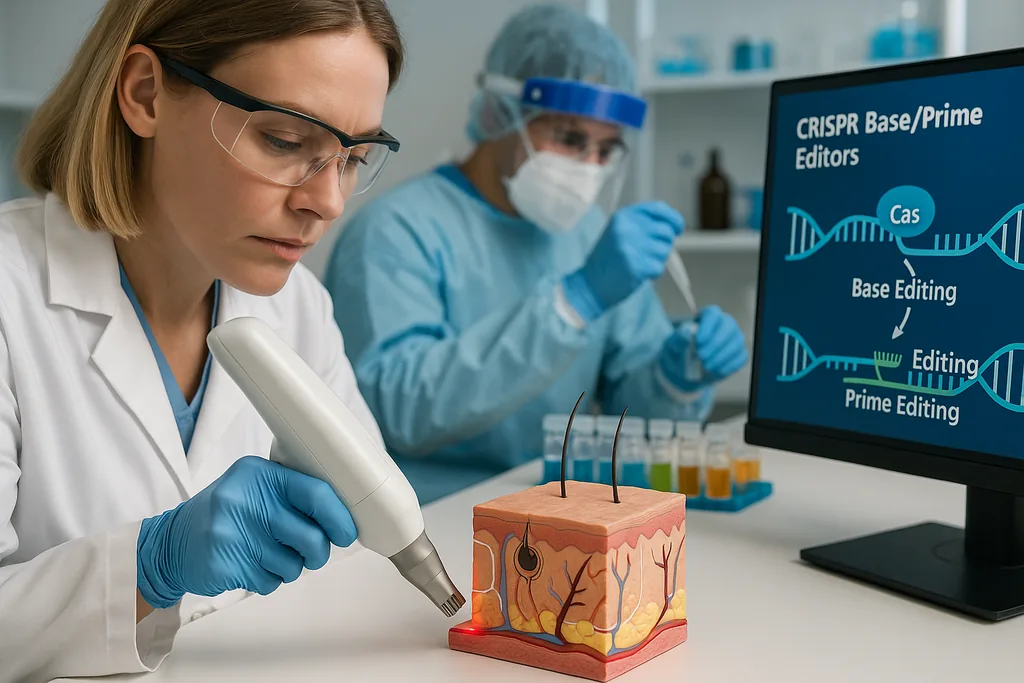
Laser, lipid bubbles and molecular scissors: a new way to edit skin
Today researchers at the University of British Columbia published a paper in Cell Stem Cell describing what they call the first gene‑editing treatment that can be applied directly to human skin. The team — working with collaborators at the Berlin Institute of Health at Charité and a Vancouver spin‑out, NanoVation Therapeutics — combined a clinically approved fractional laser with lipid nanoparticles carrying a CRISPR‑based editor to create microscopic access points in the skin and deliver the editor into skin stem cells beneath the surface. In living human skin models the treatment corrected the most common mutation behind autosomal recessive congenital ichthyosis (ARCI) and restored measurable skin function.
How the topical delivery works
One of the major technical barriers for genetic therapies of the skin is the organ's job: keep things out. The UBC group bypassed that obstacle with two established technologies arranged in a new combination. A fractional laser makes tiny, controlled microchannels through the outermost layers of the epidermis — brief, pain‑free openings that clinicians already use for drug delivery and dermatologic procedures. Into those microchannels the researchers applied lipid nanoparticles (LNPs), microscopic fatty shells that have become a standard vehicle for transporting nucleic acids into cells since their role in mRNA vaccines.
Inside the LNPs was a CRISPR‑based editor designed to repair a single DNA mutation that cripples an enzyme required for normal skin formation in ARCI. The nanoparticles penetrated to basal stem cells in the epidermis; the editor repaired the mutant gene in those cells, and the corrected stem cells gave rise to healthier skin in the laboratory models. The team reports restoration of up to about 30% of normal skin function in their assays — a level other groups have suggested could be clinically meaningful for symptoms and infection risk.
Where this sits next to other skin gene therapies
The UBC approach is a direct, in vivo editing strategy: edit the cells where they live, without grafting or ex vivo manipulation. That contrasts with the gene‑corrected skin grafts developed over two decades at Stanford Medicine and reported in a phase 3 trial last year. In that approach clinicians take a small biopsy of a patient’s skin, correct the defect in the lab (using a viral vector), grow sheets of corrected skin and then graft them back. The graft program, aimed at dystrophic epidermolysis bullosa (EB), produced dramatic wound healing in patients and led to regulatory approval for graft products and related topical gene therapies in recent years.
Both strategies attack the root cause — the defective gene — but they differ in logistics. Ex vivo grafts are personalized and intensive to manufacture (they are essentially living products grown to order), while an in vivo topical therapy could, in principle, be administered in a clinic in a single visit or a short series of treatments and scaled more like a conventional drug if safety and manufacturing align.
Safety signals and unanswered questions
UBC’s paper emphasizes two safety points: localization and lack of detectable off‑target edits in their experimental systems. Because the laser guides the LNPs past the barrier only at treated sites, the therapy stays local to the skin in the models, reducing the risk of systemic exposure. The team also reports they found no evidence of harmful off‑target DNA changes in the experiments they performed.
Those are important early indicators, but they are not the same as demonstrating safety in people. Key unknowns remain: how durable the corrected stem cells are long term in human patients, how the immune system will respond to repeated exposure to the editing payload and LNPs, and whether rare off‑target edits might occur at a frequency or in a genomic location that has clinical consequences. The UBC team has said they are working with regulators to define the studies needed for first‑in‑human trials.
Why skin is a promising testbed for genetic medicine
Skin offers several advantages for gene‑editing experiments. It is accessible for local delivery, easy to visualize and biopsy to monitor effect and safety, and skin stem cells are relatively well characterized. The organ is also regenerative: if a population of stem cells is corrected, their progeny replace defective tissue over time, potentially producing durable benefit after a short treatment course. That logic has already supported other skin approaches: Stanford’s gene‑therapy gel for smaller EB wounds and the gene‑corrected grafts for larger lesions.
UBC researchers and others see the topical LNP+laser approach as a platform: the same delivery method could be paired with different editors (CRISPR/Cas variants, base or prime editors) and different guide sequences to tackle a variety of inherited skin diseases — from blistering disorders to ichthyoses — and potentially to alter local molecular drivers in inflammatory diseases such as eczema and psoriasis.
Context from systemic gene‑editing advances
The UBC work arrives at a time of rapid innovation in gene editing overall. Groups have used LNP delivery of base editors to the liver in compassionate, rapid‑development cases for infants with life‑threatening urea‑cycle disorders, and prime editing has been trialed ex vivo to correct blood and immune disorders. Those examples underscore two trends that touch the UBC study: first, LNPs are emerging as a clinical delivery vehicle beyond vaccines; second, newer editor types (base and prime editors) can make precise single‑letter changes without cutting both DNA strands, which may reduce some safety risks.
But the clinical path for in vivo gene editors is complex. Personalized rapid‑turnaround treatments — the so‑called heroic, one‑patient efforts — show feasibility but require enormous coordination, regulatory flexibility and bespoke manufacturing. For skin diseases, the UBC approach could be less bespoke: a modular editor and LNP product might be adapted more readily across patients if safety and manufacturing are standardized.
Next steps and the road to patients
The UBC team has moved from living human skin models toward the regulatory and safety studies needed for human testing. Those will include more extensive animal toxicology, biodistribution studies to confirm localization, and manufacturing validation with clinical‑grade LNPs. The group is collaborating with NanoVation Therapeutics to develop the LNP formulation and has said it is in discussions with regulators about first‑in‑human studies.
If a topical editing therapy proves safe in people, the practical advantages are clear: clinic‑based administration, the possibility of one‑time or infrequent dosing, and the potential to treat localized disease without systemic exposure. Even so, clinicians and ethicists caution that long‑term follow‑up will be essential; altered stem cells persist and patients — particularly children — will require years of monitoring for late effects including unintended genetic changes, immune reactions or carcinogenic risk.
What this means for patients and research
For patients with severe inherited skin disorders the promise is tangible: fewer chronic wounds, less pain and lower infection risk. For common inflammatory conditions the implications are more speculative but intriguing: could a localized, durable edit to molecular pathways reduce reliance on lifelong topical steroids or systemic immunosuppressants?
UBC’s topical CRISPR is not a finished therapy — it is a step in a converging wave of gene‑editing advances that includes ex vivo grafts, topical gene‑therapy gels and systemic base‑ and prime‑editing programs. Taken together, these approaches are reshaping what is possible for skin disease. The work also crystallizes the tradeoffs facing the field: balancing faster, clinic‑friendly in vivo strategies against the rigorous safety demands that come with changing a patient’s genome, even in a patch of skin.
For now, the lab data offer a clear next objective: translate the topical platform into carefully controlled human trials, with robust monitoring and transparency about risks and outcomes. If that path succeeds, clinicians may soon have both living grafts and clinic‑delivered editors as tools to repair skin from the molecular level up.
Sources
- Cell Stem Cell (research paper on UBC topical CRISPR study)
- University of British Columbia (UBC research announcement)
- Berlin Institute of Health at Charité (collaborating institution)
- NanoVation Therapeutics (UBC spin‑out partner)
- The Lancet (phase 3 clinical trial on gene‑corrected skin grafts)
- Stanford Medicine (reports and press materials on EB grafts and topical gel)
- New England Journal of Medicine (NEJM paper on rapid base‑editing therapy)
- Children’s Hospital of Philadelphia and University of Pennsylvania (clinical teams for base‑editing case)
- Broad Institute (base and prime editing platform development)




Comments
No comments yet. Be the first!