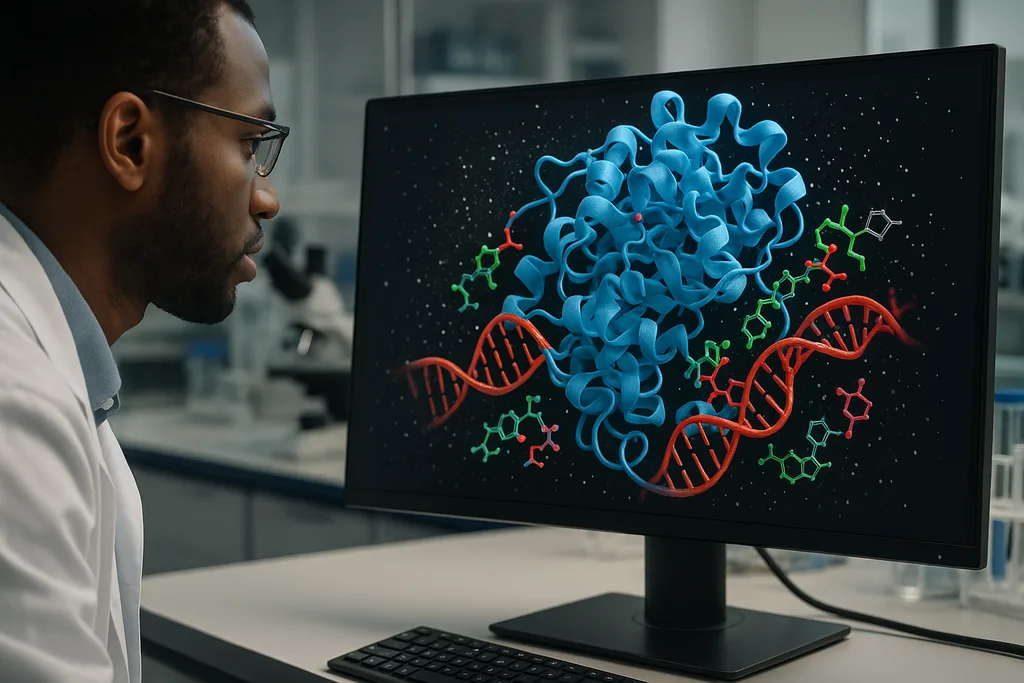
A molecular microscope arrives
When DeepMind and its partner Isomorphic Labs unveiled AlphaFold 3 in mid‑2024, they presented more than an incremental upgrade: they offered a way to see how the molecules of life fit and interact at atomic resolution, in silico and in seconds. For labs that once budgeted months for X‑ray crystallography, NMR or cryo‑EM campaigns, AF3’s promise is breathtaking — model entire protein complexes, antibodies bound to antigens, and small‑molecule ligands in a single pass, then iterate designs at computer speed. Reporters and industry groups quickly framed the release as a turning point for biomedical research and drug discovery.
What changed under the hood
AlphaFold 3 is not merely AlphaFold 2 with more tuning. Developers describe a conceptual shift: the model uses diffusion‑style generative methods together with new attention modules to construct full‑atom structures from noisy initial coordinates, rather than only refining backbone angles from evolutionary alignments. That architecture — sometimes summarized to the public as "starting from a cloud of atoms and polishing them into place" — lets AF3 predict interactions among proteins, nucleic acids, ions and small molecules in one unified pass, and to produce full‑atom docking geometries with much higher reported accuracy than earlier tools. Technical reviews and an early, peer‑reviewed survey of AF3’s performance describe tangible gains for protein–protein and protein–ligand modelling and show the system outperforming classical docking tools on a range of benchmarks.
Why structural prediction is a Nobel‑level achievement
AlphaFold’s lineage matters here. The 2024 Nobel Prize in Chemistry — announced on 9 October 2024 — formally recognized the scientific breakthrough of converting amino acid sequence into accurate 3‑D structure, awarding one half to Demis Hassabis and John Jumper of DeepMind for protein structure prediction and the other half to David Baker for computational protein design. That recognition was grounded in how rapidly AlphaFold‑class models transformed access to structural information: databases expanded to hundreds of millions of predicted structures and a wide swath of life sciences research adopted structure‑aware hypotheses and workflows. AlphaFold 3 builds on that legacy rather than replacing it.
Immediate scientific and commercial impacts
Across pharma, biotech and academic labs AF3’s effects are already visible. Drug discovery groups report shorter target‑validation cycles and a faster handoff from target hypothesis to candidate optimization when a structural hypothesis is available early. DeepMind’s industry collaborators — and large pharma groups named in reporting and analyst notes — have integrated AF3 outputs into lead‑finding and antibody engineering pipelines. A number of peer‑reviewed articles and technical reviews catalog use cases: mapping antigenic sites for vaccine design, surfacing small‑molecule binding pockets that classical docking missed, and resolving multi‑protein assemblies implicated in neurodegeneration. The claimed payoffs are real — time and cost savings in early stages of drug discovery — but they are not a substitute for wet‑lab validation. AF3 typically shortens iteration loops, it does not eliminate the need for biochemical or cellular confirmation.
Open science, competition and access
Limits, hallucinations and the need for experiments
No computational model is perfect, and AF3 has well‑documented failure modes. Disordered regions, mirror‑image conformers, post‑translational modifications and transient conformational ensembles are still hard to predict reliably; modelling dynamics remains distinct from predicting a dominant static structure. Independent reviews and the developers themselves warn that AF3 can produce high‑confidence but erroneous geometries — the phenomenon sometimes called "hallucination" — and that confidence metrics must be interpreted carefully. Peer‑reviewed assessments quantify these limits and show how performance varies across classes of targets, so sensible pipelines pair AF3 outputs with orthogonal experimental checks and molecular dynamics where possible.
Biosecurity and governance questions
As predictive power grows, so do questions about misuse. Recent technical studies and policy essays have tested whether state‑of‑the‑art interaction predictors reliably flag known viral host‑binding changes or other features associated with pathogenicity — with sobering results. Some evaluations show that current predictive filters, including PPI predictors, can miss experimentally validated interactions and therefore should not be treated as a standalone biosafety gate. Those gaps imply that governance should focus on layered responses: rapid experimental validation, surveillance of novel outputs, and careful access controls for dual‑use applications. Policymakers, funders and the scientific community are now wrestling with how to balance broad scientific benefit against the plausible risks introduced by more powerful design‑capable tools.
Where AF3 meets the lab
Economic and ethical contours
The road ahead
AlphaFold 3 marks a step toward a different relationship between computation and experiment — one in which fast, structure‑level hypotheses routinely guide wet‑lab work. That change matters because it shifts the friction points in biological discovery: instead of asking whether a structure can be solved, researchers will often ask which hypotheses, validated quickly by experiments, best justify investment in preclinical development. The next phase is likely to be hybrid: better predictive models, standardized validation pipelines, shared benchmarks and governance frameworks that make it possible to realize AF3’s benefits while containing risks. How that balance is struck will determine whether the arrival of AF3 becomes a singularity that democratizes biology, or an inflection point that accelerates concentration of power in a few corporate and institutional hands.
For scientists, funders and regulators, the sensible posture is neither techno‑euphoria nor technophobia but conditional adoption: use AF3 to explore and accelerate, and invest at least as much in reproducible experiments, safety assessment and equitable access as is invested in chasing headline performance metrics.
Sources
- Royal Swedish Academy of Sciences / Nobel Prize (press release: The Nobel Prize in Chemistry 2024)
- Precision Clinical Medicine (Z. Fang et al., "AlphaFold 3: an unprecedent opportunity for fundamental research and drug development", 2025)
- Google DeepMind and Isomorphic Labs technical and press materials on AlphaFold 3
- ArXiv (technical biosecurity analysis of protein–protein interaction predictors)
- University of Washington (David Baker / Rosetta research and computational protein design literature)




Comments
No comments yet. Be the first!