When grey returned to the headlines
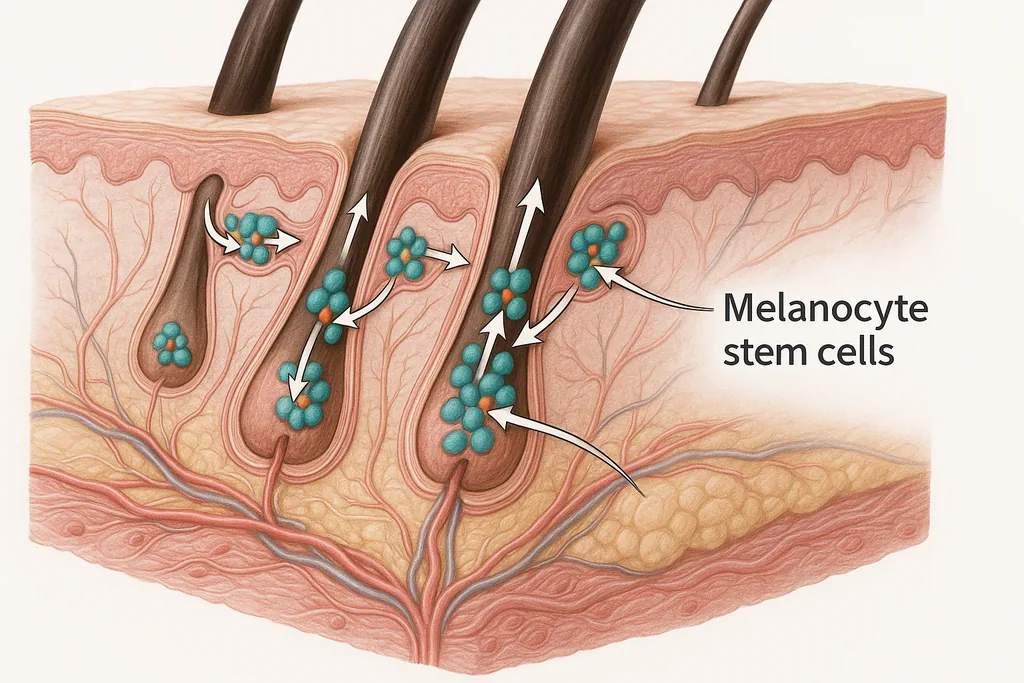
"Gray hair reversible: breakthrough" has been the shorthand on many sites this week — and there is a real, concrete scientific story behind the spin. Laboratories studying the biology of hair colour now describe two distinct cellular paths that lead to white or grey hair: one in which pigment‑making cells are effectively trapped inside the follicle and could, in principle, be freed and persuaded to repigment hair; and another in which those pigment stem cells are exhausted or eliminated, making reversal far harder. These insights — built from live imaging, single‑cell sequencing and lineage tracing in mice — have pushed the question of whether gray hair is reversible: breakthrough into serious biomedical territory.
gray hair reversible: breakthrough — a new model of trapped stem cells
How stress, depletion and exhaustion change the picture
The more optimistic model sits alongside a complementary body of work showing that greying can also stem from depletion. A separate line of research traced how severe or prolonged stress activates the sympathetic nervous system and, through a cascade of chemical signals, forces melanocyte stem cells to differentiate prematurely and be lost. That process — effectively burning through the stem‑cell reserve — creates permanent grey in the affected hairs because the stem‑cell pool has been reduced. In short, there are at least two biologically distinct routes to grey hair: cells that are trapped and potentially recoverable, and cells that are consumed and therefore much harder to replace.
What the experiments actually showed
Most of the mechanistic work so far comes from mouse models with powerful live‑imaging and single‑cell genomics. Researchers used fluorescent labelling to follow individual McSCs through hair‑growth cycles, then combined those observations with gene‑expression snapshots to show how location within the follicle correlates with differentiation state. The Nature paper documented that the fraction of follicles containing stranded McSCs rose with repeated regeneration and ageing, and that those stranded cells were not contributing to pigment regeneration. Crucially, the authors demonstrated the molecular logic that makes the germ compartment pro‑pigment (WNT‑high) while the bulge is WNT‑low and permissive for a stem state — meaning repositioning would change the cells’ fate.
gray hair reversible: breakthrough — limits, risks and species gaps
That mechanistic clarity explains why headlines trumpet reversibility, but it does not mean a ready‑made remedy exists today. All core experiments showing rescue or the possibility of repigmentation have been done in rodents. Mouse and human hair differ in cycle timing, follicle architecture and the size of stem‑cell pools; translating a targeted intervention from mouse skin to human scalps is nontrivial. There are also safety trade‑offs: some recent work has shown that the choices made by melanocyte stem cells under stress are linked to cancer biology. A separate series of studies has reported that certain DNA‑damage responses push McSCs into an irreversible differentiation and removal program that seems to protect against melanoma, while other stresses can allow damaged cells to persist and expand — a route to cancer. Any therapy that reactivates or moves stem cells must therefore be interrogated for oncogenic risk.
What might a treatment look like?
Based on the molecular picture, researchers imagine several plausible technical approaches — none of them clinically available yet. One is to target the signalling environment inside the follicle, for example by locally increasing WNT activity at the right time so stranded McSCs receive the cue to mature and produce melanocytes. Another is to modulate the adhesion and motility machinery of McSCs so they re‑enter the germ compartment. Cell‑therapy approaches could also be imagined: expanding patient McSCs ex vivo and reintroducing them to pigmentless follicles. Each route presents delivery and timing challenges (hair cycles are episodic) and safety checks (long‑term tracking for malignant transformation). The science points to mechanisms rather than ready cures.
Practical questions people ask
Can gray hair really be reversed according to the latest anti‑ageing breakthrough? The short answer is: possibly, but not yet for people. The experimental data show a mechanism that could be exploited to repigment hair in animals, and researchers explicitly note that restoring McSC movement could prevent or reclaim pigment in follicles — but human trials and safety work are still required.
Are there proven treatments that can turn gray hair back to its natural colour? Not yet. Cosmetic colours and dyes remain the only routine, proven option for masking grey. The new biology opens a credible path to biological therapies, but those would need to pass many preclinical and clinical safety hurdles before they reach salons or clinics.
Where the field goes next
Researchers are pursuing several directions in parallel. Some teams are probing precisely which motility and adhesion molecules determine McSC positioning; others are testing whether transient modulation of WNT signalling can coax repigmentation without long‑term side effects. At the same time, groups studying stress responses and DNA damage pathways are clarifying why some McSCs are lost forever while others are merely mislocated. That dual track — restoring mobility versus preventing depletion — is the realistic roadmap toward interventions that could one day reverse or slow greying.
For people watching the headlines, the practical takeaway is cautious optimism: the idea that gray hair might be reversible is now anchored in real stem‑cell biology, but the gap between mechanistic insight and a safe, effective human therapy remains substantial. Researchers emphasize both promise and prudence: any attempt to redesign the fate of pigment stem cells must be weighed against the very real cellular safeguards that evolved to limit cancer risk.
Sources
- Nature (Dedifferentiation maintains melanocyte stem cells in a dynamic niche — Sun, Lee, Hu et al., 2023)
- NYU Grossman School of Medicine / NYU Langone research materials
- National Institutes of Health (NIH) research briefing on melanocyte stem cells
- Nature Cell Biology (Antagonistic stem cell fates under stress — University of Tokyo, 2025)
- The Institute of Medical Science, The University of Tokyo press materials




Comments
No comments yet. Be the first!