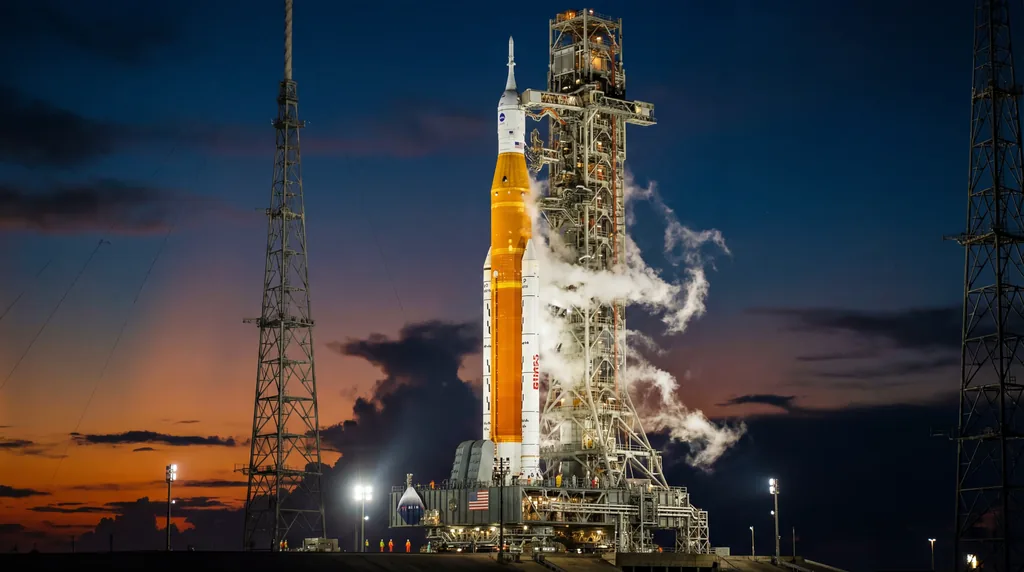

NASA teams are entering a critical validation phase for the Artemis II mission with the commencement of a second Wet Dress Rehearsal (WDR) this week. This comprehensive 50-hour simulation serves as the ultimate stress test for the Space Launch System (SLS) and Orion spacecraft before they carry a human crew to the Moon for the first time since 1972. The mission represents a pivotal moment in the Artemis program, transitioning from uncrewed testing to active human exploration of deep space.
What caused the first Artemis II WDR to have issues?
The first Artemis II Wet Dress Rehearsal encountered a critical liquid hydrogen leak at the Tail Service Mast Umbilical (TSMU) interface, which triggered an automatic termination of the countdown at the T-5:15 mark. Technical teams also identified challenges with an Orion hatch pressurization valve and experienced audio communication dropouts during the February 2 simulation.
Technical discrepancies during the initial rehearsal led Launch Director Charlie Blackwell-Thompson to pause operations to prioritize flight safety. Engineers found that while the tanks eventually reached the required propellant levels, the leakage at the interface between the rocket and the mobile launcher was too significant to proceed with the terminal count. Since that event, NASA technicians have replaced the seals at the TSMU and conducted extensive data reviews to ensure the hardware is resilient enough for the upcoming 50-hour test cycle, which begins Tuesday evening.
How does WDR prepare for the actual Artemis II launch?
The Wet Dress Rehearsal prepares for the Artemis II launch by simulating the full 50-hour countdown, including the loading of super-cold liquid hydrogen and liquid oxygen into the rocket. This "tanking" process allows NASA to verify the integrity of the Space Launch System and ground support equipment under actual cryogenic conditions without igniting the engines.
Verification of the Automated Launch Sequencer (ALS) is a primary goal of this second rehearsal. During the final 10 minutes of the countdown—the terminal count—ground controllers will practice a three-minute hold and then recycle the clock to simulate a new launch time within the same window. This flexibility is essential for Human Spaceflight, as it allows the team to troubleshoot minor issues on launch day without scrubbing the entire mission. The test will culminate in a simulated cutoff at the T-33 second mark, just before the rocket’s flight computers would normally take autonomous control.
Is March 6 the earliest launch date for Artemis II?
March 6, 2026, is currently the earliest official launch opportunity for the Artemis II mission, as confirmed by NASA officials following the rescheduling of the second Wet Dress Rehearsal. While external stakeholders previously discussed the possibility of a March 3 window, the agency has opted to maintain the March 6 target to ensure all test data is thoroughly analyzed.
The mission timeline is strictly dictated by the orbital alignment of the Earth and the Moon. NASA Administrator Jared Isaacman noted that while earlier dates were briefly considered, the priority remains the successful completion of the WDR on February 19. If the rehearsal meets all success criteria, the Space Launch System will remain at Launch Complex 39B at the Kennedy Space Center to prepare for the March 6 window, which provides the optimal trajectory for the crew’s lunar flyby and subsequent return to Earth.
Will the Artemis II astronauts participate in the WDR?
The Artemis II astronauts—Reid Wiseman, Victor Glover, Christina Koch, and Jeremy Hansen—do not typically board the Orion spacecraft during the Wet Dress Rehearsal due to the hazards associated with loading over 700,000 gallons of cryogenic propellant. Instead, the test focuses on the synchronization of ground systems and the rocket’s internal hardware and software.
While the crew is not physically inside the capsule during the fueling process, they are deeply involved in the procedural aspects of the mission. The four astronauts, representing both NASA and the Canadian Space Agency, have completed rigorous training for the "free-return" trajectory they will follow. This specific flight path is a safety protocol designed to ensure that the Orion spacecraft will naturally pull back toward Earth using lunar gravity, even if the primary propulsion system fails. This "test flight" mentality is why the WDR is treated with such high-stakes precision by the ground teams.
Technical Objectives and the Road to Artemis III
Successful completion of this week's Artemis II rehearsal is the final major hurdle before NASA can commit to the first crewed Lunar Exploration mission of the 21st century. The agency is utilizing lessons learned from the Artemis I mission in 2022, which faced similar hydrogen leak challenges and required multiple rehearsals before its successful uncrewed flight. By refining these "tanking" procedures now, NASA reduces the risk of long-term delays that could impact the 2028 target for Artemis III, the mission intended to land humans on the lunar surface.
- Critical Milestone 1: Loading of liquid hydrogen and liquid oxygen into the SLS core stage and the Interim Cryogenic Propulsion Stage (ICPS).
- Critical Milestone 2: Successful execution of a three-minute hold at T-1:30 in a launch-ready state.
- Critical Milestone 3: Hand-off to the Automated Launch Sequencer at T-33 seconds to verify autonomous software logic.
- Critical Milestone 4: Successful "recycle" of the countdown to demonstrate launch window flexibility.
The second Artemis II WDR is scheduled to reach its simulated launch window at 8:30 pm ET on Thursday. NASA will provide a livestream of the event, allowing the public to monitor the progress of the propellant loading through graphic displays and scrolling updates. This methodical approach to testing reflects NASA's commitment to safety as they prepare to send humans 230,000 miles from Earth, marking the beginning of a new era in deep space discovery.




Comments
No comments yet. Be the first!