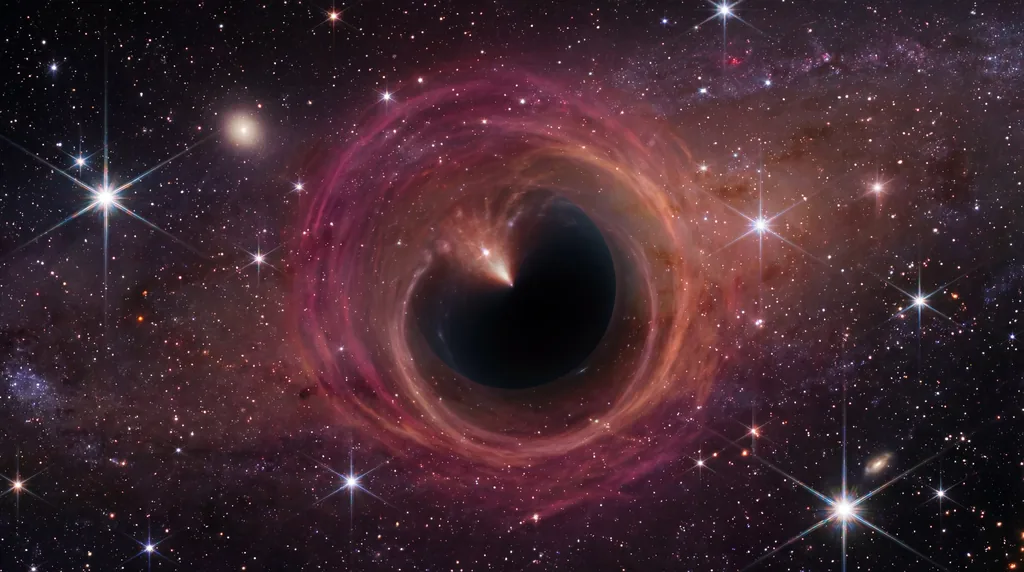

Astronomers have recently documented the quiet birth of a black hole in the neighboring Andromeda galaxy after observing a massive star, M31-2014-DS1, vanish without the characteristic brilliance of a supernova. This rare astronomical event, often called a "failed supernova," provides critical observational evidence for a stellar death where the core collapses directly into a singularity. By analyzing nearly two decades of archival data, researchers have reconstructed a timeline that suggests not all massive stars end their lives in a violent explosion, but some may simply blink out of existence.
What is a failed supernova?
A failed supernova is a rare stellar event where a massive star undergoes core collapse but fails to produce a bright explosion, instead directly forming a black hole as the star's outer layers fall inward. Unlike typical Type II supernovae, the internal shock wave is insufficient to eject the stellar material, causing the star to fade and disappear quietly from visible light.
Stellar evolution models have long predicted that a significant percentage of massive stars—perhaps as many as 20% to 30%—might end their lives this way. In a standard supernova, the core's collapse triggers a rebound shockwave that blasts the star's outer layers into space, creating a flash that can outshine a galaxy. In a failed supernova, however, the gravity of the forming black hole is so immense that it overcomes the outgoing pressure, swallowing the majority of the star’s mass and leaving only a faint infrared signature behind.
How did astronomers discover the quiet black hole formation in Andromeda?
Astronomers discovered the quiet black hole formation in Andromeda by monitoring the massive star M31-2014-DS1, which was initially bright but dramatically dimmed from 2016 to 2019 and vanished completely by 2023. By utilizing nearly 20 years of archival data from NASA’s NEOWISE mission and ground-based observatories, researchers tracked the star's unique transition from a luminous source to an invisible point.
The research team, whose findings were published in the journal Science on February 16, 2026, relied heavily on the Near-Earth Object Wide-field Infrared Survey Explorer (NEOWISE). This infrared archive allowed the team to see through the dust of the Andromeda galaxy, located 2.5 million light years away, and record a specific brightening event in 2014. This infrared spike signaled that the star was shedding its outermost layers just before its core ran out of nuclear fuel, a crucial "before-and-after" record that is rarely captured in real-time.
- 2005–2014: The star remained in a stable, high-luminosity state as a massive variable star.
- 2014: A sudden increase in infrared brightness indicated the expulsion of a thick shell of gas.
- 2016–2023: Optical light plummeted by a factor of 10, rendering the star invisible to traditional telescopes.
- Late 2023: Only a lingering, faint infrared glow remained from the heated dust surrounding the collapse site.
What evidence proves a black hole formed from M31-2014-DS1?
Evidence for black hole formation from M31-2014-DS1 includes its sustained fading to a tiny fraction of original brightness without any luminous outburst, indicating a core collapse where the majority of the mass imploded. A lingering faint infrared glow from dust-obscured hot gas orbiting the new singularity supports the conclusion that the star's core has become a compact object.
The absence of a traditional supernova "light echo" is the strongest indicator of a failed explosion. When a star like M31-2014-DS1 collapses, the gravitational energy released usually powers a massive blast. However, in this instance, the material fell back inward under the star's own gravity. According to the study supported by NASA’s Astrophysics Data Analysis Program, the resulting object is estimated to be a black hole of approximately 6.5 solar masses. This matches theoretical models of "quiet" deaths where the core collapses directly because the internal energy supply is exhausted and cannot support the star's weight.
Infrared astronomy proved essential in this discovery because it could detect the "veil" of hot gas and dust left behind. While the star disappeared in the optical spectrum, the NEOWISE data showed that the debris cloud was still being heated from within. This heat suggests that while the star's surface is gone, a massive, dense object remains at the center, continuing to interact with the surrounding material through intense gravity.
Implications for Galactic Evolution and Future Research
The discovery of M31-2014-DS1 suggests that these "quiet" endings for stars may be more common than previously recognized in our local universe. If a substantial portion of massive stars bypass the supernova stage, it would explain why astronomers find fewer supernova explosions than theoretical birth rates of massive stars suggest. This "missing" population of supernovae could be accounted for by stars that simply collapse into a black hole without the expected fireworks.
Moving forward, the success of this study highlights the immense value of long-term sky surveys and curated data archives. As new facilities like the Vera C. Rubin Observatory come online, astronomers expect to identify more failed supernova candidates. By building a more complete census of these events, scientists can better understand the mass distribution of black holes and the complex life cycles of the most massive objects in the cosmos. For now, the vanishing star in Andromeda stands as one of the clearest observational cases of a star failing to explode, yet successfully transforming into a black hole.




Comments
No comments yet. Be the first!