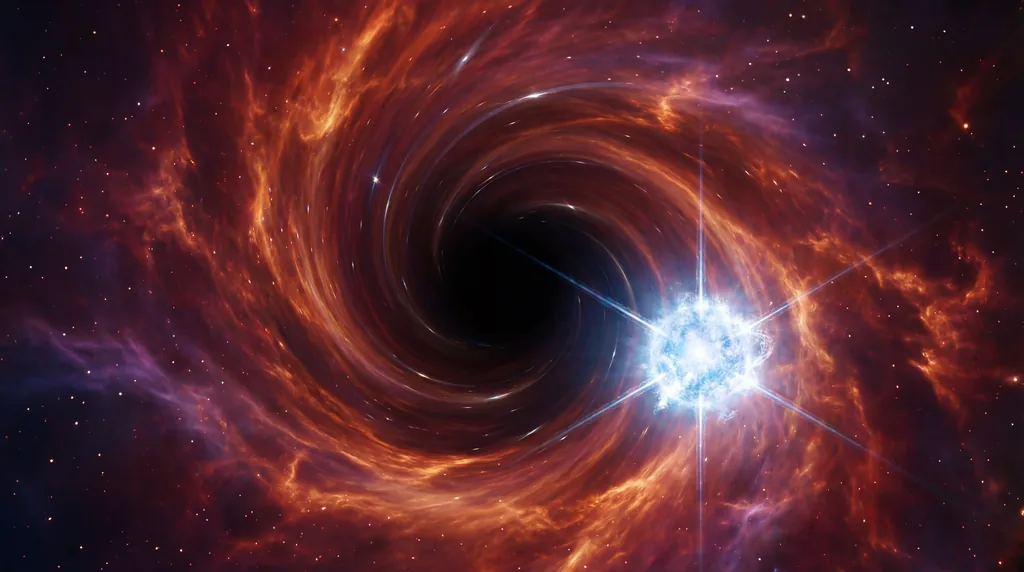

M31-2014-DS1 is a massive, hydrogen-depleted supergiant star in the Andromeda Galaxy that brightened in mid-infrared light in 2014, then faded dramatically by factors of over 10,000 in optical light by 2023, becoming undetectable. Observations indicate its core collapsed directly into a stellar-mass black hole in a failed supernova event, leaving a faint infrared glow from surrounding dust and gas. This "astronomical unicorn" provides the strongest observational record yet of a star bypassing a cataclysmic explosion to enter its final evolutionary state.
The discovery, published in the journal Science on February 12, 2026, occurred serendipitously during a broad study of the Andromeda Galaxy. Lead author and astrophysicist Kishalay De, a professor at Columbia University and researcher at the Flatiron Institute, initially intended to study stars under infrared light. Instead, his team encountered an unusual stellar object that brightened before dimming into total invisibility, sparking a decade-long investigation into the nature of stellar death and black hole formation.
Why did this star fail to explode as a supernova and form a black hole?
The star failed to explode as a supernova because its neutrino-driven shockwave was too weak to eject the outer envelope, causing the core to collapse inward under gravity. As a hydrogen-depleted star with an initial mass around 13 solar masses, it experienced a cessation of nuclear fusion, leading to a direct implosion into a black hole without the typical supernova outburst. This phenomenon is often referred to by astronomers as a "failed supernova."
Standard stellar evolution models suggest that massive stars should end their lives in a dazzling explosion known as a supernova, which disperses heavy elements across the cosmos. However, in the case of M31-2014-DS1, the internal pressure generated by the core was insufficient to overcome the immense gravitational pull of its own mass. Rather than a violent outward blast, the star’s layers were essentially swallowed by the forming singularity, a process that challenges our current census of how many black holes exist in the local universe.
According to De, the star exhibited what he describes as a "dying gasp" before its disappearance. As the star approached its end, it shed its outer layers, creating a temporary increase in brightness in the infrared spectrum. This specific signature—an infrared brightening followed by a total optical blackout—now serves as a roadmap for identifying other stars undergoing direct collapse into a black hole without the traditional fireworks of a supernova.
How did researchers confirm the disappearance of M31-2014-DS1?
Researchers utilized long-term archival data from NASA’s NEOWISE mission and the Hubble Space Telescope to track the star's sudden transition from a visible supergiant to a vanished object. By analyzing a decade of infrared and optical records, they were able to rule out alternative theories such as stellar obscuration by moving dust clouds. The data showed a permanent loss of luminosity across multiple wavelengths, confirming a total structural collapse.
The study leveraged the proximity of the Andromeda Galaxy, located approximately 2.5 million light-years from Earth. Because the galaxy is our closest neighbor, the observations were significantly brighter and easier to examine than previous candidates for failed supernovae. This proximity allowed the team to piece together a comprehensive history of the star, which Daniel Holz, a University of Chicago astrophysicist, likened to finding "baby pictures" of a cosmic event after the fact.
- NASA NEOWISE: Provided critical mid-infrared data showing the star's final thermal signatures.
- Hubble Space Telescope: Confirmed the absence of the star in visible light after 2023.
- Ground-based Observatories: Monitored the Andromeda Galaxy for sudden changes in stellar populations.
The methodology focused on the infrared brightening associated with the shedding of the star's envelope. By looking for these "failed" signatures rather than the bright flashes of traditional supernovae, the team discovered that they could identify black hole formations that would otherwise go unnoticed. This shift in methodology suggests that many black holes may be hiding in plain sight, having formed silently throughout the history of the galaxy.
Will JWST observations confirm the black hole formation?
JWST observations have not been officially confirmed as part of the published findings, though the telescope’s high-sensitivity infrared instruments are ideal for detecting any lingering thermal glow. While current evidence from NEOWISE and Hubble provides strong indirect support for a black hole, direct confirmation through the detection of an accretion disk or residual heat from the surrounding gas remains a target for future study. The James Webb Space Telescope could provide the definitive proof needed to close the case.
The role of the James Webb Space Telescope (JWST) in this field is transformative, as its ability to peer through cosmic dust allows scientists to see what optical telescopes cannot. For M31-2014-DS1, JWST could potentially detect the "dying embers" of the star—the faint heat radiated by the gas and dust that did not fall into the event horizon. Finding this specific infrared signature would provide an unprecedented look at the immediate aftermath of a direct collapse event.
Despite the lack of current JWST data in the initial report, the scientific community remains optimistic. The serendipitous nature of the discovery means that the coordinates for M31-2014-DS1 are now high-priority targets for deep-space imaging. Confirming the existence of a quiet, stellar-mass black hole where a massive star once stood would validate decades of theoretical physics regarding the mass limits of stellar stability.
What are the broader implications for black hole evolution?
This discovery suggests that the landscape of stars capable of turning into black holes is much wider than previously anticipated by the scientific community. M31-2014-DS1 was found to be approximately five times the mass of the Sun at the time of its death—roughly half the size that current models nominally expect for a direct collapse candidate. This finding implies that smaller, less massive stars may also be bypassing the supernova phase.
The implications for stellar evolution models are significant. If a larger percentage of stars collapse directly into black holes, it explains the "missing supernova" problem, where astronomers observe fewer explosions than the number of massive stars disappearing from view would suggest. It also means that the total population of black holes in galaxies like the Milky Way and Andromeda may be significantly higher than previously estimated.
Future research will now focus on identifying more of these "astronomical unicorns" in nearby galaxies. By monitoring the infrared spectrum for sudden flares followed by permanent dimming, astrophysicists hope to build a more accurate census of the universe's most mysterious objects. As Kishalay De noted, this research "points us to a completely new method of identifying the disappearance of stars," ensuring that the silent birth of a black hole will no longer go unnoticed.




Comments
No comments yet. Be the first!