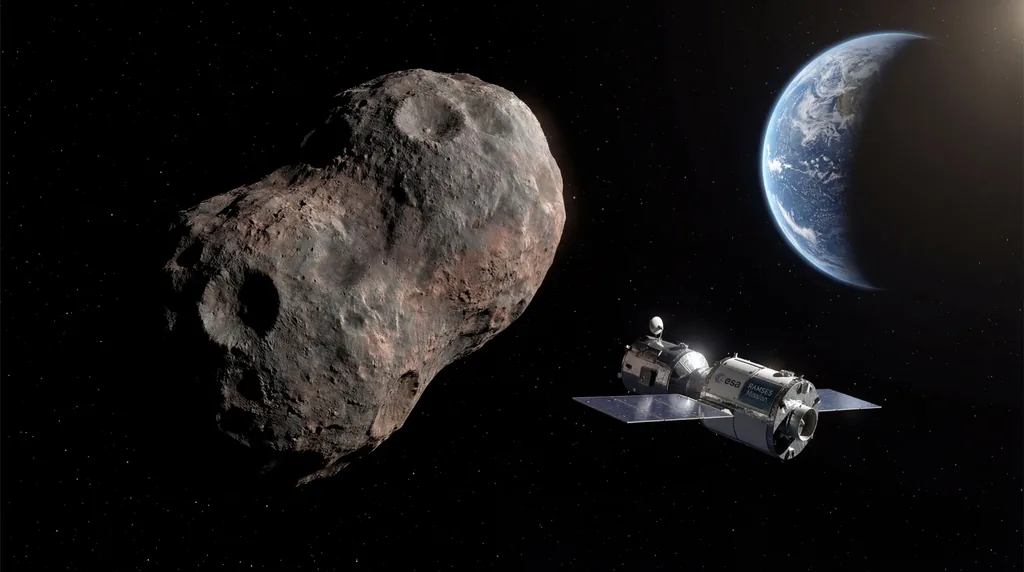

Asteroid Apophis is not a threat to Earth in 2029, as high-precision calculations by NASA and the European Space Agency (ESA) have definitively ruled out any impact risk for at least the next century. On April 13, 2029, the 375-meter-wide asteroid will pass within 32,000 kilometers of our planet—closer than geostationary satellites—providing a safe but unprecedented opportunity for scientific observation and planetary defense testing. To capitalize on this rare event, ESA officially signed a €81.2 million contract with OHB Italia on February 10, 2026, to begin the construction of the Ramses spacecraft.
What is the Ramses mission?
The Rapid Apophis Mission for Space Safety (Ramses) is an ESA-led initiative designed to rendezvous with Asteroid Apophis before its historic 2029 flyby. By deploying a specialized spacecraft and two miniature CubeSats, the mission aims to document the asteroid’s physical characteristics and monitor how Earth’s gravitational pull alters its structure and orbital path in real-time. This mission represents a significant leap in Europe’s Planetary Defense capabilities and international scientific cooperation.
International collaboration serves as the backbone of the Ramses mission, merging European industrial expertise with global space agency resources. The mission is a joint endeavor between ESA and the Japan Aerospace Exploration Agency (JAXA), with JAXA providing critical hardware such as solar arrays and a thermal infrared imager. This partnership ensures that the data collected will be shared across the global scientific community, enhancing our collective ability to respond to future Near-Earth Object (NEO) threats.
Economic investment in the mission has reached significant milestones following the recent contract signing at ESA’s ESTEC technology centre. The new agreement with OHB Italia brings the total mission value to approximately €150 million, building upon preparatory work initiated in 2024. This funding facilitates the immediate transition into the spacecraft construction, assembly, and testing phase, ensuring the mission stays on track for its 2028 launch window.
How will Ramses study Asteroid Apophis during its close approach?
Ramses will study Asteroid Apophis by utilizing a suite of advanced remote-sensing instruments and two deployable CubeSats to perform a comprehensive "before and after" analysis of the asteroid's surface. These tools will detect "asteroid-quakes," surface landslides, and changes in rotation caused by Earth’s tidal forces during the encounter. These observations provide a natural laboratory to see how external forces reshape a celestial body.
Specialized payloads are a core component of the mission's scientific strategy, including the Farinella CubeSat. On February 10, 2026, ESA signed an €8.2 million contract with Tyvak International for the construction of this small satellite, named after Italian planetary scientist Paolo Farinella. These CubeSats will operate in close proximity to the asteroid, offering high-resolution data and diverse perspectives that the main spacecraft cannot achieve alone.
Structural analysis of the asteroid will be conducted using the spacecraft’s onboard imaging and spectroscopic tools. Scientists are particularly interested in the internal structure of Apophis, which is believed to be a "rubble pile" held together by gravity. As Earth’s gravity tugs on the asteroid, Ramses will measure shifts in its mass distribution, providing critical data for future asteroid deflection strategies, such as kinetic impactors or gravity tractors.
The Ramses Mission Timeline and Development
The mission timeline for Ramses is uniquely accelerated to meet the strict deadline imposed by the asteroid's orbital mechanics. Following the successful completion of the Critical Design Review (CDR) on February 6, 2026, the project has moved into full-scale production. Paolo Martino, Ramses mission manager, noted that the accelerated pace is a testament to the engineering vision and commitment of the industrial teams involved.
- October 2024: Preliminary contracts signed to begin preparatory mission design.
- February 6, 2026: Successful completion of the Critical Design Review (CDR).
- February 10, 2026: Formal contract signature with OHB Italia for spacecraft construction.
- Spring 2028: Planned launch window to ensure rendezvous with Apophis before the flyby.
- April 13, 2029: Closest approach of Asteroid Apophis to Earth.
Spacecraft assembly will dominate the schedule over the next twelve months, focusing on the integration of the main bus and scientific payloads. Rigorous environmental and functional tests will follow, simulating the harsh conditions of deep space. This phase is critical to ensuring that the spacecraft can withstand the dynamic gravitational environment it will encounter as it shadows Apophis during its passage through Earth's neighborhood.
Planetary Defense and Global Cooperation
Planetary defense strategies will be significantly refined using the data gathered by the Ramses mission. By understanding how an asteroid responds to tidal forces, mission planners can better predict the behavior of other potentially hazardous objects. Orson Sutherland, Mars & Beyond Projects Group Leader at ESA, emphasized that Ramses is a "once-in-a-lifetime opportunity" to deepen our understanding of Near-Earth Objects and advance protection capabilities.
Synergy with NASA missions provides an additional layer of scientific value, particularly through coordination with OSIRIS-APEX. While Ramses will arrive at Apophis before the flyby to witness the "before" state, the NASA mission will study the asteroid shortly after its encounter. Together, these missions will provide the most complete picture of Asteroid Apophis ever recorded, establishing a baseline for how solar system bodies evolve over time.
European industrial excellence is highlighted through the involvement of companies like OHB Italia and Tyvak International. According to Roberto Aceti, CEO of OHB Italia, the contract reflects confidence in European expertise to deliver complex space systems under demanding schedules. This mission not only protects the planet but also strengthens the European space sector's competitive edge in robotic exploration and small-satellite technology.
Future Outlook: What's Next for Ramses?
The future of the Ramses mission involves a transition from theoretical design to physical reality as hardware components begin to arrive at integration facilities. Over the coming years, the focus will shift toward mission operations and the final launch preparations. As the 2029 date approaches, global interest is expected to peak, making Apophis a focal point for international asteroid awareness and education efforts.
Scientific legacy from this mission will likely last for decades, providing a "gold standard" dataset for asteroid modeling. Beyond the immediate findings, Ramses proves that space agencies can respond rapidly to celestial events, a capability that is essential for reacting to newly discovered threats. As the team moves forward, the successful execution of Ramses will stand as a landmark achievement in space safety and the preservation of our planetary environment.




Comments
No comments yet. Be the first!