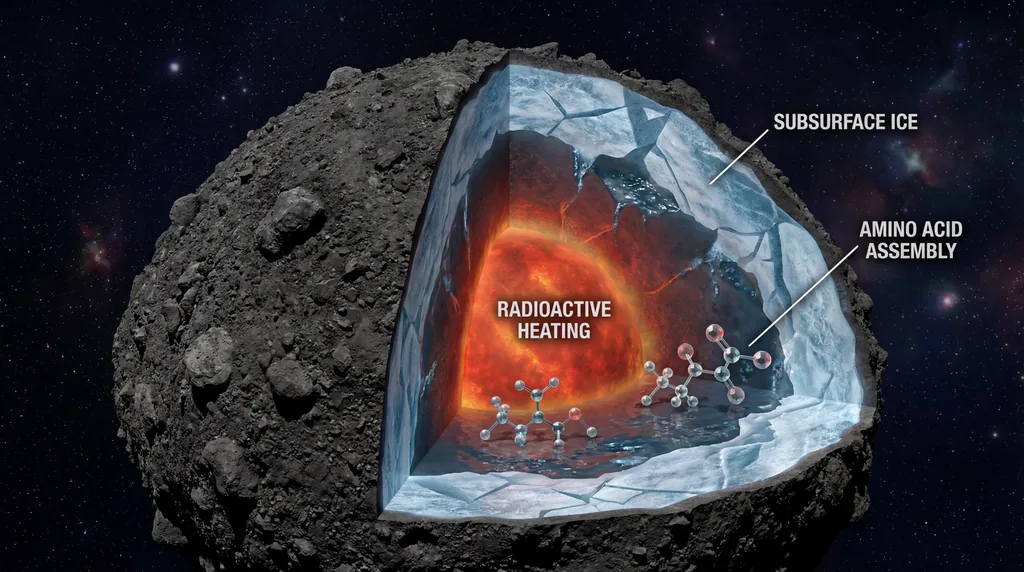

NASA’s OSIRIS-REx mission returned samples from Asteroid Bennu in 2023, providing a pristine chemical record of the early solar system that continues to yield groundbreaking insights. A new study led by researchers at Penn State University, published on February 10, 2026, reveals that amino acids found in these samples likely formed in icy, radioactive environments rather than the warm liquid water environments previously theorized. This discovery fundamentally alters our understanding of prebiotic chemistry, suggesting that the foundational building blocks of life can emerge in the cold, harsh reaches of space through ionizing radiation.
Why do Bennu amino acids suggest an icy radioactive origin instead of liquid water?
Asteroid Bennu contains amino acids like glycine with isotopic signatures that indicate formation within irradiated ice in the cold outer solar system, rather than the liquid-water-rich environments seen in meteorites like Murchison. While traditional theories rely on Strecker synthesis—which requires liquid water, hydrogen cyanide, and ammonia—the isotopic fingerprints in Bennu’s glycine suggest that ionizing radiation from short-lived radionuclides drove chemical reactions within a frozen matrix. This indicates that the early solar system hosted multiple distinct chemical pathways for organic synthesis.
The research team, led by co-authors Allison Baczynski and Ophelie McIntosh, utilized specialized instrumentation at Penn State to perform high-precision isotopic measurements on very low abundances of organic compounds. They discovered that the chemical makeup of Bennu is markedly different from well-studied carbon-rich meteorites like the Murchison meteorite, which fell in Australia in 1969. While Murchison shows evidence of formation in mild temperatures with liquid water, Bennu’s signatures point toward a much colder, more volatile-rich history in the solar system's outer regions.
Is the discovery of glycine in Bennu samples evidence of extraterrestrial life?
No, the discovery of glycine in samples from Asteroid Bennu is not evidence of extraterrestrial life; it is evidence of prebiotic chemistry, the non-biological process that creates the building blocks of life. Glycine is the simplest amino acid and is considered a precursor molecule that forms abiotically in space environments, such as on the surfaces of interstellar dust grains or within asteroid interiors. While it is an essential component for proteins, its presence indicates a chemical potential for life rather than the existence of biological organisms.
One of the most intriguing aspects of the study was the analysis of glutamic acid. The researchers uncovered an unexpected isotopic difference between the two mirror-image forms, or enantiomers, of this amino acid. In biological systems on Earth, life almost exclusively uses "left-handed" amino acids. In the Bennu samples, the "left" and "right" handed forms showed strongly contrasting nitrogen values, a discrepancy that remains unexplained and is a primary focus of ongoing investigation. This anomaly further reinforces the idea that these molecules formed through complex, non-biological radiation-driven processes.
What does the Bennu discovery mean for the origin of life on Earth?
The discovery on Asteroid Bennu means that life's building blocks could form in a much wider variety of extraterrestrial environments than previously believed, including icy and radioactive zones. This supports the theory that prebiotic ingredients were delivered to the early Earth via impacts, providing a "kit" of organic molecules that could jump-start biological evolution. It suggests that the early solar system was a diverse laboratory, producing the seeds of life in both warm, aqueous environments and frozen, radiation-blasted regions.
By identifying these diverse formation pathways, scientists are rethinking the "habitable zone" concept. Traditionally, habitability is defined by the presence of liquid water; however, the Penn State research suggests that chemical potential can be generated even in the absence of heat. This implies that icy moons and distant asteroids could be far more significant in the story of life’s origins than originally thought. The resilience of these molecules indicates that the precursors to life are robust enough to survive the violent transport from the outer solar system to the inner terrestrial planets.
The Role of Radioactive Decay in Organic Synthesis
The study highlights the critical role of short-lived radionuclides, which provided the energy necessary for chemical synthesis in the early solar system. In the absence of solar warmth, the decay of radioactive isotopes within the asteroid's parent body served as a localized power source. This ionizing radiation interacted with interstellar ices—frozen mixtures of water, carbon monoxide, and ammonia—to trigger the formation of complex organics like glycine. Key findings regarding this process include:
- Radiation vs. Heat: Ionizing radiation can break chemical bonds and create reactive radicals even at temperatures near absolute zero.
- Isotopic Mass: The team measured slight differences in atomic mass to distinguish between molecules formed in ice versus those formed in water.
- Chemical Diversity: The findings suggest that different regions of the solar nebula produced distinct chemical "flavors" of organic matter.
Space Weather Context and Modern Observations
Interestingly, the release of this research on February 10, 2026, coincided with significant space weather events that mirror the high-energy environments studied in the Bennu samples. A G1-class (Moderate) geomagnetic storm was recorded with a Kp-index of 5, causing vivid auroras across high-latitude regions. These modern interactions between solar radiation and planetary atmospheres serve as a contemporary reminder of how radiation-driven chemistry continues to influence our solar system. Visible regions for this aurora included:
- Fairbanks, Alaska: Latitude 64.8, optimal viewing overhead.
- Reykjavik, Iceland: Latitude 64.1, high intensity.
- Tromsø, Norway: Latitude 69.6, clear visibility in northern Europe.
- Stockholm, Sweden and Helsinki, Finland: Visible near the northern horizon.
Future Directions for Astrobiology
Looking forward, the research team plans to extend their isotopic analysis to a broader set of meteorites to determine if the icy-radioactive signature found in Asteroid Bennu is a common feature of the early solar system. By comparing these results with upcoming samples from other missions, such as the Martian Moon eXploration (MMX) or future icy moon probes, scientists hope to map the distribution of organic matter across the cosmos. This mapping will refine our models of how the building blocks of life are scattered across planetary systems.
The analysis of the OSIRIS-REx samples has only just begun to reveal the chemical history of our celestial neighborhood. As a pristine time capsule, Bennu provides an unaltered look at the conditions that existed 4.5 billion years ago. The discovery that amino acids can form in frozen, radioactive environments suggests that the universe may be much more fertile for the precursors of life than we ever imagined, moving the search for origins from "following the water" to "following the chemistry."




Comments
No comments yet. Be the first!