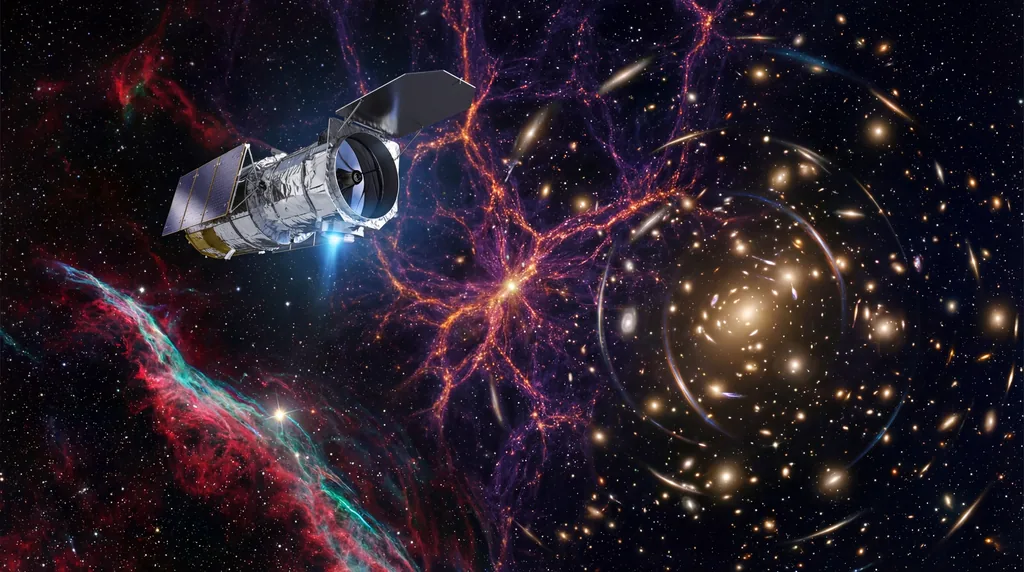

The Nancy Grace Roman Space Telescope features a field of view at least 100 times larger than the Hubble Space Telescope’s infrared instruments, enabling it to capture the equivalent of 100 Hubble-quality images in a single observation. While Hubble provides deep "keyhole" views of the cosmos, Roman’s Wide Field Instrument can image areas 1⅓ times the size of the full Moon in a single shot. This unprecedented scale allows Roman to survey more of the sky in its first five years than Hubble has in over three decades of operation.
NASA is currently preparing for the launch of this next-generation observatory, scheduled to transition from Earth to deep space as soon as late 2026. Named after Dr. Nancy Grace Roman, NASA’s first chief astronomer and the "Mother of Hubble," the mission is specifically designed to solve the greatest mysteries of modern physics: Dark Matter and dark energy. By mapping the large-scale structure of the universe with panoramic precision, Roman will provide the statistical power necessary to understand why the expansion of the cosmos is accelerating and how invisible matter dictates the formation of galaxies.
What is the Core Survey by NASA's Roman Mission?
The Core Survey, formally known as the High-Latitude Wide-Area Survey, is a primary observation program that will use the Nancy Grace Roman Space Telescope to map hundreds of millions of galaxies across 5,000 square degrees of the sky. Covering approximately 12 percent of the celestial sphere in just 1.5 years, this survey combines high-resolution imaging and spectroscopy to track cosmic expansion and the distribution of Dark Matter across billions of light-years.
To achieve the clearest possible view of the distant universe, the survey will look "up" and "out" from the dusty plane of the Milky Way. This high-latitude approach ensures that the light from remote galaxies is not obscured by local interstellar debris. According to Ryan Hickox, a professor at Dartmouth College and co-chair of the survey design committee, the mission will produce deep 3D images of the cosmos. This three-dimensional data allows researchers to measure not just where galaxies are, but how far away they are, providing a historical record of how the universe evolved from its infancy to the present day.
Why is Roman called the 'ultimate survey telescope'?
NASA’s Roman mission is considered the ultimate survey telescope because it bridges the gap between wide-field ground-based surveys and the high-resolution depth of space-based telescopes. It can capture millions of galaxies in a single ultra-deep field, producing maps that would require centuries for other telescopes to complete. This efficiency allows for the study of Dark Matter and cosmic acceleration on a statistical scale never before possible in astrophysics.
The scale of the data Roman will produce is difficult to visualize using traditional metrics. David Weinberg, an astronomy professor at Ohio State University, notes that even a single Roman image would require a wall of 4K televisions to display at full resolution. To show the entire High-Latitude Wide-Area Survey at once would require half a million 4K screens—a display large enough to cover the cliff face of El Capitan in Yosemite National Park. This massive data set is essential for identifying subtle patterns in the cosmic web that reveal the presence of invisible forces.
Decoding the Dark Universe via Gravitational Lensing
Weak gravitational lensing serves as one of the primary tools Roman will use to "weigh" the invisible components of the cosmos. Because Dark Matter does not emit or reflect light, it can only be detected through its gravitational influence on visible objects. When the light from a distant galaxy passes through a concentration of invisible mass, the gravity of that mass warps space-time, distorting the galaxy's appearance like a funhouse mirror. By analyzing these subtle distortions across millions of galaxies, Roman will create a high-resolution map of the universe's hidden scaffolding.
This process of "weighing shadows" allows scientists to see how Dark Matter clumps together over time. If dark energy—the mysterious force driving cosmic acceleration—is stronger than current models suggest, it would hinder the growth of these clumps by pushing matter apart faster. Roman’s ability to observe this tug-of-war between gravity and dark energy across different eras of cosmic history will provide critical evidence to determine if dark energy is a constant property of space or a dynamic field that changes over time.
The Role of Type Ia Supernovae in Measuring Expansion
Standard candles, specifically Type Ia supernovae, will complement the lensing data to provide a precise measurement of the universe's expansion rate. Because these stellar explosions have a known intrinsic brightness, their apparent brightness from Earth tells astronomers exactly how far away they are. By measuring the redshift of thousands of these supernovae, Roman will reconstruct the history of cosmic expansion with ten times the precision of current instruments. This historical record is vital for understanding "cosmic acceleration," which Weinberg describes as the biggest mystery in all of physics.
- Imaging: Captures the shapes and positions of 300 million galaxies.
- Spectroscopy: Measures the chemical composition and distance of millions of galaxies.
- Time-domain: Monitors the sky for transient events like supernovae.
- Resolution: Maintains Hubble-class sharpness across a wide field.
Expanding the Census: Exoplanets and Stellar Archaeology
Gravitational microlensing will enable the Roman mission to conduct a massive census of planets within our own galaxy, including those far from their host stars. While the survey’s primary goal is cosmological, the same wide-field data will capture rare events where the gravity of a foreground star or planet acts as a magnifying glass for a more distant star. This technique is sensitive to "cold" planets similar to Jupiter or Saturn, as well as rogue planets that wander through space without a parent star, providing a complete picture of planetary demographics in the Milky Way.
Furthermore, Roman will act as a tool for stellar archaeology, studying the populations of stars in nearby galaxies. By resolving individual stars in a wide variety of galactic environments, astronomers can piece together the life cycles of galaxies and the history of star formation. This broad-reaching capability ensures that the data from the High-Latitude Wide-Area Survey will be used by thousands of researchers across various subfields of astronomy, from those studying the smallest brown dwarfs to those investigating the largest superclusters in the universe.
Conclusion: A New Era of Discovery
The Nancy Grace Roman Space Telescope will fundamentally change our understanding of the 95% of the universe that remains invisible to our current instruments. While the James Webb Space Telescope (JWST) is designed to zoom in on specific targets with extreme detail, Roman provides the "big picture" context needed to find those targets and understand their place in the cosmic web. The synergy between these observatories, along with ground-based facilities like the Vera C. Rubin Observatory, will usher in a golden age of cosmology.
As the mission nears its launch from NASA’s Kennedy Space Center, the scientific community is preparing for a data deluge. The "Ultimate Survey" is not just a moniker; it represents a shift toward big-data astronomy where billions of objects are tracked simultaneously. By the end of its primary mission, Roman will have provided the definitive map of the cosmos, potentially solving the mystery of dark energy and revealing the true nature of the dark side of our universe.




Comments
No comments yet. Be the first!