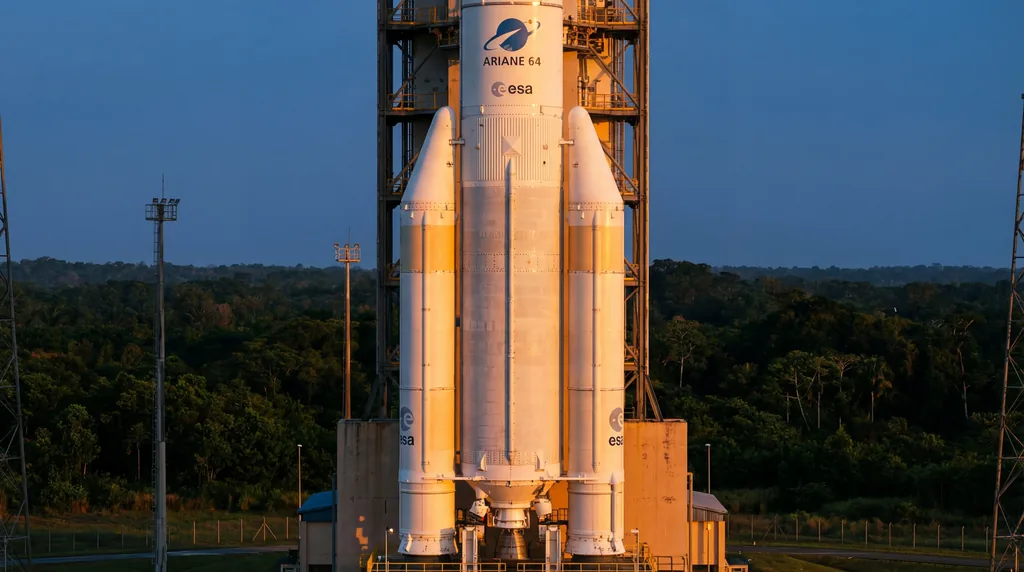

The European Space Agency (ESA) is preparing for the historic inaugural flight of the Ariane 64 configuration, marking a definitive shift in Europe’s heavy-lift capabilities and strategic autonomy in orbit. Scheduled for liftoff on 12 February 2026, flight VA267 will be the first mission to utilize four P120C boosters, doubling the rocket's performance and enabling the deployment of 32 satellites for Amazon’s low-Earth orbit (LEO) constellation. This mission represents the most powerful version of the Ariane 6 launch vehicle to date, effectively transitioning the program from its initial testing phase into a high-capacity workhorse for global telecommunications and scientific exploration.
What is the difference between Ariane 62 and Ariane 64?
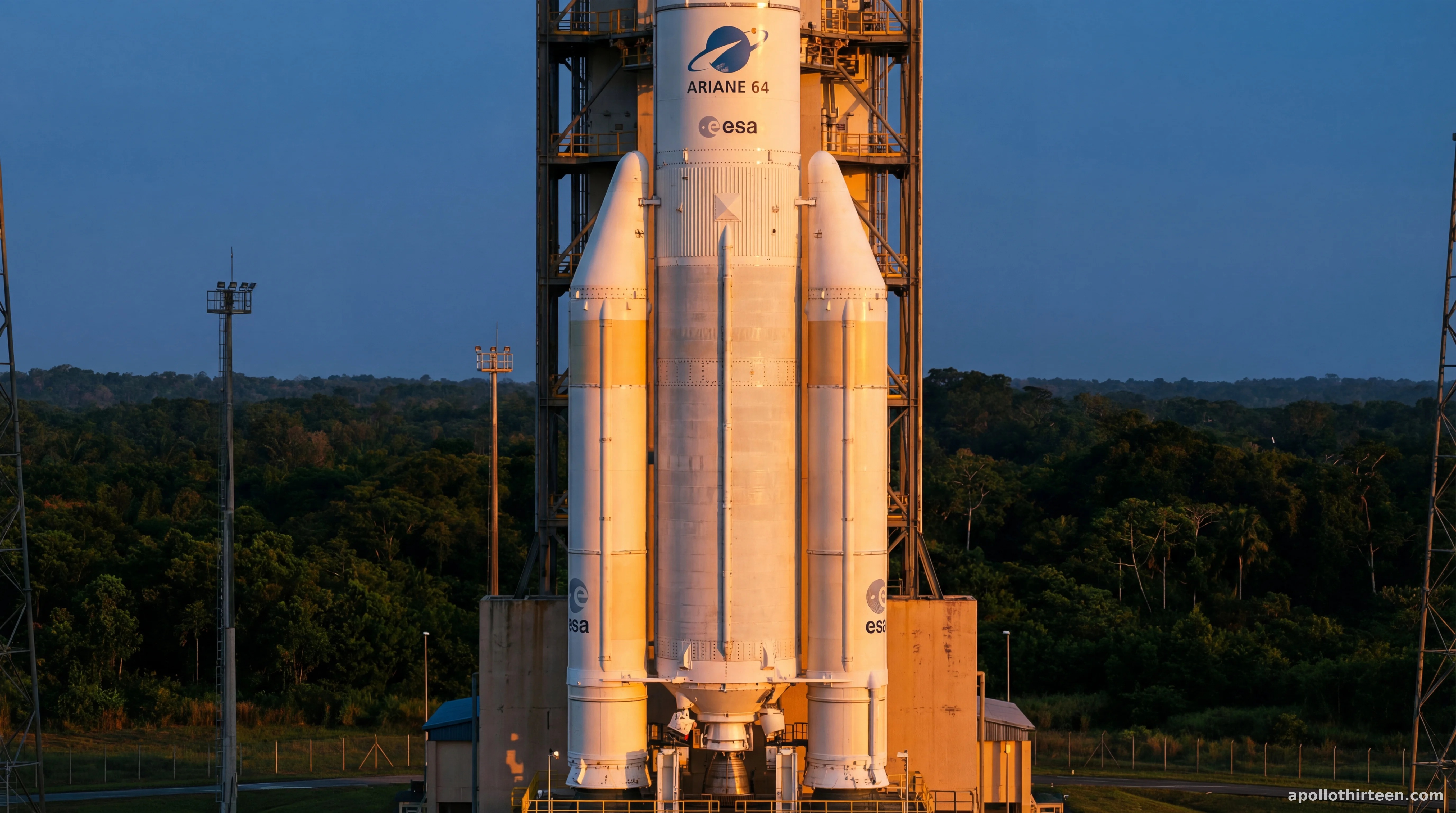
The primary difference between Ariane 62 and Ariane 64 is the number of P120C solid rocket boosters: Ariane 62 utilizes two boosters for medium-lift missions, while Ariane 64 employs four boosters for heavy-lift requirements. This configuration allows Ariane 64 to carry 21.6 tonnes to low-Earth orbit (LEO), compared to 10.3 tonnes for the two-booster variant.
The Ariane 6 architecture was designed specifically for this modularity, allowing the European Space Agency to tailor the rocket's power to the specific mass of the payload. While the Ariane 62 variant has already successfully completed five flights since its inaugural launch in 2024, the upcoming VA267 flight is the first to prove the stability and synchronization of the four-booster setup. Beyond the booster count, the Ariane 64 variant often utilizes a "long fairing"—a 20-meter tall protective nose cone—to accommodate massive satellite clusters that the smaller variant cannot house.
Technological flexibility remains at the heart of this transition from the legacy Ariane 5 system. By utilizing common components across both the 62 and 64 models, Arianespace and prime contractor ArianeGroup have reduced manufacturing costs while maintaining high reliability. The Ariane 64’s increased mass at liftoff, which reaches approximately 860 metric tons, places it in a different class of launch vehicle, capable of reaching high-energy geostationary transfer orbits (GTO) with payloads up to 11.5 tonnes, a significant leap over the 4.5 tonnes managed by the dual-booster version.
How much thrust do the four P120C boosters provide?
The four P120C boosters on Ariane 64 provide a combined liftoff thrust of approximately 14,000 kN, with each individual booster contributing 3,500 kN at the moment of ignition. During the flight's vacuum phase, the total thrust increases to 18,600 kN, consuming 142,000 kg of solid propellant per booster over 130 seconds.
Engineering the P120C solid rocket motor was a masterstroke of European collaboration, as it serves as the first stage for the Vega-C rocket while acting as the strap-on boosters for the Ariane 6. These motors are among the most powerful one-piece solid fuel engines currently in production worldwide. In the Ariane 64 configuration, these four units work in tandem with the Vulcain 2.1 core stage engine to overcome Earth’s gravity, providing the massive initial acceleration required to loft heavy payloads like the Amazon Leo constellation into stable orbits.
The technical sophistication of the Ariane 6 propulsion system extends to the upper stage, which features the Vinci re-ignitable engine. While the P120C boosters provide the "muscle" for the first two minutes of flight, the Vinci engine provides the precision, allowing the rocket to stop and start its engine multiple times. This capability is essential for deploying large batches of satellites into different orbital planes, a key requirement for the VA267 mission, which will last approximately 114 minutes from liftoff to the final separation of the 32nd satellite.
How can I watch the Ariane 6 four-booster launch live?
The first launch of the Ariane 64 can be watched live on ESA Web TV and the official ESA YouTube channel, with coverage beginning 30 minutes before the 16:45 GMT liftoff on 12 February 2026. Viewers can track real-time telemetry and expert commentary from Europe’s Spaceport in French Guiana throughout the 114-minute mission.
Live broadcasting of the VA267 flight is a critical event for the global space community, as it demonstrates the operational readiness of Europe’s most powerful rocket configuration. The launch window is currently set between 16:45 and 17:13 GMT (13:45–14:13 local time in Kourou). Monitoring the launch live allows enthusiasts and industry stakeholders to witness key milestones, including booster separation, fairing jettison, and the complex maneuvers of the upper stage as it deploys its multi-satellite payload.
Key mission phases to watch for during the broadcast include:
- T+0:00: Simultaneous ignition of the Vulcain 2.1 engine and the four P120C boosters.
- T+2:10: Separation of the four boosters after exhausting their solid propellant.
- T+3:30: Jettison of the 20-meter long fairing once the vehicle is above the dense atmosphere.
- T+1:54:00: Final separation of the 32 satellites, signaling mission success for the Ariane 64 debut.
The Mission Profile: Deploying Amazon's LEO Constellation
The primary objective of Flight VA267 is the deployment of 32 satellites for Amazon’s ambitious Leo constellation project. This mission serves as a critical proof-of-concept for the Ariane 64, demonstrating its ability to handle high-volume satellite deployments. At 62 meters tall—equivalent to a 20-storey building—the rocket will utilize its maximum fairing volume to protect these sophisticated instruments during the ascent through the atmosphere over the Atlantic Ocean.
Managed by the French space agency CNES at the Guiana Space Centre, the launch operations involve a vast industrial network spanning 13 European countries. This flight is not merely a commercial endeavor; it is a demonstration of the Ariane 6's design authority and its ability to compete in the global heavy-lift market. The successful deployment of these satellites will validate the heavy-lift capacity of the four-booster variant and solidify Arianespace's role as a primary launch service provider for mega-constellations.
The implications of this launch extend far beyond a single mission. By proving the Ariane 64 configuration, the European Space Agency secures independent access to space for heavy institutional and commercial missions that previously relied on aging or foreign launch systems. Future directions for the program include further optimizations of the P120C boosters and the potential for even heavier payloads as Europe continues to expand its footprint in the lunar and deep-space exploration sectors.




Comments
No comments yet. Be the first!