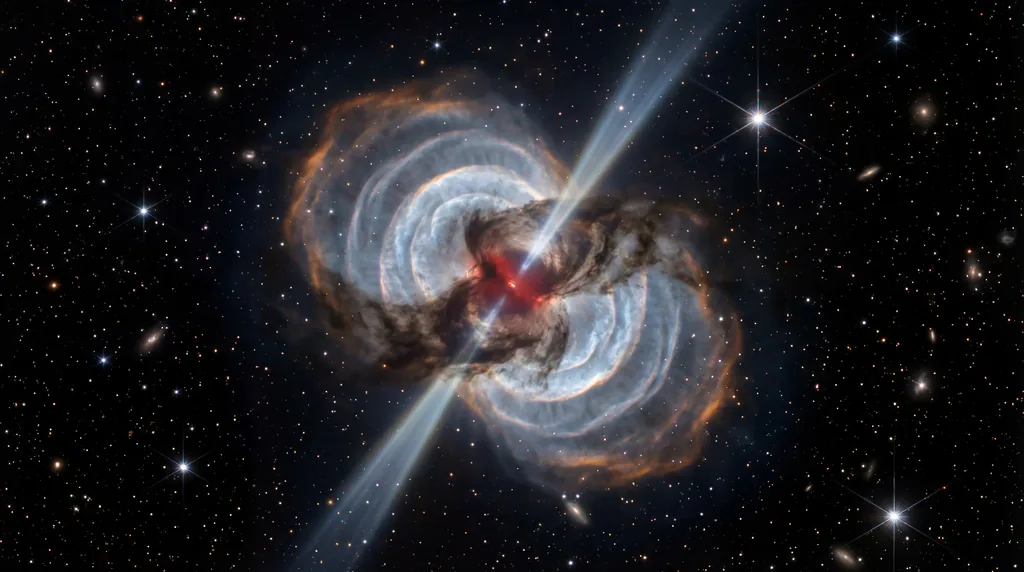

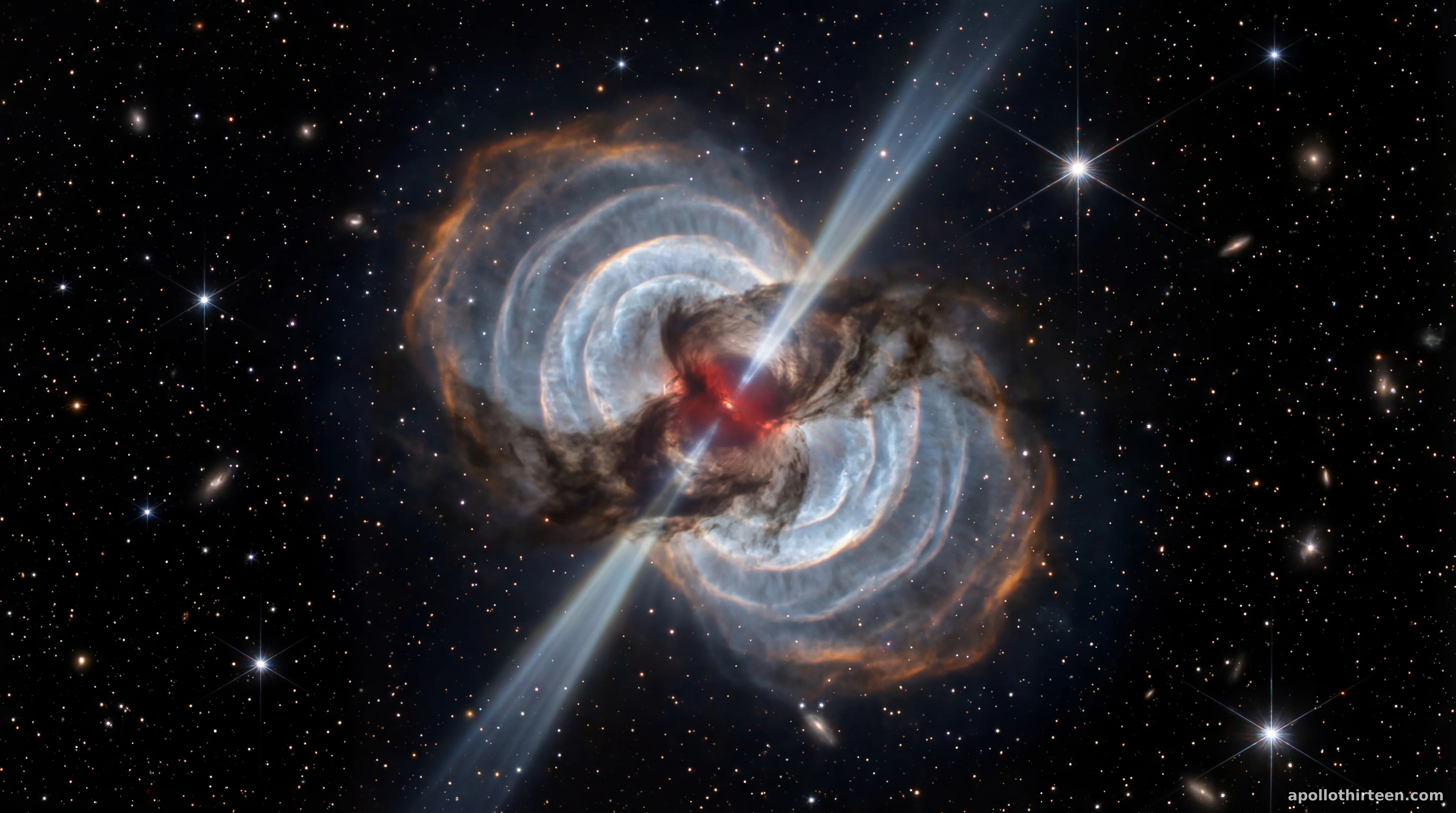
NASA’s Hubble Space Telescope has captured a highly detailed view of the Egg Nebula, a rare astronomical phenomenon that marks the rapid, final transition of a dying star. Located roughly 1,000 light-years away in the constellation Cygnus, this pre-planetary nebula offers researchers a unique "forensic" look at how Sun-like stars shed their outer layers. The new imagery, processed by the Goddard Space Flight Center on February 10, 2026, reveals a complex interplay of light and shadow, where beams of starlight pierce through a dense, opaque cocoon of stardust to create a ghostly visual display.
What is a pre-planetary nebula?
A pre-planetary nebula is a short-lived evolutionary stage where a low- to intermediate-mass star expels its outer gas layers, creating a cool, dark envelope that is not yet hot enough to ionize. During this brief phase, which lasts only a few thousand years, the nebula shines by reflecting starlight off dust particles rather than emitting its own radiation. This stage serves as the bridge between a Red Giant and a fully formed planetary nebula.
Stellar evolution models suggest that stars like our Sun eventually exhaust their hydrogen and helium fuel, causing them to collapse and then expand. According to Bruce Balick of the University of Washington, the Egg Nebula represents the first and youngest pre-planetary nebula ever discovered, providing a vital test case for theories regarding late-stage stellar death. Because this phase is so fleeting, capturing such a clear image allows astronomers to witness the ejection process while the structural evidence remains fresh and undistorted by ionization.
The term "planetary nebula" is actually a historical misnomer, as these structures have no relation to planets. Instead, they are the glowing shells of gas created when a star's exposed core becomes hot enough to ionize the surrounding material. In the case of the Egg Nebula, the central star remains hidden behind a "yolk" of dust, making it a "pre-planetary" object. This compact structure will eventually transform into something resembling the Helix or Butterfly nebulae as the central star continues its terminal heating process.
How does the Egg Nebula form its light beams and shadows?
The Egg Nebula forms its signature light beams and shadows through ring-shaped holes in a thick, equatorial disk of dust, which act like searchlights in a foggy sky. These apertures allow intense beams of light from the central star to escape the opaque "egg white" cocoon and illuminate the outer, faster-moving polar lobes. This process creates the dramatic concentric arcs and shadows visible in the latest imagery.
Hubble Space Telescope observations suggest that these "searchlight" beams are the result of high-speed jets piercing through a slower-moving shell of older material. The symmetry and precision of these patterns indicate that the process is not a chaotic explosion but a coordinated series of ejection events. Researchers believe these outflows originate from the carbon-enriched core of the dying star, which sputters and releases material in periodic pulses over several hundred years.
The intricate shapes seen in the nebula also hint at the presence of gravitational interactions. Many astronomers suspect that a hidden companion star—a binary partner—resides within the central dust disk. This companion would influence the orbital mechanics of the system, helping to sculpt the outflowing gas into the symmetrical lobes and arcs captured by the Wide Field Camera 3 (WFC3). Without such a partner, the star’s death would likely result in a much simpler, spherical cloud rather than this complex geometry.
How far away is the Egg Nebula from Earth?
The Egg Nebula is situated approximately 1,000 light-years from Earth within the northern constellation Cygnus. While some historical astrophysical models have estimated distances of up to 3,000 light-years, current NASA data confirms its position within the 1,000 light-year range, making it one of the nearest objects of its kind. This proximity is crucial for achieving the high-resolution imaging necessary to study small-scale dust ripples.
The scale of the nebula is immense, with the ejected material traveling at speeds that have allowed it to expand significantly over just a few centuries. By observing the proper motion of the dust arcs, scientists can calculate the timeline of the star’s demise. These measurements indicate that the innermost rings of stardust were expelled only a few hundred years ago, making the Egg Nebula a relatively new feature in the Milky Way's landscape.
Scientific interest in the distance and composition of the Egg Nebula extends beyond simple mapping. Because stars like this forged the very elements that make up rocky planets, studying their chemical enrichment provides clues about our own solar system's origins. The dust captured in these Hubble images is identical to the material that coalesced into Earth 4.5 billion years ago. Monitoring this nebula allows scientists to see the "seeds" of future worlds being scattered into the interstellar medium.
Scientific Value of Hubble’s Observations
- Long-term Monitoring: This new image combines data from 2012 with recent observations, allowing for a multi-decade comparison of the nebula’s expansion.
- Technological Continuity: By using the Wide Field Camera 3, Hubble maintains its status as a premier tool for visible and near-infrared light analysis.
- Modeling Stellar Death: The high-resolution views help refine computer models that predict how asymmetric nebulae form from spherical stars.
- Dust Composition: Analysis of the reflected light helps determine the size and density of the carbon grains within the nebula’s disk.
The Hubble Space Telescope has revisited the Egg Nebula several times over its 35-year mission, including landmark observations in 1997 and 2003. Each successive visit, utilizing more advanced instruments like the Advanced Camera for Surveys (ACS) and the NICMOS (Near Infrared Camera and Multi-Object Spectrometer), has peeled back a new layer of this cosmic onion. As the star continues to heat up, the Egg Nebula will eventually transition into a glowing plasma, marking the final chapter of its multibillion-year journey.




Comments
No comments yet. Be the first!