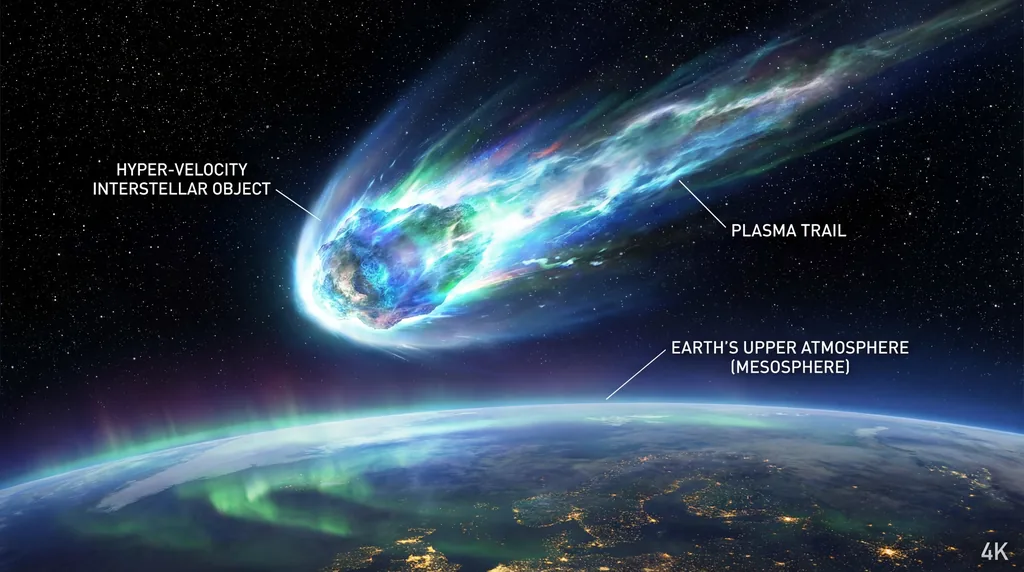

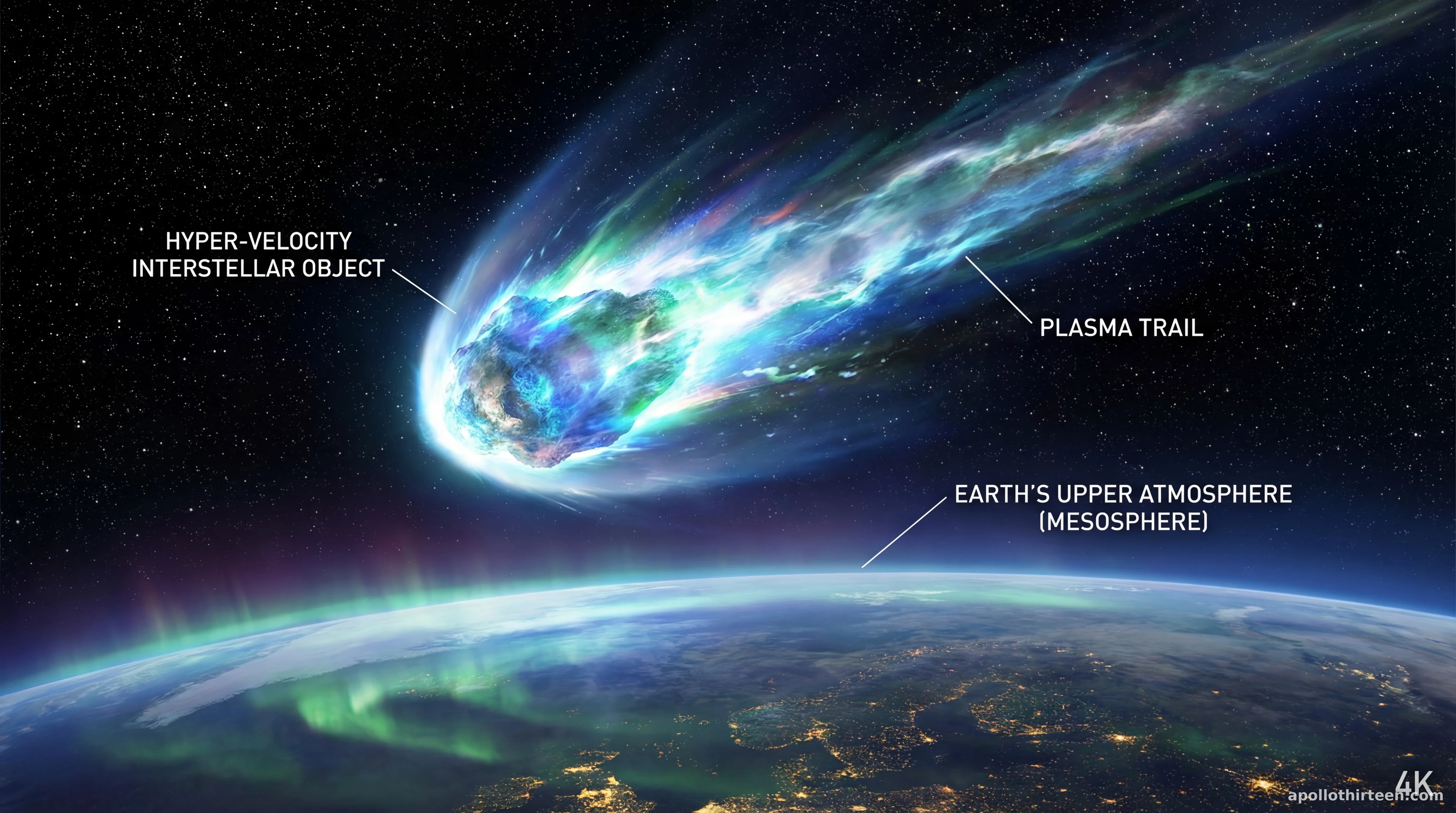
New research led by Harvard University’s Avi Loeb and Richard Cloete has identified two robust interstellar meteor candidates, designated as CNEOS-22 and CNEOS-25, within the NASA Center for Near-Earth Object Studies (CNEOS) fireball database. These objects, which impacted the Earth’s atmosphere in 2022 and 2025 respectively, were confirmed to have originated from outside our solar system based on their extreme heliocentric velocities. This discovery, detailed in a new study, suggests that the influx of interstellar material into our atmosphere may be more frequent than previously estimated.
What are the two new interstellar meteor candidates in the CNEOS database?
The two new interstellar meteor candidates are CNEOS-22 and CNEOS-25, which were identified through heliocentric orbit computations from space-based velocity measurements. These previously unrecognized events were discovered in the post-2018 CNEOS database and validated using 10^6 Monte-Carlo simulations, which confirmed they follow unbound hyperbolic trajectories rather than local solar orbits.
Specific coordinates and timestamps have been provided for both events to facilitate future scientific review and potential recovery efforts. CNEOS-22 entered the atmosphere on July 28, 2022, over the eastern tropical Pacific (6.0°S, 86.9°W), while CNEOS-25 impacted more recently on February 12, 2025, over the Barents Sea (73.4°N, 49.3°E). The location of the Barents Sea impact is particularly notable for its high latitude, placing it within a region frequently illuminated by the aurora borealis, such as near Tromsø, Norway and Murmansk, Russia.
Why do Avi Loeb and researchers believe these meteors are interstellar?
Avi Loeb and his team conclude these meteors are interstellar because their heliocentric speeds significantly exceed the Solar System escape speed at Earth’s distance. Using a calibrated uncertainty model, the researchers demonstrated that none of the one million simulated realizations for either event resulted in a bound orbit, indicating an interstellar probability of nearly 100%.
The statistical confidence for these findings is remarkably high, exceeding standard scientific thresholds for discovery. CNEOS-22 recorded a heliocentric speed of 46.98 km/s, exceeding the solar escape velocity by a margin of 5.18 ± 0.60 km/s, which corresponds to a z-score of 8.7σ. Similarly, CNEOS-25 reached a speed of 45.63 km/s, representing a 5.5σ deviation from the escape threshold. For either of these objects to be "bound" to our sun, the current error models would have to underestimate uncertainties by a factor of 5 to 9, which is considered highly improbable.
How accurate are post-2018 CNEOS fireball velocity measurements?
Post-2018 CNEOS fireball velocity measurements follow an empirically calibrated low-discrepancy uncertainty model with a 1σ speed accuracy of 0.55 km/s. This model, established by Peña-Asensio et al. (2025), provides the precision necessary to transform CNEOS velocity vectors into reliable heliocentric orbits for interstellar candidacy assessment.
The transition to this more accurate calibration model in 2018 has been a turning point for interstellar meteor research. Prior to this period, data discrepancies often led to debates regarding the reliability of satellite-derived fireball speeds. By utilizing the Peña-Asensio model, Loeb and Cloete were able to account for right ascension and declination uncertainties of 1.35° and 0.84° respectively, ensuring that the hyperbolic trajectories of these candidates were not the result of measurement noise.
Environmental Context of the Barents Sea Impact
The impact of CNEOS-25 occurred during a period of moderate geomagnetic activity, which may have provided a unique atmospheric backdrop for the event. Historical data for the region indicates a Kp-index of 5 around that period, with aurora visibility extending across northern Europe and Scandinavia. Scientific observations in cities like Tromsø, Norway and Reykjavik, Iceland often capture atmospheric phenomena during such G1-class geomagnetic storms, though the fireball itself would have been a distinct, high-velocity transient event.
- Impact Date: February 12, 2025
- Geomagnetic Intensity: Moderate (G1)
- Visibility Latitude: 56.3°N and above
- Key Viewing Regions: Alaska, Iceland, Norway, and Sweden
What are the scientific implications for the Galileo Project and Avi Loeb?
The identification of these two candidates provides the Galileo Project with concrete targets for potential seafloor recovery expeditions to search for extraterrestrial fragments. By locating the specific impact sites in the Pacific and the Barents Sea, researchers hope to retrieve material that could reveal the chemical composition of objects from other star systems.
The Galileo Project, headed by Avi Loeb at Harvard, is dedicated to the systematic scientific search for evidence of extraterrestrial technological artifacts. These two new candidates join the ranks of IM1 (CNEOS 2014-01-08) as high-priority subjects for study. The researchers suggest that the "v-infinity" values—the speeds at which these objects were traveling before entering the Sun's gravitational influence—of 21.5 km/s and 16.9 km/s indicate they originated from the local stellar neighborhood, potentially offering a glimpse into the building blocks of other planetary systems.
What's Next for Interstellar Research?
Future directions for this research involve the continued monitoring of the CNEOS database as more sophisticated satellite sensors come online. The team plans to refine the search for even smaller interstellar fragments that may be entering the atmosphere at higher frequencies than previously realized. Furthermore, the Barents Sea location of CNEOS-25 presents a logistical challenge for recovery compared to the tropical Pacific, but the potential for finding pristine interstellar material remains a powerful motivator for the international scientific community.




Comments
No comments yet. Be the first!