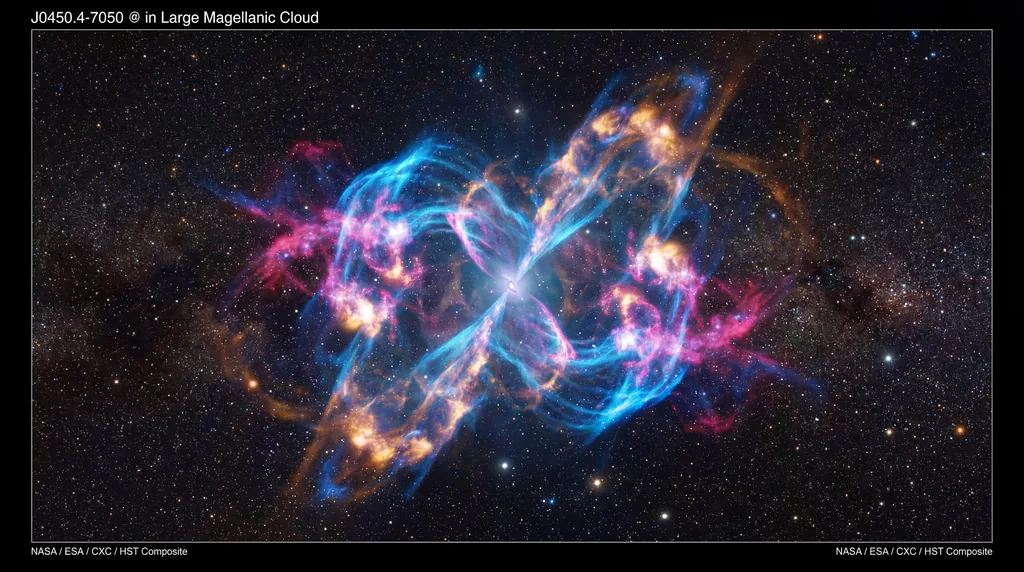

The jittering jets explosion mechanism (JJEM) is an emerging theoretical framework suggesting that core-collapse supernovae are driven by multiple pairs of stochastic, energetic jets launched by a newly formed compact object. In a landmark study, researcher Noam Soker has identified this mechanism as the definitive architect behind the structure of the supernova remnant J0450.4-7050. This discovery provides a pivotal piece of evidence in the ongoing debate regarding how the universe's most massive stars meet their violent ends.
Where is the supernova remnant J0450.4-7050 located?
The supernova remnant J0450.4-7050 is located within the Large Magellanic Cloud (LMC), a nearby satellite galaxy of the Milky Way. Situated at coordinates RA(J2000) = 4h 50m 26.8s and Dec(J2000) = -70d 50m 45.5s, this remnant resides in a cosmic laboratory that allows astronomers to observe supernova evolution with unprecedented clarity and detail.
Detailed analysis of J0450.4-7050, a core-collapse supernova (CCSN) remnant, was made possible by synthesizing multi-wavelength imaging from recent astronomical surveys. By examining radio, optical, and X-ray data, researchers can peer through the interstellar medium to map the debris of a stellar explosion that occurred thousands of years ago. The LMC’s proximity makes it an ideal location for identifying structural nuances that might be obscured in more distant galaxies, allowing for a rigorous examination of the explosion's final moments.
What does 'Veliki' mean for SNR J0450.4-7050?
The nickname 'Veliki' translates to "large" in Serbian and was assigned to SNR J0450.4-7050 to reflect its massive physical dimensions. The remnant spans approximately 489 by 264 light-years, establishing it as one of the largest known supernova remnants ever identified, which prompted a re-evaluation of its morphological history and explosion energy.
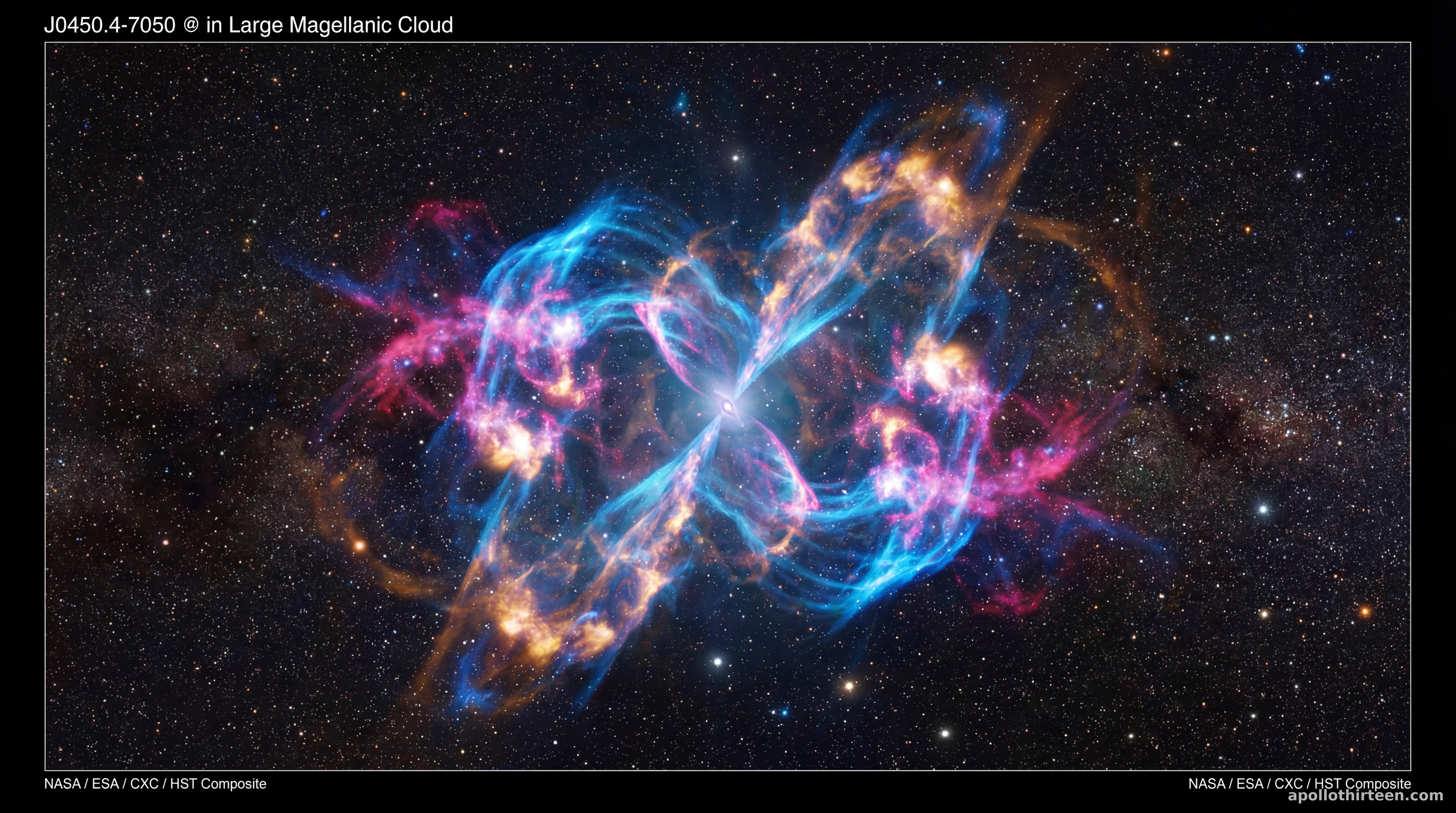
The sheer scale of Veliki is matched by its intricate point-symmetric morphology. This symmetry is defined by three distinct pairs of structural features: two pairs of "ears," a pair of "blowouts" extending along the north and south of the long axis, and a pair of "dents." These features are not merely random clouds of gas; they are precisely aligned along axes that pass through the center of the remnant. This geometric precision implies a highly ordered, albeit violent, series of events during the progenitor star's collapse.
Understanding the "Veliki" remnant requires looking at both the inner and outer ejecta. Noam Soker argues that the alignment of these features suggests they were shaped by internal forces rather than external interactions with the surrounding interstellar medium. When structural features in the inner ejecta align perfectly with those in the outer shell, it provides a "smoking gun" for jet-driven shaping, as external gas would not produce such synchronized, point-symmetric patterns across such vast distances.
How does this discovery challenge the neutrino-driven supernova mechanism?
This discovery challenges the neutrino-driven supernova mechanism because traditional models struggle to produce the point-symmetric morphologies observed in remnants like Veliki. While neutrino-driven models rely on heating and hydrodynamic instabilities to trigger an explosion, they typically result in more chaotic, less structured symmetries that cannot account for multiple pairs of perfectly aligned jets.
The jittering jets explosion mechanism (JJEM), however, predicts exactly the kind of structures seen in SNR J0450.4-7050. According to the JJEM, as a massive star collapses, it forms an accretion disk around a central neutron star or black hole. This disk launches pairs of jets that "jitter" or change direction due to the stochastic nature of the angular momentum in the collapsing shells of the star. These multiple jet pairs carve out the "ears" and "blowouts" seen in the remnant today, leaving a permanent morphological map of the explosion process.
The presence of at least three pairs of energetic jets in Veliki suggests that the explosion was not a single, spherical burst but a series of directional injections of energy. This findings lean heavily toward the JJEM as the primary mechanism for CCSN. If the supernova was driven solely by neutrinos, the resulting remnant would likely lack the specific "point-symmetric" alignment of the north-south blowouts and the secondary ears, which are hallmark indicators of jet activity.
The Implications of Point-Symmetry in Astrophysics
Point-symmetry in a supernova remnant acts as a fossil record of the physics occurring in the heart of a dying star. By identifying these patterns in J0450.4-7050, researchers can work backward to calculate the energy and orientation of the jets that launched them. This methodology shifts the focus from simple volumetric expansion to a more complex understanding of how angular momentum is redistributed during a core collapse.
- Jet Pairs: Identification of three distinct energetic pairings (ears, blowouts, and dents).
- Symmetry Axes: Structural alignment between inner and outer ejecta confirms internal origin.
- Energy Scale: The massive size of Veliki suggests highly energetic jet activity sustained over the explosion duration.
Furthermore, the study of Veliki encourages a broader re-examination of other known remnants. If point-symmetry is a common feature rather than an anomaly, the jittering jets explosion mechanism may transition from a theoretical alternative to the dominant model in high-energy astrophysics. The implications for our understanding of heavy element nucleosynthesis and the birth of neutron stars are profound, as the jet-driven model alters the thermal and chemical history of the ejected material.
Future Directions: What is Next for Veliki?
Future research will likely focus on high-resolution spectroscopic observations to confirm the chemical composition of the jet-carved regions. By measuring the velocities and elemental abundances within the "ears" and "blowouts" of SNR J0450.4-7050, astronomers can further distinguish between the JJEM and neutrino-driven signatures. This will provide a more granular look at the fluid dynamics of the explosion and the precise timing of the jet launches.
Ultimately, the discovery of Veliki’s unique shape serves as a reminder that the most massive explosions in the universe are far from simple. As Noam Soker’s research suggests, the supernova remnants we observe today are the intricate blueprints of a star's final, desperate struggle for equilibrium—a struggle defined by the powerful, jittering jets that eventually tear it apart. This study not only highlights the importance of the Large Magellanic Cloud as a research hub but also sets a new standard for how we interpret the scars left behind by dying stars.




Comments
No comments yet. Be the first!