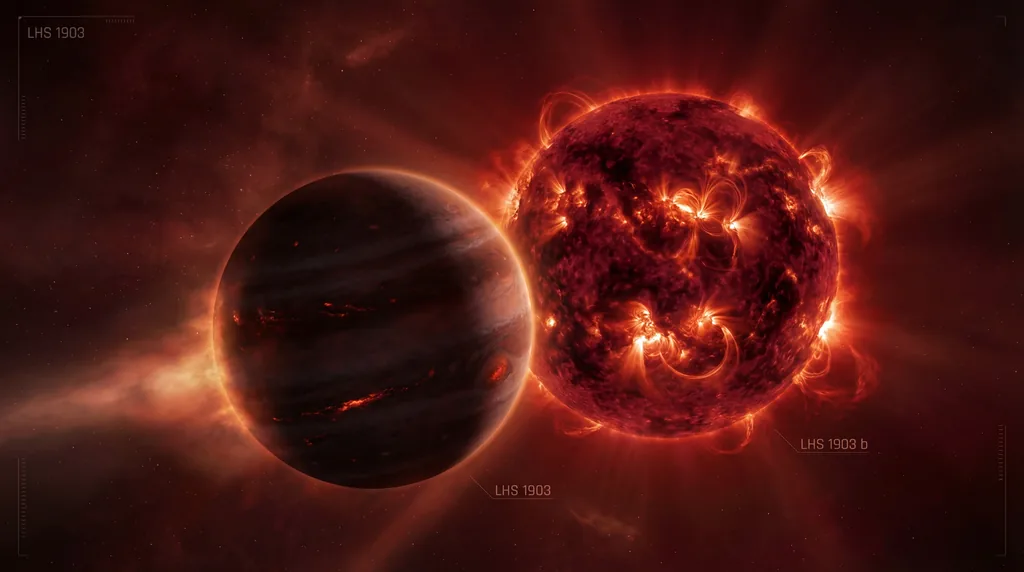

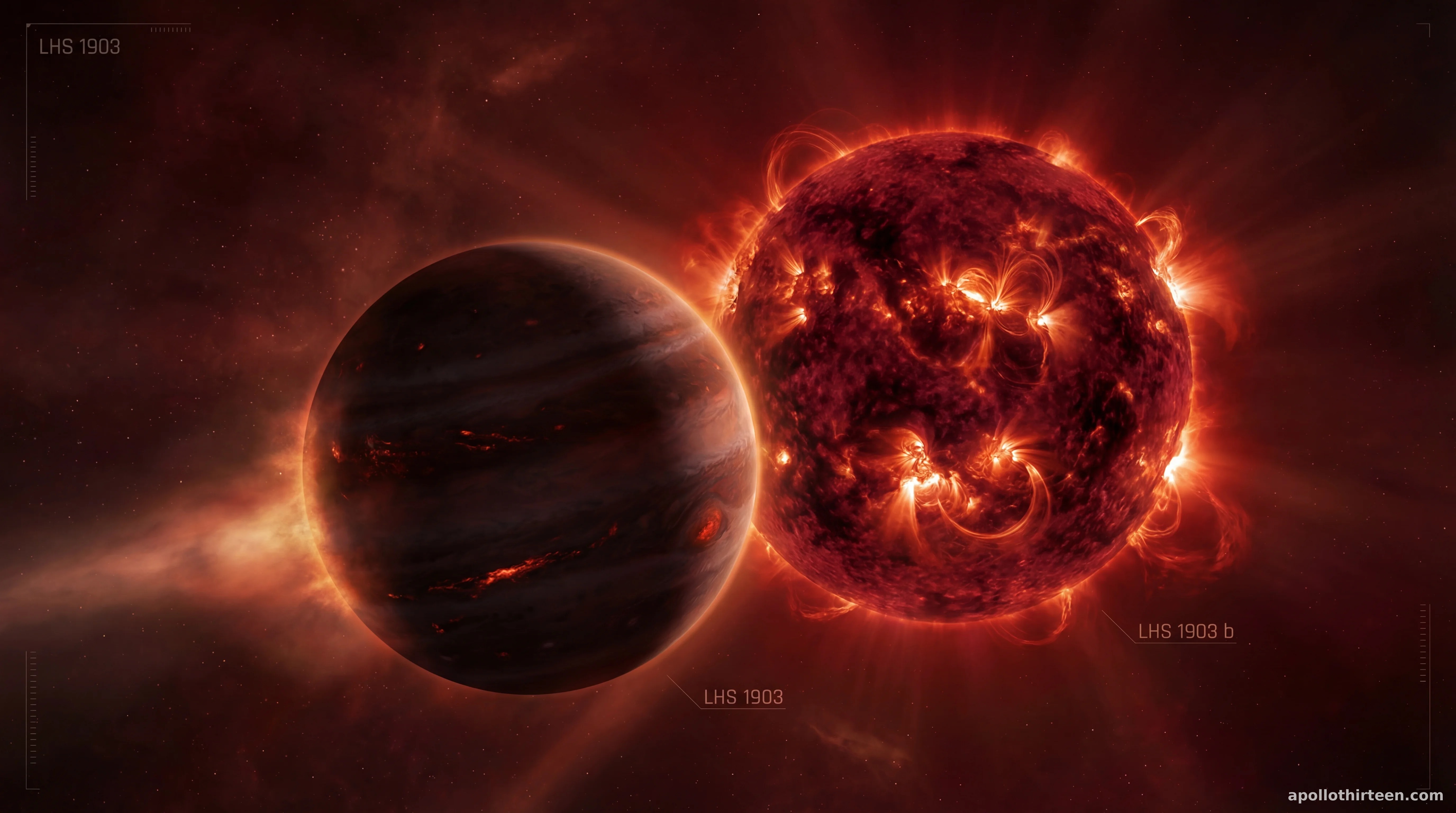
Astronomers have discovered a bizarre "inside-out" planetary system around the star LHS 1903 that challenges the fundamental laws of how worlds form. Unlike our Solar System, which places rocky planets near the sun and gas giants further out, this system features a rocky world orbiting beyond its gaseous neighbors. This discovery, announced on February 12, 2026, by an international team of researchers, suggests that planetary evolution can follow a sequential "inside-out" path previously unknown to science.
How does the planetary order in LHS 1903 differ from our Solar System?
The planetary order in LHS 1903 is characterized by an "inside-out" architecture consisting of a rocky inner planet, followed by two gas giants, and finally another rocky planet in the outermost orbit. This contradicts the standard Solar System model where terrestrial planets like Earth stay close to the Sun while gas giants like Jupiter reside in the colder, outer regions. In the LHS 1903 system, the presence of a small, dense world beyond the gaseous giants defies the traditional rocky-inner, gas-outer gradient.
Our current understanding of planetary architecture is largely based on the composition of our own neighborhood. In the Solar System, the four planets closest to the Sun—Mercury, Venus, Earth, and Mars—are small and rocky because stellar radiation prevented light gases from accumulating near the star. Farther out, beyond the "snow line," temperatures were cool enough for gas giants like Jupiter and Saturn to gather massive atmospheres. LHS 1903, a red dwarf star located in the Milky Way’s thick disc, breaks this mold entirely by hosting a fourth, rocky planet in the far reaches of the system where gas giants typically dominate.
The discovery was spearheaded by Thomas Wilson, a planetary astrophysicist from the University of Warwick. Wilson and his team initially identified three planets around the red dwarf, which appeared to follow the expected order: one rocky world followed by two gaseous ones. However, further investigation into data from the European Space Agency’s CHEOPS (Characterising Exoplanet Satellite) revealed a hidden fourth member. This outermost planet, designated as LHS 1903 e, is a small, rocky world that exists where scientists expected to find either nothing or an icy giant.
Why is the outer planet in LHS 1903 rocky instead of gaseous?
The outer planet in LHS 1903 is rocky because it likely formed in a "gas-depleted environment" after the inner planets had already consumed the available hydrogen and helium in the protoplanetary disc. According to lead author Thomas Wilson, this suggests the planets formed one at a time rather than simultaneously. By the time the fourth planet began to coalesce, the system had run out of the gas necessary to build a thick atmosphere, leaving only solid material to form a rocky core.
Standard protoplanetary disc theory posits that planets form concurrently from a massive ring of dust and gas. As dust grains clump together to form planetesimals, they eventually grow into cores. If a core grows large enough while gas is still abundant, it triggers a runaway accretion process, becoming a gas giant. In the case of LHS 1903, the researchers propose a sequential formation scenario. This "inside-out" process implies that the inner planets were "gas-hungry," stripping the disc of its lighter elements before the outermost planet could reach its final stages of growth.
This finding provides the first concrete evidence for planet formation in environments where gas has been prematurely exhausted. "Rocky planets don't usually form so far away from their home star," Wilson noted in a statement published in the journal Science. The existence of LHS 1903 e proves that small, rocky worlds can emerge in the cold, outer reaches of a system if the timing of the disc's dissipation aligns correctly. This challenges the "snow line" theory, which assumes that distance from the star is the primary determinant of a planet's gaseous or rocky nature.
What role did ESA’s CHEOPS play in this discovery?
ESA’s CHEOPS satellite provided the high-precision transit photometry required to detect the slight dip in brightness caused by the outermost rocky planet passing in front of LHS 1903. While other telescopes had identified the inner three planets, CHEOPS allowed astronomers to calculate the density and size of the fourth planet with extreme accuracy. These measurements confirmed that the planet was a dense, rocky body rather than a low-density gaseous world, revealing the system's "inside-out" nature.
The CHEOPS mission is specifically designed to characterize known exoplanets by measuring their sizes with unprecedented detail. By observing the light curves of LHS 1903, the satellite enabled the international team to rule out the presence of a thick hydrogen-helium envelope on the outermost world. This level of precision is vital for distinguishing between "super-Earths" (rocky) and "mini-Neptunes" (gaseous), which can often look similar in lower-resolution data from other surveys like NASA’s TESS.
The use of CHEOPS highlights the importance of targeted follow-up observations in modern astronomy. As Isabel Rebollido, a planetary disc researcher at the European Space Agency, explained, our theories of how planets form have historically been biased by the Solar System. "As we are seeing more and more different exoplanet systems, we are starting to revisit these theories," Rebollido stated. The data from CHEOPS acted as the "smoking gun" that forced researchers to look beyond simultaneous formation models and consider more complex, staggered evolutionary paths.
Implications for Future Astronomy and Planetary Evolution
The discovery of the LHS 1903 system necessitates a significant revision of planetary formation textbooks. If planets can form sequentially in gas-depleted environments, the variety of planetary architectures in the Milky Way may be far greater than previously imagined. This has profound implications for our understanding of M-dwarf systems, which are the most common types of stars in our galaxy and are frequent targets in the search for habitable zones.
Future research will likely focus on whether this "inside-out" order is a rare anomaly or a common byproduct of red dwarf evolution. Because red dwarfs like LHS 1903 are cooler and smaller than the Sun, their protoplanetary discs behave differently, potentially allowing for the gas-depletion scenarios described by Wilson’s team. Astronomers are now looking to use the James Webb Space Telescope (JWST) to analyze the atmosphere—or lack thereof—on LHS 1903 e to confirm if any trace gases remain from its formation era.
As we continue to catalog the more than 6,000 exoplanets discovered since the 1990s, systems like LHS 1903 serve as a reminder that the universe is not bound by the specific rules observed in our own backyard. The transition from "rocky-inner, gas-outer" to a more fluid understanding of orbital architecture will help scientists better predict where Earth-like worlds might be hiding. The hunt for life beyond our Solar System depends on accurately modeling these "bizarre" systems that defy our initial expectations.
Space Weather Update: Aurora Visibility Note
In addition to these deep-space discoveries, observers on Earth may experience their own celestial display this week. Following the LHS 1903 announcement, space weather reports indicate a Moderate (G1) geomagnetic storm with a Kp-index of 5. This activity is expected to make the aurora borealis visible across several northern regions. Key viewing details include:
- Visibility Latitude: 56.3 degrees north.
- Prime Viewing Regions: Fairbanks (Alaska), Reykjavik (Iceland), Tromsø (Norway), Stockholm (Sweden), and Helsinki (Finland).
- Viewing Tips: For the best experience, find a dark location away from city lights between 10 PM and 2 AM local time and look toward the northern horizon.




Comments
No comments yet. Be the first!