europe's most powerful rocket: Ariane 64 enters service
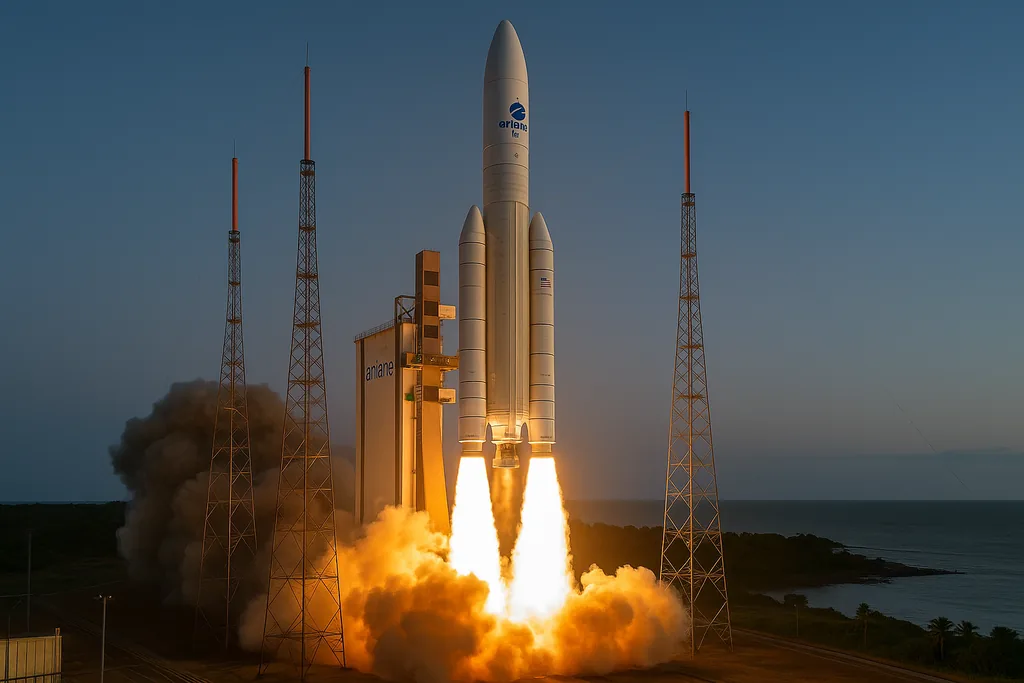
The new workhorse rose from the Guiana Space Centre in Kourou on 12 February 2026, when Europe's most powerful rocket — the Ariane 64 variant of Ariane 6 — thundered into a clear tropical sky carrying 32 Amazon Leo satellites. Liftoff occurred at 16:45 UTC (1:45 p.m. local Kourou time) and the mission, designated VA267 by Arianespace and LE-01 by Amazon Leo, lasted roughly 1 hour and 54 minutes from launch to the final spacecraft separation. That sequence marked the first flight of the four-booster Ariane 64 and the sixth Ariane 6 launch overall, but it was the first time the launcher flew in its full-power configuration and with the new 20-metre long payload fairing.
europe's most powerful rocket vs previous launchers: capacity and changes
The Ariane 64 is the most potent configuration of the Ariane 6 family; the two-letter suffix '64' denotes the vehicle has four P120C solid rocket boosters attached. That set-up lifts Ariane 6 into heavy-lift territory, able to deliver around 20 metric tonnes to low Earth orbit on constellation-style missions — roughly double the payload mass of the smaller two-booster Ariane 62 variant that flew earlier missions. Compared with the retired Ariane 5, Ariane 6 introduces modernised engines and an upper stage with a relightable Vinci motor and an Auxiliary Propulsion Unit, enabling more flexible mission profiles and a controlled deorbit of the stage at the end of operations. Engineers are already planning further evolutions, including a P160C booster upgrade, to push performance yet higher for future heavy missions.
Amazon Leo batch LE-01: the 32 satellites and what they will do
The payload on VA267 consisted of 32 operational Amazon Leo satellites, encapsulated under the new long fairing and deployed into a roughly 465 km, 51.9° inclined orbit. Those spacecraft are part of Amazon's Leo broadband constellation (previously called Project Kuiper), a global network designed to provide high-speed internet to customers and communities beyond the reach of existing terrestrial networks. After separation — which began about 1 hour 29 minutes into the flight and continued over roughly a 25-minute window — the satellites performed initial checks and will climb themselves to operational altitudes near 630 km. The LE-01 flight is the first of 18 Ariane 6 missions that Arianespace has under contract to support Amazon Leo's rollout; across all providers Amazon plans hundreds of launches to build a constellation that can number in the thousands.
Flight profile, hardware highlights and mission timing
The Ariane 64 lifted off from the Ensemble de Lancement Ariane 4 pad and flew a northeasterly trajectory over the Atlantic. The four P120C strap-on boosters burned out and separated about 2 minutes 25 seconds after launch, and the core stage and upper stage performed a sequence of burns — including an upper-stage relight late in the mission — to place the payload stack into the target insertion. The mission used the Ariane 6 long fairing for the first time, giving the rocket a total height of about 62 metres during the countdown and ascent. Arianespace reported that the upper stage executed a deorbit burn after satellite deployment so the stage will reenter safely; the Vinci engine’s relight capability and the new Auxiliary Propulsion Unit were central to achieving that controlled end-of-life sequence.
Why this launch matters to Europe and to commercial constellations
The successful inaugural flight of Ariane 64 is both a technical milestone and a commercial signal. For Europe, it demonstrates that Ariane 6 can serve heavy, constellation-style customers at pace — a capability national agencies and commercial operators have wanted since the retirement of Ariane 5. For Amazon Leo, the mission moves the company closer to providing a competitive alternative to other mega-constellations by deploying many satellites per launch, which is essential to build coverage quickly and economically. The flight also shows that European industry — from ArianeGroup and Arianespace to partner agencies — can deliver high-volume launches while integrating upgrades such as larger fairings and improved booster designs.
Industrial upgrades and the roadmap after the Ariane 64 debut
While the Ariane 64 hauled approximately 20 tonnes to LEO on LE-01, engineers are already focused on iterative improvements. The P160C booster — a lengthened evolution of the P120C used on both Ariane 6 and Vega-C — has been tested and is slated to fly on future missions to raise performance by around 10 percent without changing core interfaces. ArianeGroup has signaled a production ramp-up and design evolution programme that aims to cut costs and increase competitiveness in a crowded global launch market. In parallel, Arianespace will begin a cadence of launches for Amazon and other constellation customers; under the Amazon contract Ariane 6 will fly multiple LE missions this year, complementing launches on other rockets worldwide.
Operational context and how Europe’s launcher compares in the market
What is Europe’s most powerful rocket called? In practical terms, that answer today is the Ariane 64 — the four-booster variant of Ariane 6 — which joins other heavy lifters globally such as SpaceX’s Falcon 9 and United Launch Alliance’s Vulcan. Compared to earlier European launchers, Ariane 6 brings modularity: the 62 and 64 variants share stages and core systems but change the number of strap-on boosters and fairing size to match mission needs. That flexibility allowed Arianespace to book constellation flights like Amazon Leo where launching more satellites per mission reduces the total number of missions and the complexity of a global deployment. The result is an up-to-date European offering positioned to compete for large commercial business while serving institutional requirements from ESA and national space agencies.
Video and imagery from Kourou captured the launch trajectory, the booster separations and the fairing jettison; those visuals underline how the new long fairing expands the launcher’s ability to host large payload stacks for mass deployments. The LE-01 mission also highlighted mission planning improvements: long coasts, multiple upper-stage relights and a controlled disposal sequence that responds to growing expectations for responsible orbital operations.
What to watch next
In the short term, Arianespace and Amazon will track the health and orbit-raising of the LE-01 satellites as they transition to service altitude and begin in-orbit tests. Over the next months, follow-on Ariane 6 flights — some in upgraded configurations — will be watched closely for cadence, reliability and cost metrics. For Europe’s space sector the focus will be on production ramp-up, evolving booster technology and maintaining a flow of commercial customers. For global broadband competition, Amazon Leo’s continued launches across multiple rockets will determine how quickly it can close coverage gaps and compete with incumbent megaconstellations.
Sources
- Arianespace press release (VA267 / Ariane 64 mission).
- European Space Agency (ESA) mission and hardware briefings.
- ArianeGroup technical statements and booster test reports.
- Centre National d'Études Spatiales (CNES) Guiana Space Centre launch details.




Comments
No comments yet. Be the first!