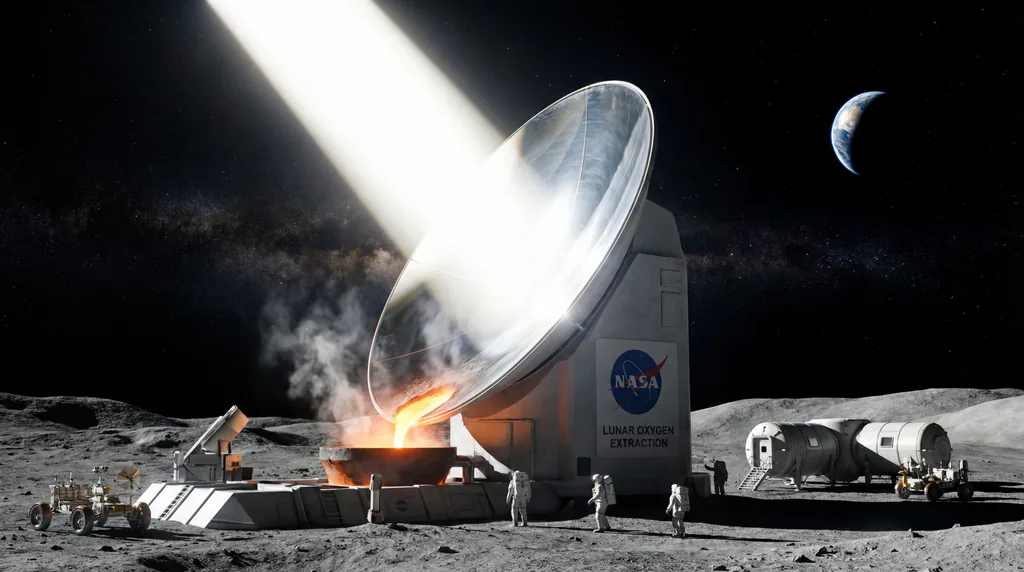

Solar Chemistry: NASA Demonstrates Method to Extract Oxygen from Lunar Regolith Using Concentrated Sunlight
NASA researchers have successfully demonstrated a groundbreaking method to extract oxygen from simulated lunar soil using the power of concentrated solar energy. This milestone, achieved through the Carbothermal Reduction Demonstration (CaRD) project, utilizes a solar-driven chemical reaction to break down regolith, providing a sustainable path for long-term human presence on the Moon. By producing life-support consumables and propellant locally, this technology significantly reduces the logistical burden of transporting heavy supplies from Earth.
The development of In-Situ Resource Utilization (ISRU) technologies is a cornerstone of the Artemis Program, which aims to establish a permanent base at the lunar south pole. To sustain a human crew for months or years, space agencies must move away from total Earth-dependence. Extracting oxygen directly from the lunar surface—where it is chemically bound within the mineral oxides of the lunar regolith—is considered the most efficient way to provide breathable air and liquid oxygen for rocket engines.
What is NASA's Carbothermal Reduction Demonstration (CaRD) project?
NASA’s Carbothermal Reduction Demonstration (CaRD) is a technology pilot that uses concentrated solar energy to extract oxygen from simulated lunar regolith through a solar-driven chemical reaction. On February 13, 2026, the team completed integrated prototype testing, successfully producing oxygen and confirming the production of carbon monoxide. This project integrates hardware from private industry and multiple NASA centers to validate lunar manufacturing capabilities.
The CaRD project represents a massive collaborative effort in aerospace engineering and planetary science. The integrated prototype utilized a carbothermal oxygen production reactor developed by Sierra Space, which was paired with a sophisticated solar concentrator designed by NASA’s Glenn Research Center in Cleveland. To ensure the solar energy was focused with high precision, the team employed specialized mirrors from Composite Mirror Applications. The entire system was regulated by avionics, software, and gas analysis systems developed at NASA’s Kennedy Space Center, while NASA’s Johnson Space Center provided overall project management and systems engineering.
Why is extracting oxygen from regolith important for lunar exploration?
Extracting oxygen from lunar regolith is essential because it provides breathable air for astronauts and rocket propellant locally, drastically reducing the cost and complexity of space missions. By leveraging local resources, NASA can minimize the mass required for launch from Earth. This capability is the key to transforming the Moon from a destination for short visits into a long-term hub for deep space exploration.
The logistical benefits of this "living off the land" approach cannot be overstated. Currently, every kilogram of oxygen or fuel sent to the Moon requires a massive amount of energy and expense to escape Earth's gravity. By harvesting oxygen from the lunar surface, mission planners can dedicate more payload capacity to scientific instruments and habitat modules. Furthermore, the ability to refuel spacecraft on the Moon could turn the lunar surface into a "gas station" for missions heading further into the solar system, such as to Mars.
What role does carbon monoxide play in the CaRD process?
In the CaRD process, carbon monoxide serves as a critical chemical intermediate that confirms the successful reduction of metal oxides within the heated lunar regolith. The production of carbon monoxide during the solar-driven reaction proves that the carbothermal reactor is effectively breaking chemical bonds to release oxygen. These same chemical conversion systems can also be adapted to turn carbon dioxide into oxygen and methane for future Mars missions.
This chemical versatility makes the CaRD technology a dual-use innovation for solar system exploration. While the current focus is on the Moon, the solar chemistry involved in managing carbon-based gases is directly applicable to the Martian atmosphere. On Mars, where carbon dioxide is abundant, similar reactors could provide the necessary oxygen for life support and methane for return-trip propellant. The integrated prototype testing has confirmed that these downstream gas analysis systems are robust enough to handle the harsh, vacuum-like conditions required for space operations.
Implications for the Artemis Program and Beyond
The successful testing of the CaRD prototype marks a transition from theoretical research to practical space manufacturing. By demonstrating that concentrated sunlight can provide the intense heat necessary for carbothermal reduction, researchers have proven that we do not need to rely on nuclear or massive battery arrays for thermal processing. This reliance on solar energy makes the system more sustainable and easier to deploy at the lunar south pole, where peaks of eternal light offer near-constant access to the sun.
- Resource Sustainability: Utilizes 100% local regolith and renewable solar energy.
- Scalability: The reactor design can be scaled up to support larger lunar colonies.
- Interplanetary Utility: Core technology is adaptable for Mars In-Situ Resource Utilization.
- Cost Reduction: Significantly lowers the "price per liter" of oxygen in deep space.
Future Directions for Lunar Solar Chemistry
Looking ahead, the CaRD team plans to refine the solar concentrator and reactor integration to withstand the extreme temperature fluctuations of the lunar environment. Future phases of the project will likely involve testing the hardware in vacuum chambers that more closely simulate the Moon's atmosphere and thermal conditions. Scientists are also investigating how different types of regolith—ranging from highland materials to basaltic mare soils—affect the efficiency of the oxygen extraction process.
The long-term vision for NASA involves a fully automated oxygen production plant situated on the lunar surface. Such a facility would operate autonomously, stockpiling oxygen in cryogenic tanks before the arrival of human crews. As Artemis missions progress, the integration of solar chemistry and robotic mining will be the foundation of a self-sustaining lunar economy, paving the way for the next giant leap in human exploration.
Environmental Note: While NASA focuses on lunar chemistry, observers on Earth may notice heightened atmospheric activity today. According to recent data from February 13, 2026, a Moderate (G1) aurora is visible in northern regions, including Fairbanks, Alaska and Reykjavik, Iceland, with a Kp-index of 5.




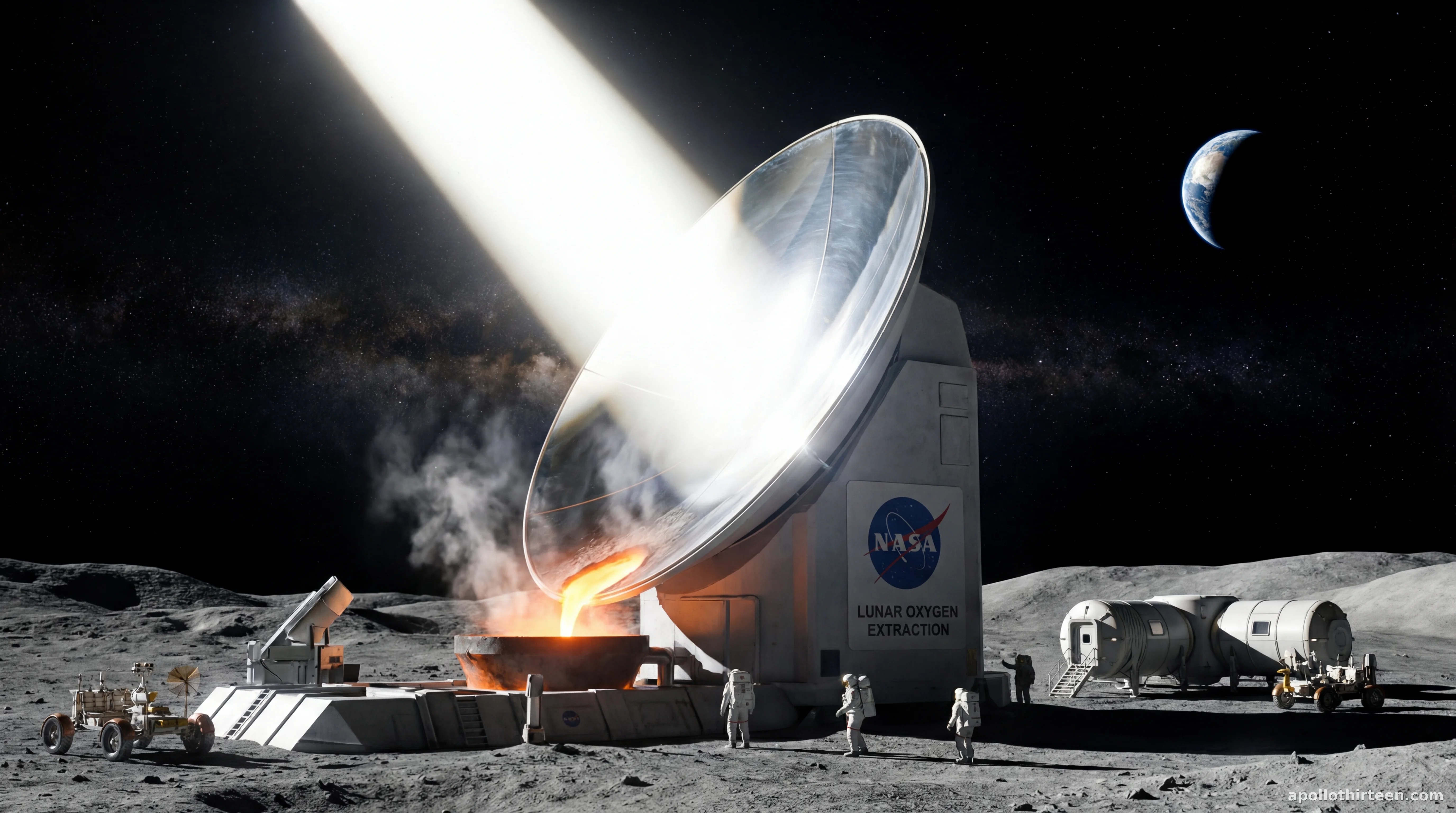
Comments
No comments yet. Be the first!