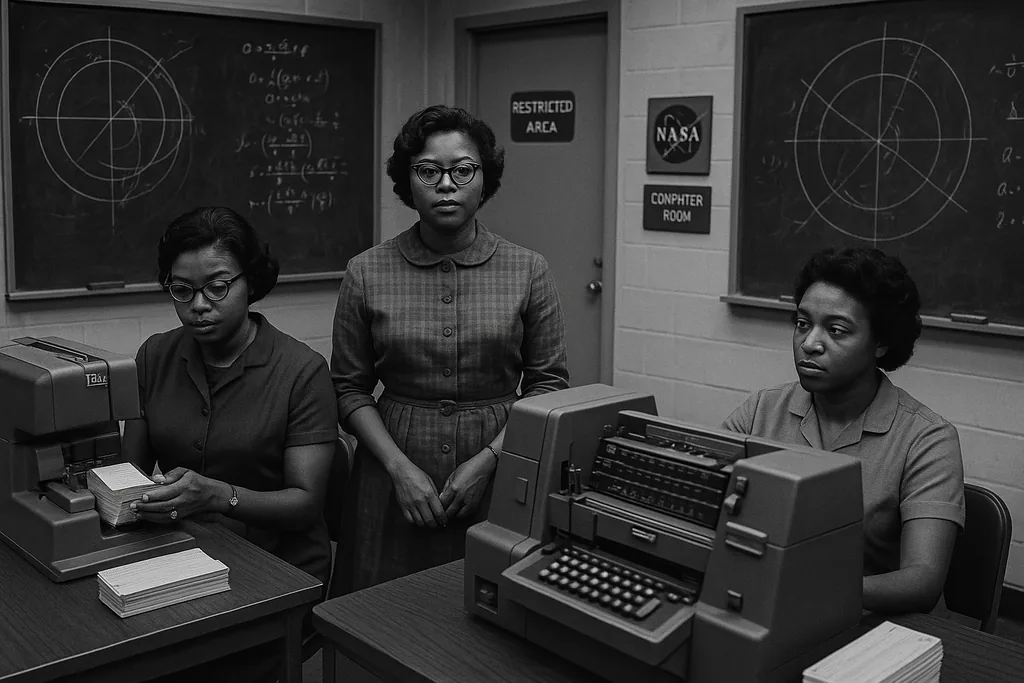
When segregated labs calculated the moonshot
In the 1950s and 1960s, long before pocket calculators and modern software, rows of women at typewriters and slide rules bent over trajectory tables that would decide whether a spacecraft returned safely to Earth. It was in that moment — when segregated labs calculated the numbers for missions such as Friendship 7 and the Apollo flights — that the banal, painstaking work of human "computers" became mission-critical. Many of those human computers were African American women working in the West Area Computing sections at sites like NASA's Langley Research Center; their calculations verified the electronic machines and guided orbital insertions, re‑entries and the course to the Moon.
When segregated labs calculated trajectories for astronauts
The technical heart of early U.S. human spaceflight depended on trajectory analysis: predicting where a capsule would be after launch, during orbital insertion, and on re‑entry. Human computers performed the numerical integration and checks that electronic systems of the time could not yet be trusted to do alone. Katherine Johnson, a mathematician recruited into Langley's flight research division, famously rechecked the electronic computer outputs for John Glenn's Friendship 7 mission — Glenn reportedly told officials he would not fly until Johnson had manually verified the numbers. Those same calculations and the more extensive orbital analyses undertaken by teams across Langley, Goddard and Marshall underpinned Project Apollo's guidance and targeting, making moon orbits and precise re‑entry corridors possible.
The human computers and the calculations
The women who did this work came from varied academic and regional backgrounds but shared a deep facility with mathematics. Katherine Johnson handled coordinate transformations and orbital mechanics; Dorothy Vaughan mastered early programming languages like FORTRAN and led personnel in adapting to electronic computation; Mary Jackson moved from computation into wind‑tunnel engineering and became NASA's first Black female engineer. Others — including Gladys West, Annie Easley, Melba Roy Mouton, Christine Darden and Jeanette Scissum — contributed to geodesy, software for rocket stages, satellite tracking and aerodynamic research. Their tasks ranged from hand‑calculating multi‑body gravitational perturbations to deriving launch windows and building the tabulated data that mission planners fed into guidance systems.
When segregated labs calculated careers and institutions
These workplaces existed at the intersection of national urgency and racial segregation. NACA (the precursor to NASA) began hiring women as computers in the 1930s; African American women were admitted into these positions during World War II to fill labor shortages. At Langley, the West Area Computing unit was a segregated group: a structural reality of the Jim Crow era even as those women produced work of national importance. Over time, as electronic computers emerged, the skill sets those women built allowed many to transition into programming, engineering and leadership roles. Dorothy Vaughan's trajectory from mathematician to the agency's first Black manager, and Mary Jackson's course from computer to engineer after special training, are examples of how segregated beginnings still produced enduring institutional change.
How segregation shaped the work and the recognition
Segregation left a mixed legacy: it constrained where people worked and how they were promoted, yet the structure of segregated labs concentrated talent. Because African American women were often hired as groups, they developed internal mentorship networks and specialized expertise that could be mobilised for complex problems. However, their contributions were frequently overlooked in official accounts for decades; many of their names only returned to public view after historical research and popular accounts revived the record. Institutional changes — desegregation of facilities, creation of integrated computation and analysis divisions, and later affirmative recruitment efforts — were accelerated by the undeniable technical successes that those women helped produce.
Which programs relied on these mathematicians
Multiple programs and projects across the space agency depended on the computations from these teams. Friendship 7 and early Mercury missions required precise orbital calculations that human computers verified. The SCOUT launch vehicle and Centaur upper stage development relied on mathematical modeling and software where people such as Dorothy Vaughan and Annie Easley contributed. Project Apollo's guidance, navigation and control systems used input from Langley and Goddard analysts; Gladys West's geodetic models later enabled the precise Earth models that would feed global positioning systems. Teams tracking Echo satellites, designing wind‑tunnel experiments, and modeling atmospheric and magnetic effects on spacecraft all drew on the expertise of Black women mathematicians in NACA/NASA facilities.
Personal stories that rewrote expectations in STEM
The arc of individual careers reveals how the work changed STEM culture. Katherine Johnson's calculations for Shepard, Glenn and Apollo became part of the arc of acceptance for women and for mathematicians of colour in mission planning rooms. Dorothy Vaughan's early mastery of FORTRAN meant she could steer her team through the transition from manual calculation to electronic programming, winning managerial roles previously denied to Black women. Mary Jackson sought and obtained permission to attend segregated engineering classes so that she could qualify as an aeronautical engineer — a process that required petitioning local officials and confronting institutional inertia. Those concrete acts — verification of electronic outputs, learning new programming languages, petitioning for entry to engineering courses — did more than support missions; they created pathways for subsequent generations of women and engineers of colour.
Legacy: places, preservation and ongoing impact
The legacy of these women is now preserved in sites and institutional records: Langley Research Center, historical markers, and the National Register listings that highlight Hampton City Hall, Wilberforce University and other places connected to their lives. The National Park Service has mapped these locations and traced the stories of individuals whose names once appeared only in internal reports. Beyond plaques and archives, the more consequential legacy is cultural and structural: an expanded idea of who could do advanced engineering and computation, the normalization of women in analyst and programmer roles, and new programmes to recruit and retain underrepresented groups in STEM. The ripple effects reach into GPS development, satellite operations, and the diversity of teams designing the next generation of missions.
How history answers common questions
Who were the Black women mathematicians who helped calculate the moon landing? They were a cohort that included Katherine Johnson, Dorothy Vaughan, Mary Jackson, Gladys West and many others such as Annie Easley and Melba Roy Mouton. Their roles ranged from manual integration and trajectory tables to early computer programming and aeronautical engineering. How did segregated labs contribute to NASA's Apollo missions? Segregated labs concentrated skilled women into computing units where they developed expertise that translated directly into mission‑critical calculations; as electronic systems matured, those same women adapted and taught others, ensuring continuity of knowledge. What impact did Katherine Johnson and Dorothy Vaughan have on STEM? Johnson's verification of orbital math became a touchstone demonstrating the necessity of human oversight, while Vaughan's embrace of programming helped convert an entire workforce to the new computational era. What changes did the moon landing bring to STEM careers for women and people of colour? The visibility of moon‑shot success helped accelerate desegregation of facilities, created new training access, and established precedents for hiring and promoting women into engineering and managerial roles.
Sources
- NASA (Langley Research Center, Goddard Space Flight Center, Marshall Space Flight Center historical materials)
- National Park Service (Places of Hidden Figures: Black Women Mathematicians in Aeronautics and the Space Race)
- U.S. Naval Weapons Laboratory / Naval research records (geodetic and early computing work)
- Wilberforce University (historical records relating to Dorothy Vaughan and student pathways)




Comments
No comments yet. Be the first!