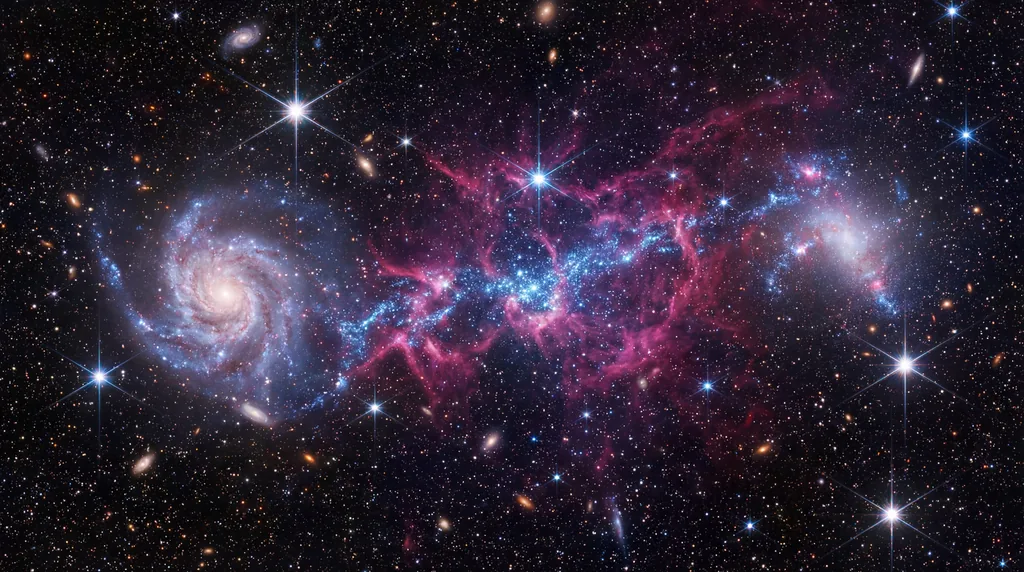

Astronomers have successfully reconstructed the star formation history of the Magellanic Bridge by applying synthetic color-magnitude diagram (CMD) techniques to deep optical data from the STEP survey. By analyzing the luminosity and color of thousands of individual stars, researchers led by M. Bellazzini, C. Tortora, and M. Gatto identified specific epochs of stellar birth, finding that gravitational interactions between the Large and Small Magellanic Clouds triggered a significant burst of star formation approximately 100 million years ago.
The Galactic Umbilical Cord
The Magellanic Bridge is a vast tidal stream of neutral hydrogen gas and stars that spans the gap between the Large Magellanic Cloud (LMC) and the Small Magellanic Cloud (SMC). This "galactic umbilical cord" serves as a unique laboratory for studying galaxy-galaxy interactions in our local cosmic neighborhood. Because the Bridge was formed by the gravitational forces exerted by the LMC on its smaller companion, it contains a pristine record of the dynamical history of these two dwarf galaxies. Understanding when stars formed within this bridge allows scientists to create more accurate models of how these galaxies have orbited each other over billions of years.
The SMC in Time: Evolution of its Stellar Populations (STEP) survey was designed to map this region in unprecedented detail. Covering a massive 54 square degrees across the SMC and the Bridge, the survey provides the depth required to observe stars that are far fainter than those seen in previous studies. This high-resolution data is essential for identifying the "main-sequence turnoff," the point where stars begin to exhaust their hydrogen fuel, which acts as a reliable cosmic clock for dating stellar populations.
How does tidal stripping affect star formation in the Magellanic Bridge?
Tidal stripping occurs when the Large Magellanic Cloud’s gravitational pull removes gas and stars from the Small Magellanic Cloud, concentrating this material into the Magellanic Bridge. This process creates high-density gas environments that trigger triggered star formation, allowing new stars to form in the intergalactic space between the two clouds where gas would otherwise be too sparse.
The gravitational dance between the LMC and the SMC has been a violent one. As the SMC made its most recent close approach (pericenter) to the LMC, the resulting tidal forces acted like a giant siphon, pulling a trail of low-metallicity gas into the Bridge. Research indicates that this gas provides the raw material for recent stellar nurseries. The STEP survey findings show that this stripping process is not uniform; the star formation intensity increases significantly as one moves closer to the SMC, where the gas reservoir is most concentrated. This suggests that the Magellanic Bridge is not merely a graveyard of old stars, but an active site of galactic rebirth.
When did the most recent star formation bursts occur in the Magellanic Bridge?
The most recent significant star formation burst in the Magellanic Bridge occurred approximately 100 million years ago, a finding that aligns with recent dynamical models of the Magellanic system's interaction. This peak in activity is most pronounced in the western portion of the Bridge, indicating that the recent close encounter between the LMC and SMC had a delayed but potent effect on stellar birth.
In addition to this 100 Myr peak, the research identified older populations that provide a longer-term perspective on the Bridge's history. While the western side (near the SMC) is dominated by young stars, the eastern part of the Bridge (closer to the LMC) tells a different story. In this region, star formation actually peaked much earlier, with significant episodes occurring roughly 2 billion years ago and even 10 billion years ago. This spatial variation suggests that the Bridge is composed of a complex mix of stars—some formed in situ during recent tidal events, and others stripped from the pre-existing stellar populations of the SMC during earlier encounters.
Decoding the Stellar Fossil Record
To reach these conclusions, the research team utilized the synthetic color-magnitude diagram (CMD) technique, which involves comparing observed stellar data to theoretical libraries. By simulating millions of stars with known ages and metallicities, the researchers can "match" the observed distribution of stars from the STEP survey. They employed two primary libraries of synthetic stellar populations: the PARSEC-COLIBRI and BaSTI stellar evolutionary models. These models covered a wide range of metallicities, from -2.0 to 0 [Fe/H], spanning the entire history of the universe.
The study focused on 14 square degrees of the STEP data, reaching stars well below the oldest main sequence turnoff. This level of depth is critical because it ensures that the oldest stars in the system—those that formed more than 10 billion years ago—are included in the analysis. By accounting for these ancient populations, the researchers were able to calculate a total stellar mass for the Bridge of approximately (5.1 ± 0.2) x 10^5 solar masses. This mass measurement provides a vital constraint for future simulations of the Magellanic system's evolution.
A Dynamic History of Interaction
The reconstructed star formation history (SFH) acts as a powerful constraint for dynamical modeling of the Magellanic system's past. Prior to this study, many models relied on gas dynamics alone; however, the stellar component provides a more permanent record of tidal history. The presence of intermediate-age stars in the Bridge suggests that the interaction between the two clouds is not a recent phenomenon but a recurring cycle that has persisted for billions of years. Specifically, the peak at 2 billion years ago suggests a prior close passage that significantly disrupted the SMC’s structure.
The present-day stellar metallicity of the Bridge was measured at approximately [Fe/H] ~ -0.6 dex. This value is remarkably close to the metallicity of the SMC, providing "smoking gun" evidence that the material in the Bridge was indeed stripped from the SMC rather than the LMC. The following key findings summarize the Bridge's current state:
- Total Stellar Mass: (5.1 ± 0.2) x 10^5 M⊙
- Major Peak (Recent): ~100 Myr ago, primarily in the western Bridge.
- Older Peaks: ~2 Gyr and ~10 Gyr, primarily in the eastern Bridge.
- Metallicity: ~-0.6 dex, matching the Small Magellanic Cloud.
Implications for Dwarf Galaxy Evolution
The study of the Magellanic Bridge has broader implications for our understanding of how dwarf galaxies evolve within the halos of larger galaxies like the Milky Way. As satellite galaxies interact, they lose mass through tidal stripping, which eventually leads to their transformation or total dissolution. The Bridge shows us that this process is not just about destruction; it is also about the rebirth of stars in the most unlikely of places. By studying these interactions, astronomers can better predict the ultimate fate of the Magellanic Clouds as they continue their descent toward the Milky Way.
Future research will likely focus on high-resolution spectroscopy to confirm the metallicities of individual stars within the Bridge. While the synthetic CMD technique is highly effective, direct spectroscopic measurements would provide even greater precision regarding the chemical enrichment history of the stripped gas. Additionally, as telescopes like the Vera C. Rubin Observatory come online, astronomers hope to map the full extent of the Bridge's faint stellar periphery, potentially discovering even older tidal debris that could rewrite the history of our nearest galactic neighbors.




Comments
No comments yet. Be the first!