
What is an intermediate-mass black hole?
An intermediate-mass black hole (IMBH) is a cosmic object with a mass ranging from 100 to 100,000 solar masses, effectively bridging the evolutionary gap between stellar-mass and supermassive black holes. These "missing links" are significantly rarer than their counterparts and are typically sought in dense star clusters or the outskirts of distant galaxies.
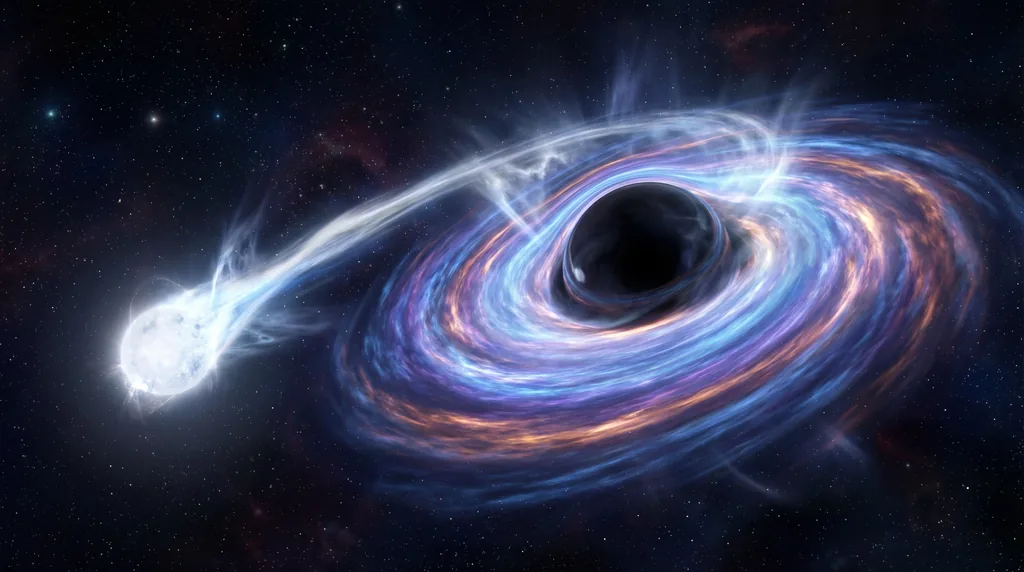
The discovery of EP250702a on July 2, 2025, by the China-led Einstein Probe mission represents a landmark moment in high-energy astrophysics. During a routine sky survey, the mission's Wide-field X-ray Telescope (WXT) detected a rapidly varying X-ray source that exhibited characteristics far beyond ordinary cosmic phenomena. This event, later corroborated by NASA's Fermi Gamma-ray Space Telescope, signaled the violent destruction of a white dwarf star by an IMBH, a phenomenon known as a tidal disruption event (TDE).
What makes the Einstein Probe space telescope unique?
The Einstein Probe is unique due to its innovative "lobster-eye" optics, which allow its Wide-field X-ray Telescope to monitor vast areas of the sky simultaneously with high sensitivity. This capability enables the detection of unpredictable and fast-evolving X-ray transients, providing the precise coordinates necessary for global follow-up observations across multiple wavelengths.
Mission scientist Professor Weimin Yuan of the National Astronomical Observatories of China (NAOC) emphasized that the satellite was specifically designed to capture these extreme moments. By providing real-time data on short-lived events, the Einstein Probe allows international teams to pivot ground-based and space-based assets quickly. In the case of EP250702a, the Follow-up X-ray Telescope (FXT) tracked the source for 20 days, observing a brightness drop by a factor of over 100,000 as the emission shifted from "hard" to "soft" X-rays.
What is the difference between intermediate-mass and supermassive black holes?
The difference between intermediate-mass and supermassive black holes lies in their total mass and galactic distribution; IMBHs weigh between 100 and 100,000 Suns, while supermassive black holes exceed 100,000 to billions of solar masses. While supermassive variants anchor the centers of large galaxies, IMBHs are often found in off-center locations or smaller stellar environments.
Analysis of EP250702a placed the outburst in the outskirts of a distant galaxy, rather than its nucleus. This off-center position is a critical signature of an intermediate-mass black hole, as supermassive black holes almost exclusively occupy the central gravitational well of their host galaxies. The sheer luminosity of the flare, peaking at approximately 3 x 10^49 erg per second, further distinguished this event from the more common stellar-mass black hole transients, marking it as a rare high-energy eruption.
The Mechanics of a Tidal Disruption Event
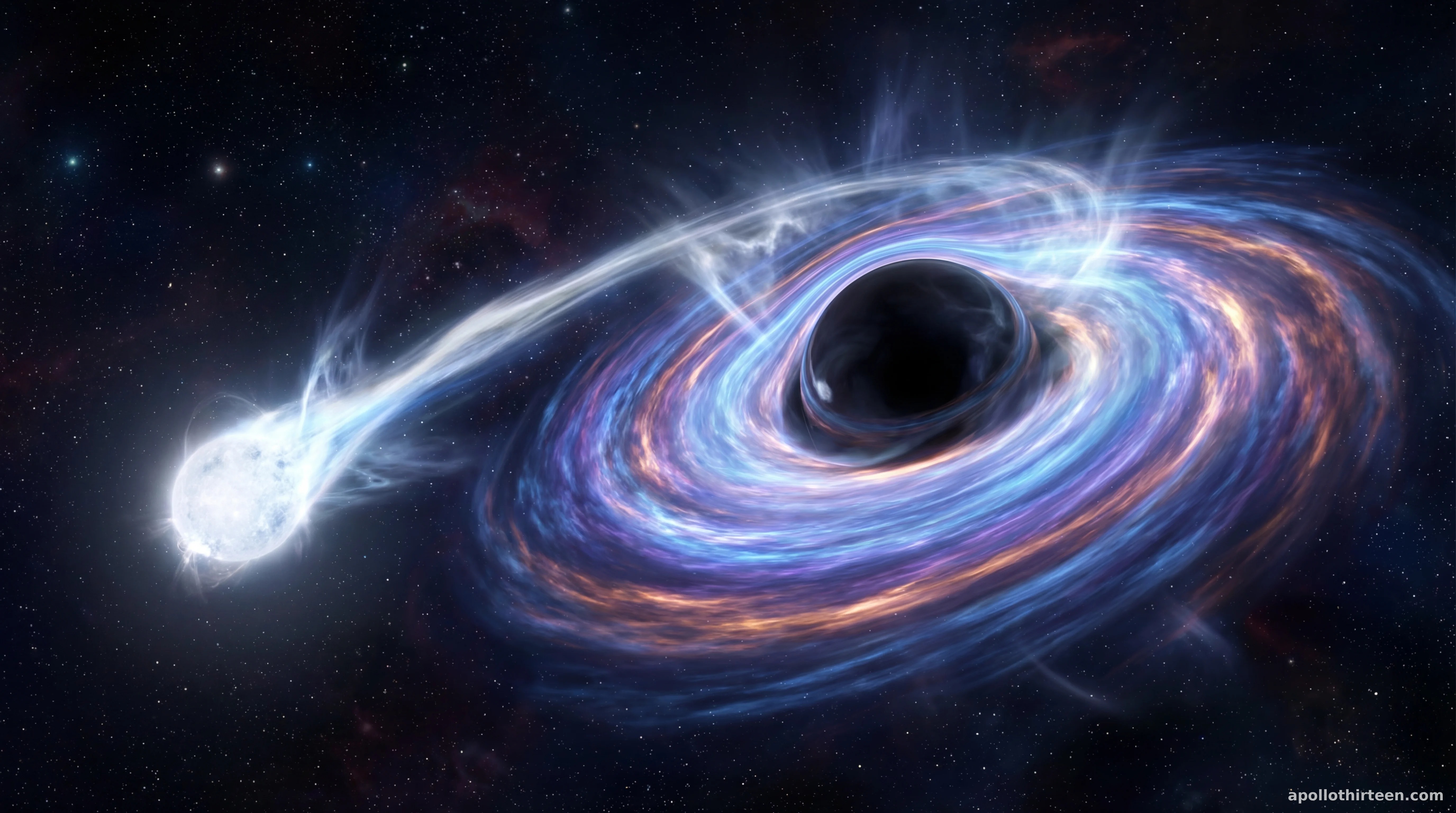
A tidal disruption event occurs when a star wanders too close to a black hole's event horizon and is torn apart by tidal forces. In this specific encounter, the extreme density of a white dwarf required the immense gravitational pull of an IMBH to initiate the shredding process. As the stellar material was pulled inward, it formed an accretion disk, generating a relativistic jet that produced the intense gamma-ray and X-ray signals observed by the Einstein Probe and Fermi telescopes.
Computational simulations led by Dr. Jinhong Chen, a postdoctoral fellow at The University of Hong Kong (HKU), confirmed this model. By applying numerical physics to the observational data, the team demonstrated that the energy output and evolutionary timescales were highly consistent with a white dwarf being consumed by an IMBH. This research suggests that the resulting jet was responsible for the high-energy emission that initially triggered the global astronomical alert.
Collaborative Research and Scientific Expertise
The interpretation of this rare event was the result of an extensive international collaboration involving over 300 scientists from 40 institutions. Key contributions came from the Department of Physics at HKU and the Hong Kong Institute of Astronomy and Astrophysics. Professor Lixin Dai, a co-corresponding author from HKU, noted that the white dwarf-IMBH model remains the most natural explanation for the unique data set gathered during the 20-day observation window.
- Principal Investigators: Scientists from HKU, NAOC, and the Max Planck Institute.
- Key Institutions: University of Science and Technology of China, ESA, and the French National Centre for Space Studies.
- Data Sources: Integrated feeds from X-ray, gamma-ray, and optical ground-based telescopes.
Implications for Modern Astrophysics
Identifying an IMBH through a tidal disruption event provides direct evidence for a population of black holes that has long eluded definitive detection. This discovery helps fill the "mass gap" in the black hole census, offering new insights into how these objects grow from stellar-mass seeds into the gargantuan black hole entities found at the centers of galaxies like the Milky Way. It also provides a laboratory for studying the ultimate fate of compact stars and the physics of relativistic jets.
Future research will focus on analyzing the transition of the emission from hard to soft X-rays, which provides a roadmap for the accretion process. Professor Bing Zhang, Director of the Hong Kong Institute of Astronomy and Astrophysics, highlighted that this discovery underscores the value of international cooperation in tackling frontier problems. As the Einstein Probe continues its survey, astronomers expect to find more examples of EP250702a, further illuminating the dark and violent corners of the evolving universe.




Comments
No comments yet. Be the first!