
China Achieves First Maritime Rocket Recovery: The Long March 10 and the 2030 Lunar Timeline
The China Manned Space Agency (CMSA) successfully retrieved a Long March 10 first-stage booster from the South China Sea on February 16, 2026, following a milestone test flight earlier that week. This achievement represents the first time China has recovered a major rocket component from the ocean, signaling a pivotal shift toward a fully reusable heavy-lift launch architecture. By successfully executing a controlled descent and maritime splashdown, China has validated key technologies required to lower the cost of its ambitious lunar exploration program.
The recovery operation was conducted on Friday morning in a preselected splashdown zone, where a specialized recovery vessel utilized a crane to lift the massive stage from the water. This hardware was part of a critical flight test involving the Long March 10 first-stage booster integrated with the Mengzhou crewed spacecraft. Following the recovery, the booster was secured for transport and subsequent structural analysis at facilities managed by the China Aerospace Science and Technology Corp (CASC). Engineers intend to use the data gathered from this post-flight inspection to refine the refurbishment protocols necessary for rapid launch turnarounds.
How does China's rocket recovery compare to the US?
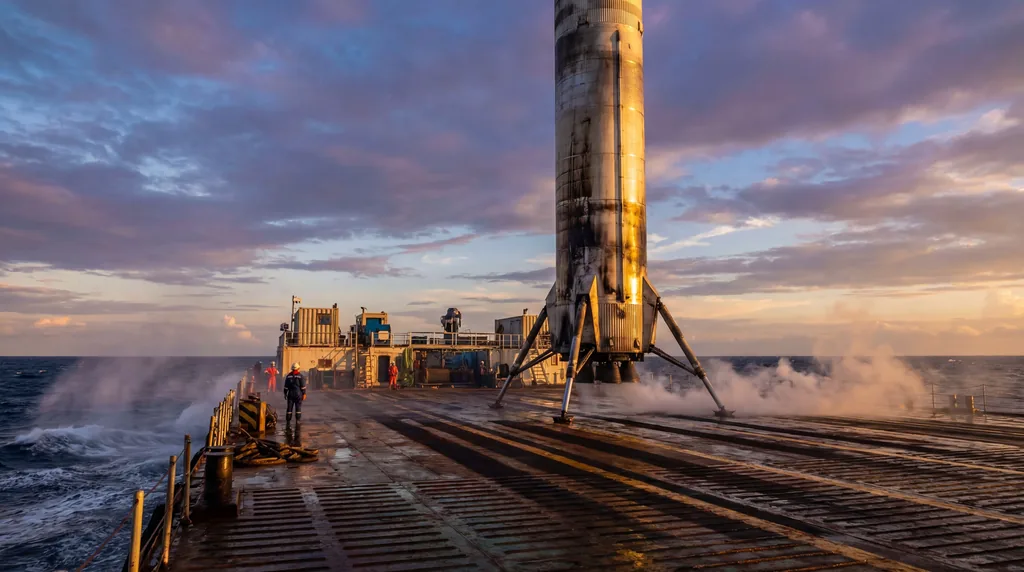
China's successful recovery of the Long March 10 booster in February 2026 marks its first major entry into the exclusive domain of reusable orbital-class rocketry, a field previously dominated by the United States. While this maritime splashdown demonstrates significant progress in controlled reentry and guidance, the U.S. maintains a substantial operational lead through SpaceX’s routine land-based and drone-ship landings, which have been standard practice for nearly a decade. Unlike the high-cadence reuse seen in the West, China is currently in the validation phase of its reusability roadmap.
The technical methodology employed during this test involved the booster performing a controlled return using its primary engines to decelerate through the atmosphere. This approach mirrors the vertical descent maneuvers pioneered by the Falcon 9, though China’s current recovery focused on a maritime splashdown rather than a vertical landing on a solid platform. Despite the developmental gap, the China Academy of Launch Vehicle Technology (CALT) has emphasized that this successful retrieval proves their ability to manage the thermal and aerodynamic stresses of reentry, a prerequisite for competing with American deep-space logistics capabilities.
Why is the Long March 10 important for China's lunar missions?
The Long March 10 is the central pillar of China’s lunar architecture, designed specifically to transport the Mengzhou crew spacecraft and the Lanyue lunar lander to the Moon. Standing 92.5 meters tall with a liftoff mass of 2,189 metric tons, this heavy-lift vehicle provides the 2,678 tons of thrust required to inject 27 tons of payload into an Earth-moon transfer trajectory. Without this specific launch vehicle, China would lack the lift capacity necessary to achieve its goal of landing taikonauts on the lunar surface before 2030.
Beyond its raw power, the Long March 10 is designed with a modular philosophy that supports multiple mission profiles. The standard lunar configuration utilizes a central core flanked by side boosters, while a shorter 67-meter variant is being developed to ferry 14 tons of cargo and crew to the Tiangong space station in low Earth orbit. By using a common first-stage design for both the lunar and space-station versions, Chinese engineers can streamline production and maximize the economic benefits of the newly demonstrated reusability features, ensuring a sustainable long-term presence in cislunar space.
What are grid fins on the Long March 10 booster?
Grid fins are foldable, lattice-like aerodynamic control surfaces located at the top of the Long March 10 booster that deploy during reentry to provide steering and stability. These fins are essential for navigating the booster through the varying densities of the Earth's atmosphere, allowing the flight computer to make precise adjustments to the descent path. By manipulating the high-velocity airflow, grid fins ensure the rocket remains upright and on target for its designated recovery zone in the South China Sea.
The integration of grid fins represents a sophisticated engineering hurdle, as these components must withstand extreme aerodynamic heating and turbulent pressures during high-velocity descent. In the recent test flight, the Long March 10 utilized these fins in conjunction with engine restarts to perform a "gentle splashdown." The successful deployment and performance of these surfaces are critical for future iterations of the rocket, which aim to transition from ocean splashdowns to precision landings on sea-based platforms or inland launch sites, further reducing the salt-water corrosion issues associated with maritime recovery.
When will China send astronauts to the moon using Long March 10?
China officially plans to conduct its first crewed lunar landing using the Long March 10 rocket by the year 2030, according to timelines released by the China Manned Space Agency. This ambitious schedule relies on a dual-launch strategy where one Long March 10 delivers the Lanyue lander into lunar orbit, while a second rocket launches the Mengzhou spacecraft to rendezvous with it. This milestone recovery of the first-stage booster is a prerequisite for verifying the reliability and cost-efficiency required for such complex mission architectures.
The path to 2030 involves several more intermediate test flights to ensure the safety of the crewed systems. Following the February 2026 test, the CMSA is expected to move into full-scale integrated testing of the three-stage lunar variant, which includes a specialized third stage for trans-lunar injection. Industry analysts note that the successful recovery of hardware from this test flight provides an invaluable opportunity for "forensic engineering," allowing CASC scientists to inspect engine wear and structural fatigue. These insights will be vital as China enters the final stages of research and development for the hardware that will eventually carry the first Chinese citizens to the lunar south pole.
The Economic and Strategic Implications of Reusability
- Reduced Launch Costs: Recovering the first-stage booster allows for the potential reuse of high-value engines and structural components, significantly lowering the price per kilogram for lunar payloads.
- Increased Launch Cadence: A reusable fleet enables China to fly missions more frequently, supporting the rapid construction of the planned International Lunar Research Station (ILRS).
- Technological Sovereignty: Mastering maritime recovery reduces China's reliance on expendable hardware, aligning its space program with modern global standards for sustainable exploration.
- Safety Protocols: Controlled returns minimize the risk of spent rocket stages falling over populated areas, a concern that has historically plagued inland Chinese launch sites.
Future directions for the Long March 10 program will likely focus on transitioning from "recovery for analysis" to "recovery for reuse." While the current booster was retrieved from the ocean, the ultimate goal of the China Academy of Launch Vehicle Technology is to achieve vertical landings on a specialized recovery vessel. This would eliminate the damaging effects of seawater immersion, allowing the engines to be refurbished and reflown with minimal turnaround time. As China continues to iterate on this technology, the global space community is witnessing the emergence of a second major power capable of sustained, reusable heavy-lift operations, forever changing the dynamics of the 21st-century space race.




Comments
No comments yet. Be the first!