growing buildings space: uncg — biology meets engineering
The partnership pairs Nicholas Oberlies’s fungal ecology lab at UNC Greensboro with Luna Labs, a Virginia-based product development firm that will perform structural testing and materials analysis. Oberlies’s team brings experience in culturing and characterizing fungi — including species such as oyster mushrooms (Pleurotus ostreatus) and certain shelf fungi noted for rigidity — while Luna Labs brings mechanical testing, compression measurements and the kind of standards-driven data engineers need to evaluate a new construction material.
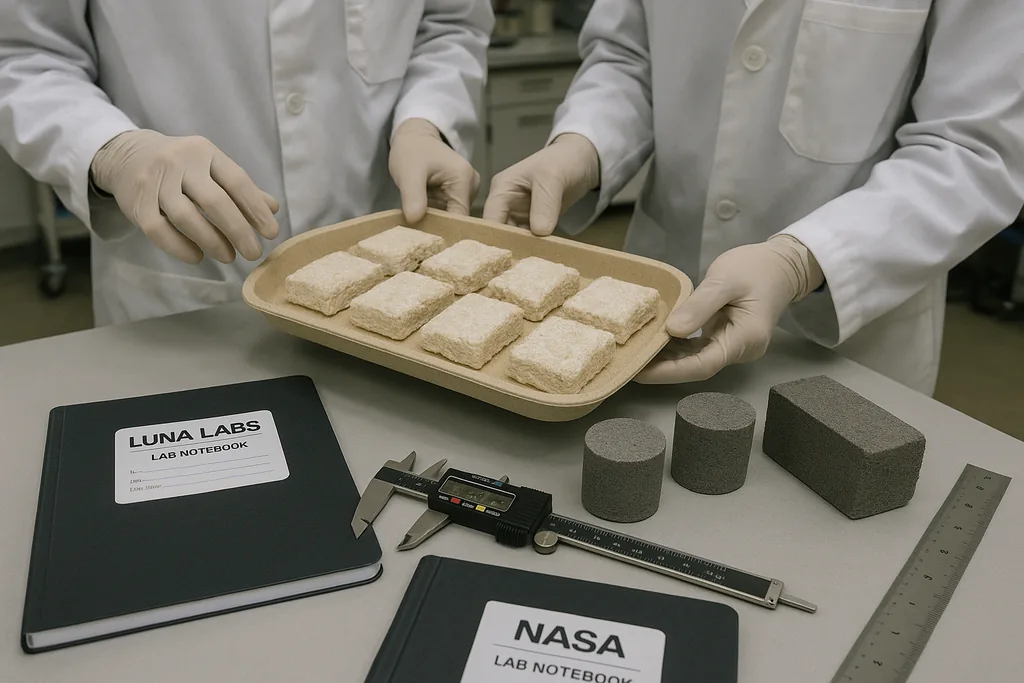
According to the university announcement, the plan is to culture fungal hyphae so they infiltrate and bind loose particles of regolith mixed with a nutrient stream derived from simulated human waste. If the hyphal network links the granular material effectively, researchers will sterilize and compress the composite into a consolidated block. Luna Labs will then quantify how much load these blocks can bear, how they behave under compression, and whether they can be made durable enough for habitats or other infrastructure.
The framing is quintessential in-situ resource utilization: rather than lifting bricks and cement from Earth, the system would grow and shape materials where they are needed, using only small starter payloads of spores or inoculum plus power, water and a nutrient loop. That makes the concept attractive to mission planners trying to minimize launch mass and long-term supply chains for Moon and Mars bases.
growing buildings space: uncg — tests, materials and metrics
At its core the UNCG–Luna Labs experiment tests three linked ideas: which fungal species tolerate regolith-like chemistry, whether a mycelial network can bind inorganic particles into a coherent composite, and what post-growth processing is required to make the material safe and structurally useful. The team will run controlled growth trials using simulated regolith (rock and dust analogues that mimic the Moon's or Mars’s surface) mixed with a feedstock intended to resemble recycled human waste, giving the fungus a carbon and nutrient source.
Once growth creates a dense mycelial matrix, the composite will be heat-treated or otherwise sterilized and mechanically consolidated into a brick-like form. Luna Labs will measure compressive strength, stiffness and failure modes; they will also test variability between batches and the effects of different growth recipes. Those data will determine whether the material is suited to non-load-bearing uses such as insulation or interior partitions, or whether it could be engineered toward structural roles.
The collaborators are explicit that this is early-stage research: the team seeks to identify promising species and process windows, not to deliver fully certified building blocks. Still, the emphasis on measurable material properties and repeatable testing marks a step beyond purely conceptual work — it is an attempt to move mycelium composites into engineering language mission designers can use.
Mycelium mechanics and practical advantages
Mycelium-based materials rely on networks of fungal hyphae — microscopic, thread-like filaments — that interweave and exude polymers to bind substrate particles together. In terrestrial demonstrations, mycelium composites made from agricultural waste are lightweight, thermally insulating and fire-resistant, and they can be grown into specific shapes with relatively little energy input compared with high-temperature sintering or conventional concrete curing.
For space applications the attractions are clear: fungi can convert waste streams into material, reducing logistics and closing loops in life-support systems; growth can occur at low temperatures relative to sintering; and the cellular structure of mycelium composites can provide inherent insulating properties for thermal control. In addition, because living systems can sometimes self-heal minor cracks, bio-based materials offer maintenance pathways that purely inert materials do not.
The UNCG project emphasises these possibilities while remaining cautious. The most likely near-term uses are non-load-bearing: habitat insulation, radiation-damping interior panels, or protective overburden for buried habitats. If compressive and tensile properties can be improved by additives or post-processing, broader structural roles could become plausible, but that remains an open question the current tests will probe.
Challenges and unanswered questions
Turning a promising laboratory demo into a mission-ready building material faces many hurdles. The Moon and Mars expose organisms and materials to near-vacuum or thin CO2 atmospheres, extreme temperature swings, and ionizing radiation — conditions very different from a humid lab bench. Growing mycelium will require water, a controlled atmosphere and temperatures compatible with fungal metabolism, all of which impose energy and engineering costs.
Planetary protection is another constraint: any biological approach must avoid contaminating planetary environments with Earth life. That means clear sterilization or containment strategies, which the UNCG team plans to test by sterilizing grown composites before deployment. There are also open questions about durability under micrometeoroid impact, long-term mechanical creep in low gravity, and how regolith chemistry (reactive perchlorates on Mars, for example) affects growth and material stability.
Finally, simulated human waste is a useful test feedstock on Earth, but real mission systems will require robust nutrient recycling loops and tight microbial control. Scaling up from small bricks to multi-meter structures raises additional engineering issues — framing, joining, sealing and integration with airlocks and power systems — that must be addressed in later development phases.
A path toward habitable habitats
The UNCG–Luna Labs work is one piece of a broader research agenda exploring biology as a construction technology for space. If tests show consistent mechanical performance and if engineering solutions can provide growth chambers, water recycling and sterilization at acceptable mass and power budgets, fungal composites could join a toolbox that already includes regolith sintering, 3D printing with cement-like binders and inflatable modules.
Near-term milestones are practical and modest: identify resilient fungal strains, quantify compressive strength and variability, and demonstrate a sterilization-and-consolidation workflow. Success in those steps would justify small-scale in-orbit or lunar demonstrations where controlled growth and post-processing can be tested in relevant environments. Over the longer term, a proven biofabrication chain might reduce reliance on Earth-supplied materials and open new design paradigms for shelters that grow from local dirt and recycled waste.
For now, the project’s value is as much conceptual as technical: it forces engineers and biologists to share units, timelines and failure modes. That translation — converting biological process descriptions into compression curves and design factors — is what will determine whether fungi remain an intriguing idea or become a practical tool for future explorers.
Sources
- UNC Greensboro (UNCG) — project announcement and research summary
- Luna Labs — materials testing and engineering partnership
- NASA — funding for in-situ resource utilization research




Comments
No comments yet. Be the first!