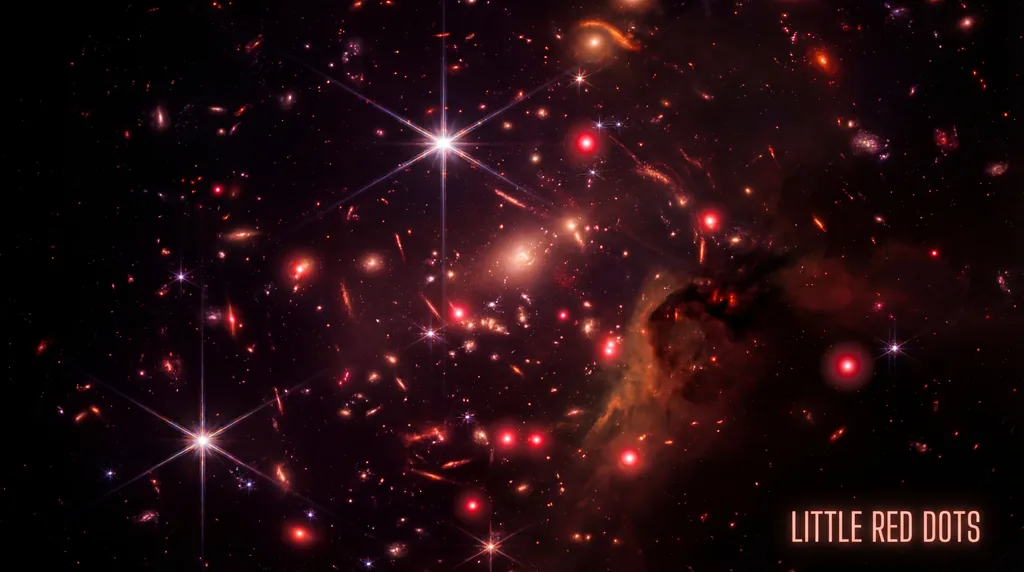

JWST NIRSpec spectra reveal that Little Red Dots (LRDs) at z~4 are composed of a dual-structure system featuring a compact, dust-enshrouded central engine and a more extended, blue star-forming host galaxy. High-resolution spectroscopic analysis indicates these objects possess a dramatic change in continuum slope from ultraviolet to optical wavelengths, with significant dust attenuation (A_V ~ 5.7) affecting the inner regions while the outer galaxy remains relatively clear. This discovery, led by researchers including Xin Wang, Qianqiao Zhou, and Hang Zhou, provides a critical window into the rapid maturation of galaxies just 1.5 billion years after the Big Bang.
The study of Little Red Dots has become a cornerstone of modern extragalactic astronomy since the James Webb Space Telescope (JWST) began its mission. These objects appear as tiny, crimson pinpricks in deep-space images, but their physical nature remained a subject of intense debate until the deployment of NIRSpec (Near-Infrared Spectrograph). By focusing on 11 LRDs at a redshift of approximately z~4, the research team sought to determine if the intense red color originated from massive amounts of dust in a starburst galaxy or the presence of a hidden, growing Black Hole. The resulting data suggests a complex interplay between central accretion and galactic evolution that was previously invisible to older observatories.
What do JWST NIRSpec spectra reveal about LRDs at z~4?
JWST NIRSpec spectra of Little Red Dots (LRDs) at z~4 reveal a compact red source embedded in a more extended blue star-forming galaxy, characterized by broad Hα emission and high dust attenuation. These observations show unresolved morphology in long-wavelength filters (radii < 0.17 kpc) while exhibiting extended structures in short-wavelength filters. This indicates a multi-component system where an active central core is obscured by dense gas, while the surrounding host galaxy continues to form stars.
High-resolution spectroscopy allows astronomers to decompose the light from these distant objects into broad and narrow components of the Balmer emission lines. The researchers found that while the UV continuum is relatively blue and likely dominated by stellar light, the optical and near-infrared (NIR) continuum is exceptionally red. This shift is quantified by an attenuation value of A_V = 5.7 for the optical components, suggesting that the central regions are buried behind a massive screen of cosmic dust. Such high levels of extinction are characteristic of Active Galactic Nuclei (AGN) that are still in their formative, "enshrouded" stages of development.
How does the broad Hα luminosity indicate Black Hole origin in LRDs?
Broad Hα luminosity indicates a Black Hole origin because the extreme widths of these emission lines (2000–4300 km/s) signal gas moving at high velocities within a broad-line region. This specific spectroscopic signature is a hallmark of gravity-driven motion near a supermassive Black Hole. The correlation between the broad Hα luminosity and the optical continuum further reinforces that both emissions arise from a common central engine rather than star formation.
The research team utilized the width and luminosity of the Hα line to calculate the masses of the Black Hole at the heart of each LRD. They estimated these central engines range from 10^6 to 10^8 solar masses. Furthermore, these objects exhibit high Eddington ratios (λ_Edd ~ 0.6), which means they are consuming material at nearly the maximum theoretical rate possible. This rapid accretion explains how these massive entities could exist so early in cosmic history, essentially providing a snapshot of a "growth spurt" that allows Black Hole seeds to reach gargantuan proportions in a very short timeframe.
What is the 'Clumpy Envelope' model for high-redshift Black Hole environments?
The 'Clumpy Envelope' model proposes that the optical emission in LRDs arises from an extended, clumpy gas structure with a radius of tens of light-days surrounding the central engine. This model accounts for the observed diversity in optical continuum shapes through radial temperature gradients and self-absorption effects within the gas. It explains how light from a Black Hole can appear both highly obscured and yet visible in specific spectral lines.
This clumpy architecture is essential for reconciling the size of the broad-line region with the observed luminosity of the LRDs. In traditional AGN models, the light is often blocked uniformly by a "torus" of dust, but the Clumpy Envelope suggests a more chaotic environment. By assuming a slim-disk model of accretion, the researchers inferred growth timescales of approximately 10^5 to 10^7 years. This suggests that the LRD phase is a transient but intense epoch of Black Hole growth, where the surrounding environment is still thick with the raw materials needed for accretion.
Evolutionary Pathways: From LRDs to Seyfert Galaxies
LRDs may represent the precursors to narrow-line Seyfert 1 galaxies, serving as the "infant" stage of the well-known active galaxies seen in the local universe. The study suggests that as the Black Hole continues to grow and its radiation pressure clears out the surrounding clumpy envelope, the LRD will transition into a more conventional AGN. This evolutionary link is supported by the intrinsically weak optical Fe II emission found in the LRD spectra, which differentiates them from mature quasars but aligns them with younger, rapidly accreting systems.
The transition from a "Little Red Dot" to a stable galaxy involves a delicate balance of feedback and fuel. As the central Black Hole reaches a critical mass, its energy output may eventually quench star formation in the host galaxy or blow away the dust that gives the LRD its signature red color. The z~4 epoch is therefore a critical laboratory for understanding how the symbiotic relationship between a galaxy and its central singularity is established. The findings by Wang et al. demonstrate that the early universe was far more active and dust-rich than some previous models had predicted.
Future Implications for Cosmology and JWST Surveys
These findings reshape our understanding of early supermassive Black Hole formation by proving that rapid growth phases are common in the early universe. By identifying the LRDs as site of intense accretion, scientists can better calibrate their models of how the first large structures in the cosmos formed. The sheer number of LRDs discovered by JWST suggests that the "impossible" growth of black holes shortly after the Big Bang may not be an anomaly, but a standard phase of galactic maturation.
- High Impact: This research provides some of the first high-resolution spectral confirmation of the AGN nature of LRDs.
- Measurements: Black hole masses of 10^6-10^8 M⊙ and accretion rates at 60% of the Eddington limit.
- Institutions: The analysis relies on data from JWST/NIRSpec, representing a global collaboration in infrared astronomy.
- Next Steps: Upcoming surveys are expected to provide larger samples of LRDs to determine if their "clumpy envelopes" are universal.
Upcoming JWST surveys will further categorize the LRD population to determine if these objects are the primary drivers of galaxy evolution at high redshifts. Astronomers are particularly interested in whether the LRD phase is universal for all massive galaxies or if it represents a unique pathway for only a specific subset. As more data from NIRSpec becomes available, the "Little Red Dots" may finally lose their status as mysteries and become well-defined milestones in the history of the Black Hole and its host galaxy.




Comments
No comments yet. Be the first!