The Day That Changed Everything
In the spring of 1993, the hallways of Building 31 at CERN, the European Organization for Nuclear Research, did not hum with the anticipation of a global revolution. There were no flashing lights, no television crews, and certainly no sense that the world was about to tilt on its axis. Instead, there was the rhythmic click of keyboards and the smell of stale coffee. In a modest office, a sleek, black NeXTcube computer sat quietly, adorned with a hand-scrawled sticker that warned in frantic red ink: "This machine is a server. DO NOT POWER IT DOWN!!"
On that machine lived a fledgling system of interconnected documents that its creator, a British computer scientist named Tim Berners-Lee, called the World Wide Web. For three years, it had been a niche tool for particle physicists to share data across the lab’s sprawling complex beneath the Franco-Swiss border. It was clever, certainly, but it was just one of many competing systems vying to organize the chaotic, text-heavy wilderness of the early internet.
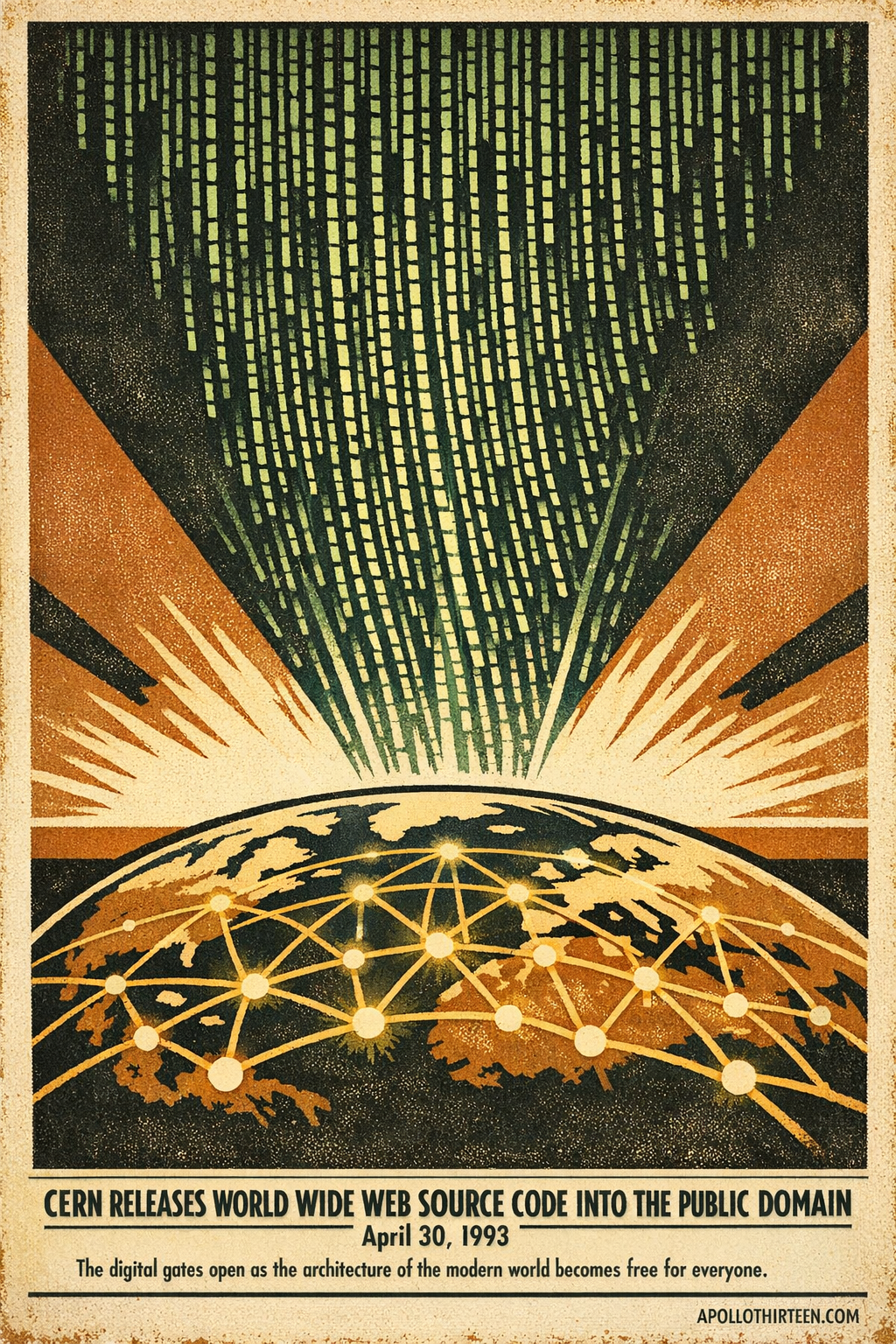
Then came April 30, 1993. On this day, thirty-three years ago, a two-page internal memo was signed with remarkably little fanfare. It wasn't a manifesto or a call to arms; it was a legal surrender. With a few strokes of a pen, CERN’s directors declared that the organization was relinquishing all intellectual property rights to the World Wide Web software. They were giving it away—entirely, irrevocably, and for free.
In that moment, the digital gates were thrown open. The architecture of the modern world transitioned from a proprietary academic experiment into a public utility. Had CERN decided to patent the web, or to charge a few cents for every hyperlink clicked, the history of the 21st century would look unrecognizable. Instead, they chose a path of radical openness, triggering a digital Big Bang that continues to expand to this day.
What Actually Happened
The event that redefined human communication was, in its physical form, an exercise in mundane bureaucracy. The document, titled "Statement concerning CERN W3 software," was addressed simply "To whom it may concern." It was signed by Walter Hoogland, the Director of Research, and Helmut Weber, the Director of Administration.
The memo stated: "CERN relinquishes all intellectual property rights to this code, both source and binary form, and permission is granted for anyone to use, duplicate, modify and redistribute it." This applied to the three pillars of the project: the basic "Line-Mode" browser, the W3 server (httpd), and the "libwww" library of common code that allowed different computers to speak the same language.
There was no press conference. The document was physically stamped with a rubber "CERN" date stamp on May 3, but the legal release was effective as of April 30. At the time, the software was actually for sale for about 50 Euros per site. By signing this memo, CERN effectively deleted that price tag and invited the world to take the source code, tear it apart, and build something better.
This was a calculated gamble. CERN's primary mission was—and remains—unraveling the mysteries of the universe through physics. Supporting a commercial software product was outside their mandate and beyond their budget. By making the web public domain, they ensured its survival by making it impossible for any single entity to control it. They didn't just release a product; they released a standard.
The People Behind It
While the signatures on the memo belonged to directors, the soul of the movement belonged to two men who had spent years navigating the labyrinth of CERN’s administration.
Tim Berners-Lee was the visionary. He had proposed the web in 1989 as a way to solve the problem of "losing" information as researchers moved between projects. He didn't just want a library; he wanted a "mesh" of knowledge. Berners-Lee was adamant from the beginning that the web could only succeed if it was a non-proprietary standard. He spent months lobbying his superiors, arguing that if CERN tried to monetize the web, the internet would remain fragmented and the web would eventually wither away.
Robert Cailliau, a Belgian systems engineer, was Berners-Lee’s first collaborator and the project's most vital diplomat. While Berners-Lee focused on the code—HTML, HTTP, and the concept of the URL—Cailliau focused on the people. He recognized that the greatest threat to the web wasn't a technical bug, but a legal one. He navigated the complex administrative landscape of CERN, convincing skeptical physicists and lawyers that giving away their intellectual property was not an act of surrender, but an act of leadership.
Then there were Walter Hoogland and Helmut Weber. These men had to make the final call. Hoogland, in particular, had tried to interest the European Commission in the web, hoping for a coordinated European technological push. When the EU proved too slow to act, Hoogland realized that the only way to save the web was to set it free. He signed the document knowing that CERN was giving up a potential gold mine in exchange for a global legacy.
Why the World Reacted the Way It Did
To understand why the CERN release was so explosive, one must look at what was happening elsewhere on the internet in early 1993. At the time, the web was the underdog. The dominant system for finding information was "Gopher," a menu-based protocol developed at the University of Minnesota. Gopher was faster, more intuitive, and had a significantly larger user base than Berners-Lee’s web.
However, in February 1993, just two months before the CERN announcement, the University of Minnesota made a fateful decision: they announced they would begin charging licensing fees for certain commercial uses of Gopher. The move sent a wave of anxiety through the nascent internet community. Developers who had spent years building on Gopher suddenly realized they were building on rented land.
When CERN’s memo arrived on April 30, it felt like a rescue mission. Here was a system—arguably more powerful than Gopher because of its "hypertext" ability to link any document to any other—and it was being offered for free, with no strings attached. The reaction was swift and seismic within the technical community.
The "Great Migration" began almost overnight. Developers abandoned Gopher in droves and turned their attention to the web. In April 1993, there were only about 50 known web servers in existence. By October, that number had jumped to 500. By the end of the following year, the web had effectively consumed all other internet traffic, leaving Gopher, FTP, and Usenet in its wake.
Curiously, the mainstream media missed the story entirely. There were no headlines in The New York Times or The Guardian on May 1, 1993. To the general public, the "internet" was still a mysterious realm for academics. The significance of the CERN release would only become clear years later, as the world began to realize that the fundamental language of human interaction had been democratized before most people even knew it existed.
What We Know Now
Three decades later, the decision to release the source code is viewed as one of the most successful policy decisions in history. It prevented the "balkanization" of the digital world. Had the web been proprietary, we likely would have seen a landscape of closed "walled gardens"—perhaps a Microsoft Web, an IBM Web, and a French Minitel Web—none of which could communicate with the others.
The release also provided the legal bedrock for the browser wars of the 1990s. When Marc Andreessen and his team at the NCSA in Illinois developed Mosaic—the first browser to display images alongside text—they were able to do so because the underlying "libwww" code from CERN was free to use. Mosaic eventually morphed into Netscape, which in turn forced Microsoft to develop Internet Explorer. This competition, which drove the rapid evolution of the web, was only possible because the foundation was public property.
We also now recognize the 1993 release as a precursor to the modern Open Source movement. While the term "Open Source" wouldn't be coined for another five years, CERN's move established the precedent that the most important infrastructure of the digital age should be open to all. It proved that a "gift economy" could outperform a traditional market model when it came to establishing global standards.
Legacy — How It Shaped Science Today
The legacy of April 30, 1993, extends far beyond our ability to stream video or order groceries. It fundamentally changed the culture of science itself. This "CERN Effect" established the idea that the tools created for high-level research belong to the public that funds them.
Today, this philosophy drives the Open Science movement. When the Large Hadron Collider (LHC) generates petabytes of data, much of it is eventually made available through open-access portals. Scientific journals have shifted toward open-access models, ensuring that breakthrough research isn't hidden behind paywalls. The web's birth at CERN ensured that the organization’s legacy isn't just about finding the Higgs Boson, but about creating a world where information flows without borders.
However, the anniversary also serves as a reminder of what we have lost. Berners-Lee’s original vision for the web was that every browser would also be an editor—a space where every user was a creator. As the web grew, it became increasingly passive, a medium for consumption rather than collaboration. It wasn't until the rise of Wikis and social media that the "editable" web returned, albeit in a more centralized, corporate-controlled form.
Thirty-three years later, the memo signed by Hoogland and Weber remains a testament to the power of a simple, selfless act. By choosing not to own the web, CERN allowed the web to own the future. It remains perhaps the greatest gift ever given to humanity by a scientific institution—a free, open map to the sum of all human knowledge, available to anyone with a connection and a curiosity to explore.
Fast Facts
- The Date: April 30, 1993 (Legally released); May 3, 1993 (Physically stamped).
- The Hardware: The web was born on a NeXTcube, a high-end workstation designed by Steve Jobs during his time away from Apple.
- The Original Name: Tim Berners-Lee considered naming the system "The Information Mesh," "The Information Mine," or "Mine of Information" (MOI) before settling on "World Wide Web."
- The Scale: In April 1993, there were roughly 50 web servers. Today, there are over 1.1 billion.
- The Cost: Before the release, the source code was sold for 50 Euros per site. After the release, the cost dropped to zero forever.
- The First Site: The first website ever created is still live today at info.cern.ch.



Comments
No comments yet. Be the first!