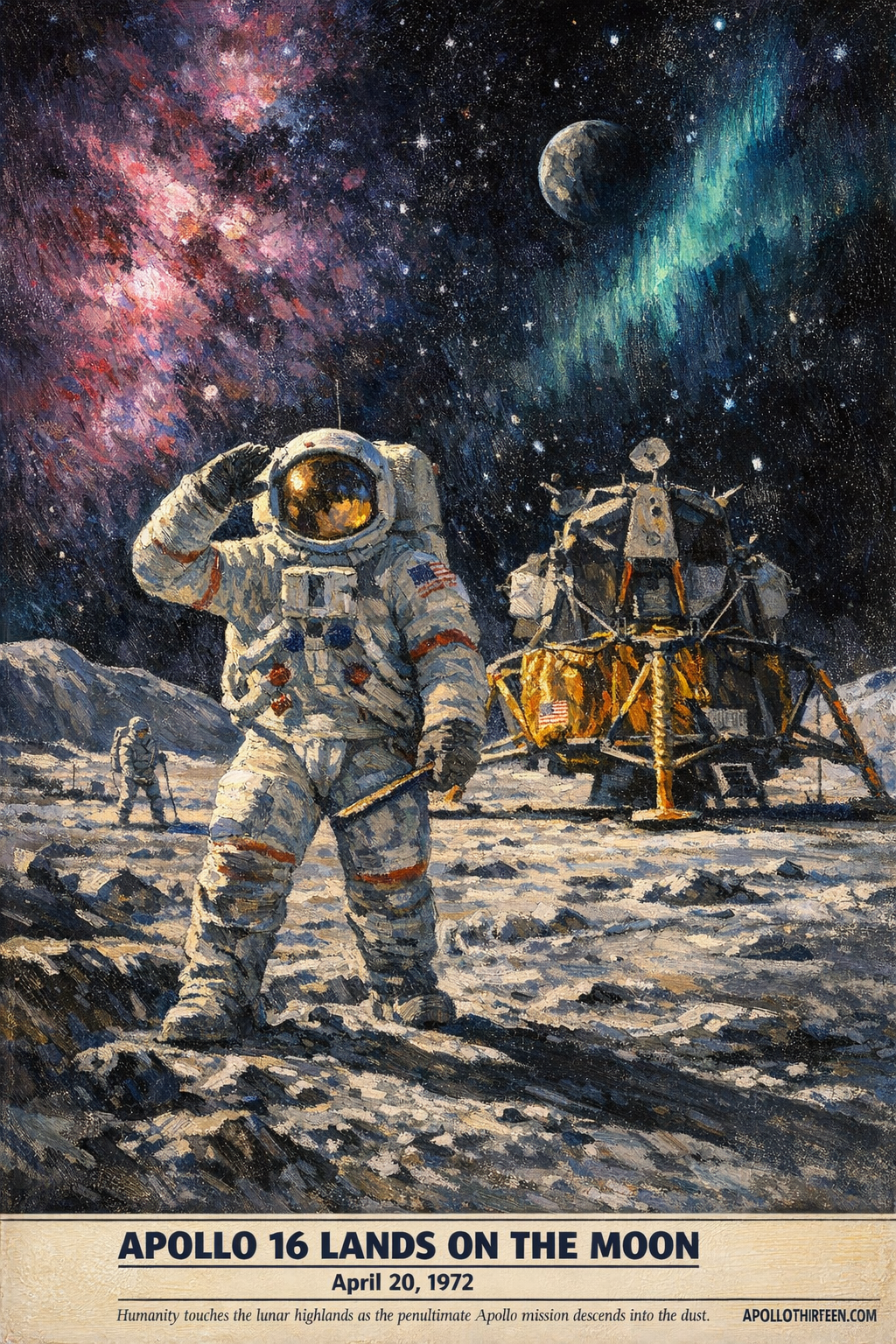
The Day That Changed Everything
Fifty-four years ago today, 240,000 miles above the Earth, a metallic insect-like craft named Orion drifted in the velvet blackness of lunar orbit. Inside, John Young and Charlie Duke were waiting for a death sentence—or a miracle. For six agonizing hours, the mission that was supposed to be the jewel of the Apollo program hung by a literal thread. A mechanical gremlin in the command module’s engine had turned a routine undocking into a high-stakes standoff. If the engine failed, Young and Duke wouldn’t just miss the Moon; they would be stranded in the abyss, and Ken Mattingly, orbiting alone in the command module Casper, would be unable to bring them home.
The tension in Mission Control was thick enough to choke. Flight directors stared at oscillating graphs, calculating the risk of a backup gimbal motor that refused to behave. To land on the Moon was to gamble with physics, but this was different. This was a technical breach of the mission rules. According to the book, they should have aborted. But Apollo 16 was different. It wasn’t just another landing; it was a journey to the Descartes Highlands, a rugged, mountainous region that scientists believed held the secrets to the Moon’s volcanic soul. To turn back now was to leave the most important geological questions of the space age unanswered.
Finally, the word came down: "Go." At 9:23 PM EST on April 20, 1972, John Young—perhaps the coolest pilot to ever wear a pressure suit—guided Orion down through a blizzard of silver dust. As the footpads settled into the lunar soil, Young looked out at the rolling hills and jagged craters of the highlands. "There you are: Mysterious Old Descartes," he whispered. "Apollo 16 is gonna change your image." He had no idea how right he was.
What Actually Happened
The landing of Apollo 16 was the penultimate act of the most ambitious engineering project in human history. By 1972, NASA had mastered the art of getting to the Moon, but Descartes was a new kind of challenge. Unlike the flat, basaltic plains of the "seas" (the Maria) visited by previous missions, Descartes was high, old, and incredibly rough. Scientists were convinced that the hills they saw through telescopes—the Cayley Plains and the Descartes Formation—were the result of thick, viscous lava flows, similar to the volcanic landscapes of the Andes or the Cascades on Earth.
The mission was a marathon of physical and scientific endurance. Young and Duke spent nearly 71 hours on the lunar surface, three days in which they lived, slept, and worked out of a cabin the size of a large closet. They conducted three separate Extravehicular Activities (EVAs), totaling over 20 hours of moonwalking. They drove the Lunar Roving Vehicle (LRV) for 16 miles, pushing the "Moon Buggy" to its absolute limits, climbing the slopes of Stone Mountain and skirting the edges of North Ray Crater.
But the mission was plagued by the "Apollo jinx." Beyond the initial engine scare, Young accidentally tripped over a critical cable for the heat flow experiment, snapping it instantly. It was a heart-wrenching moment; months of scientific planning were undone by a single misplaced boot in the bulky, pressurized suit. Yet, despite the setbacks, the crew collected 95.7 kilograms of lunar material—a geological treasure trove that would eventually turn the scientific community upside down.
The People Behind It
The success of Apollo 16 rested on the shoulders of three men whose personalities couldn’t have been more different, yet whose synergy was perfect for the task. John W. Young was the veteran’s veteran. Having already flown Gemini 3, Gemini 10, and Apollo 10, he was a man of few words and legendary composure. He would later go on to command the first-ever Space Shuttle flight, cementing his status as the "astronaut's astronaut."
Charlie Duke was the spark plug. At 36, he was the youngest person ever to walk on the Moon. Duke was already a part of space history; he was the voice of CAPCOM during the Apollo 11 landing, the man who told Neil Armstrong, "You got a bunch of guys about to turn blue. We're breathing again." On the Moon, Duke’s enthusiasm was infectious, though it nearly led to disaster when he attempted a "lunar high jump" for the cameras, falling backward onto his life-support pack—an accident that could have been fatal had the suit’s pressure been compromised.
Then there was Ken Mattingly. Mattingly’s story was one of redemption. Two years earlier, he had been pulled from the Apollo 13 crew just 72 hours before launch because of exposure to the measles. He had watched from the ground as his crewmates fought for their lives. Now, finally at the Moon, Mattingly proved his worth, operating a sophisticated suite of cameras and sensors from the command module Casper, mapping the lunar surface with unprecedented precision while his friends were in the dirt below.
On the ground, the mission was supported by visionaries like George Carruthers, a brilliant African American astrophysicist who designed the Far Ultraviolet Camera/Spectrograph. This was the first true astronomical observatory placed on another world. While Young and Duke were hunting for rocks, Carruthers’ camera was capturing the Earth’s geocorona and distant stars in wavelengths that are invisible through Earth’s atmosphere, proving that the Moon was the ultimate platform for observing the universe.
Why the World Reacted the Way It Did
To understand Apollo 16, one must understand the year 1972. The raw wonder of Apollo 11 had faded into a peculiar kind of "lunar fatigue." To the average American, moon landings had become almost routine. The evening news was dominated by the escalating Vietnam War and the tremors of the Watergate scandal, which was just beginning to stir. While the 1969 landing had stopped the world, Apollo 16 was often relegated to the middle pages of the newspaper.
Public interest was waning, and so was political support. The Nixon administration, facing a cooling economy and a shift in national priorities, had already swung the axe on the final three planned Apollo missions. Apollo 16 was seen by many in Washington as an expensive remnant of the Kennedy era—a victory lap for a race that had already been won. The program was being dismantled even as Orion sat on the lunar surface.
Yet, within the scientific community, the reaction was the opposite of fatigue. It was feverish excitement. For the first time, NASA wasn't just trying to prove it could land; it was doing deep, investigative field geology. This was "pure science" at the highest level. The lack of fanfare from the general public didn't matter to the geologists at Mission Control; they knew that Young and Duke were standing in the middle of a mystery that was about to break wide open.
What We Know Now: The Great Paradigm Shift
The legacy of Apollo 16 is defined by what the astronauts didn't find. Every scientist on Earth expected Young and Duke to bring back volcanic rocks. They expected to see the cooled remains of ancient lunar eruptions. Instead, everywhere they looked, they found "breccias."
Breccias are the Frankenstein's monsters of the geological world—rocks made of smaller fragments of other rocks, shattered and fused together by the immense heat and pressure of meteorite impacts. As the mission progressed, the expected volcanic narrative began to crumble. The Descartes Highlands weren't built by volcanoes; they were shaped by a cosmic rain of fire. This discovery forced planetary scientists to completely rewrite the Moon's history.
We now know, thanks to Apollo 16, that the early Moon was a place of unimaginable violence. The highlands represent the "original" crust of the Moon, formed during a period when the entire lunar surface was a "magma ocean." As this ocean cooled, lighter minerals floated to the top, forming the highlands. Then, for hundreds of millions of years, giant asteroids slammed into this crust, grinding the surface into the breccias Young and Duke collected. This realization changed our understanding of the entire inner solar system, including the early history of our own Earth.
Legacy — How It Shaped Science Today
Fifty-four years later, Apollo 16 is not a museum piece; it is a foundation. The 211 pounds of rocks brought back by the crew are still being analyzed today using technology the scientists of 1972 couldn't have dreamed of. From mass spectrometry to 3D X-ray imaging, these samples continue to reveal the isotopic secrets of the Moon's birth and the chemical composition of the solar wind.
The mission also served as the ultimate test bed for lunar mobility. The performance of the Lunar Rover on the steep slopes of the highlands provided the data necessary to design the robotic rovers that currently traverse Mars, and it is informing the design of the next generation of pressurized rovers for the Artemis program. When astronauts return to the Moon later this decade, they will be using navigational techniques and geological sampling methods pioneered by Young and Duke.
Perhaps most importantly, Apollo 16 taught us about the human element of exploration. It gave us the "Orange Juice Incident," where John Young’s hot-mic complaints about gastric distress from potassium-enriched juice reminded the world that these icons were also human beings. It gave us the image of Charlie Duke’s family photo, left behind in the dust—a poignant reminder that we didn't just send machines to the Moon; we sent families, dreams, and a piece of our shared humanity.
As we look back at the 54th anniversary, Apollo 16 stands as a testament to the power of scientific curiosity. It was the mission that proved that the more we think we know about the universe, the more it has the power to surprise us. The "Mysterious Old Descartes" wasn't what we thought it was, and because three men dared to go there, we finally began to see the Moon for what it truly is: a witness to the history of the solar system, waiting for us to return and read the rest of its story.
Fast Facts: Apollo 16 at a Glance
- Launch Date: April 16, 1972
- Lunar Landing: April 20, 1972, at 9:23:35 PM EST
- Landing Site: Descartes Highlands
- Crew: John Young (Commander), Charlie Duke (Lunar Module Pilot), Ken Mattingly (Command Module Pilot)
- Total Lunar Surface Time: 71 hours, 2 minutes
- Samples Collected: 95.7 kilograms (211 lbs) of lunar rock and soil
- Notable Hardware: First and only Far Ultraviolet Camera/Spectrograph used on the Moon
- The "Grand Prix": John Young performed a high-speed test of the Lunar Rover, reaching nearly 11 mph (18 kph)
- Anniversary: 54 years since the lunar landing
Comments
No comments yet. Be the first!


