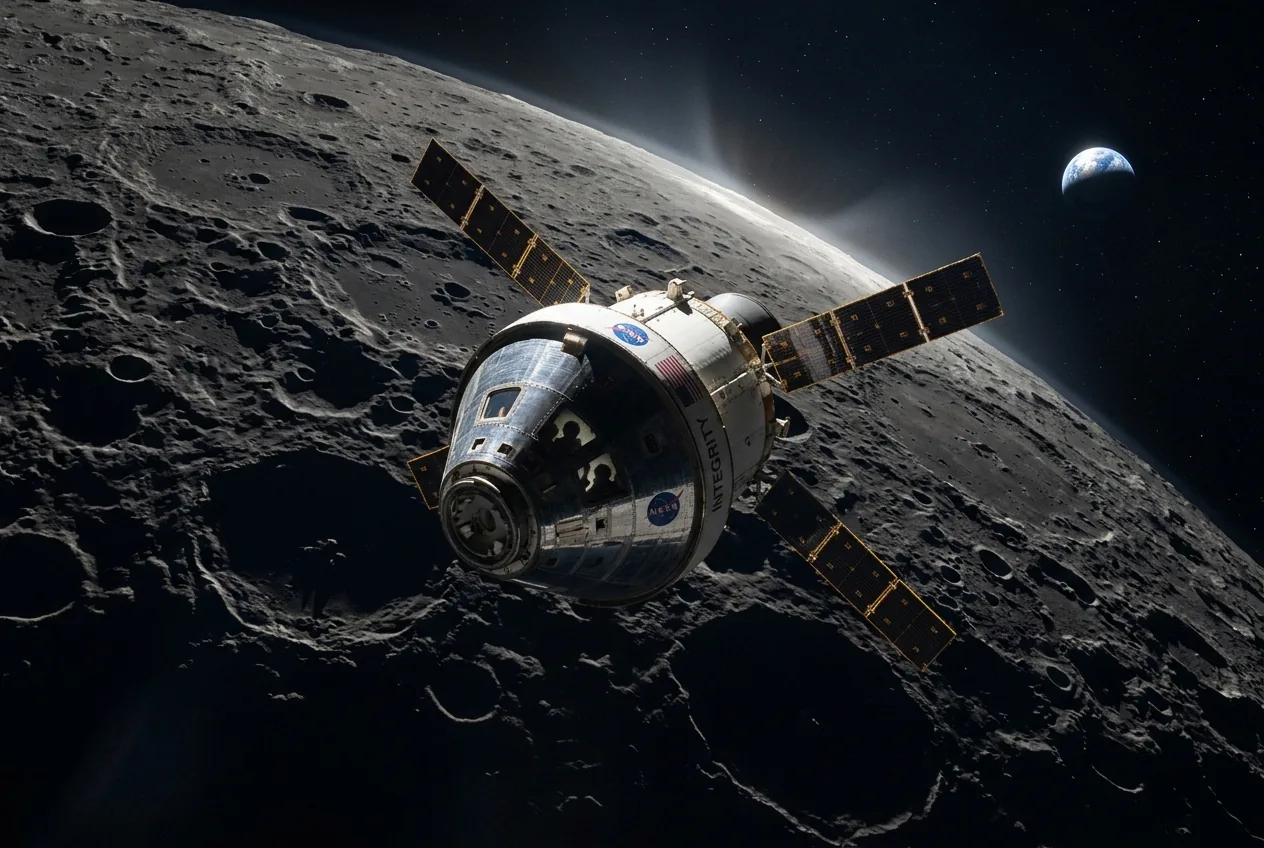
For forty minutes on April 6, the four astronauts aboard Artemis II were completely cut off from Earth. Drifting 406,773 kilometres from home behind the far side of the Moon, they spent the communications blackout watching an hour-long solar eclipse visible only to their capsule.
When the telemetry finally reconnected, Orion had quietly eclipsed a 56-year-old human spaceflight record, passing the 248,655-mile high-water mark set by Apollo 13 in April 1970. The milestone, however, is not a product of raw American rocket power. It is the result of a meticulously timed free-return trajectory, a lunar apogee, and a European-built service module keeping the crew breathing while Newton’s laws did the heavy lifting.
A matter of orbital scheduling
It is tempting to attribute the new distance record to the Space Launch System stack that lofted Orion on April 1. But thrust only determines mass to orbit, not maximum distance. Artemis II beat Apollo 13 because mission planners exploited a celestial calendar quirk. The spacecraft's lunar encounter coincided with the Moon's apogee—the most distant point in its elliptical orbit around Earth.
The trajectory itself was a free-return profile, identical to the emergency route used in 1970. Rather than burning fuel to insert the capsule into lunar orbit, engineers timed the trans-lunar injection to swing Orion past the far side. From there, lunar gravity simply bent the trajectory back toward Earth, trading raw propulsion for orbital mechanics.
Flashes on the far side
The record distance was achieved during a six-hour observational window where the capsule skimmed 6,547 kilometres above the lunar terrain. This is a long way up, but close enough to gather visual data unavailable to automated probes. Re-establishing contact after the blackout, the crew reported real-time sightings of transient lunar phenomena, including multiple impact flashes on the surface.
These manual observations serve a dual purpose. They validate the capsule’s optical windows and observational protocols, while confirming that a human crew can actively monitor the environment when automated systems are blinded by the Moon's bulk.
The Bremen supply chain
Below the crew cabin, the critical hardware enabling this ten-day flight was assembled in Germany. The European Service Module provides Orion's propulsion, power, and life-support. Validating its performance under deep-space thermal loads was the primary pragmatic objective of the mission before the capsule's scheduled splashdown on April 10.
Artemis II is a systems check for the rendezvous and landing architectures planned for Artemis III and IV. For European industrial policy, it is a visible proof of concept for supply-chain sovereignty. ESA contractors have delivered the modules, but they are operating in an environment of fluctuating space budgets and procurement delays.
The orbital mechanics for the next landing are already calculated. The Moon keeps a strict calendar. Brussels will have to figure out how to match it.



Comments
No comments yet. Be the first!