The 31-Second Heartbeat
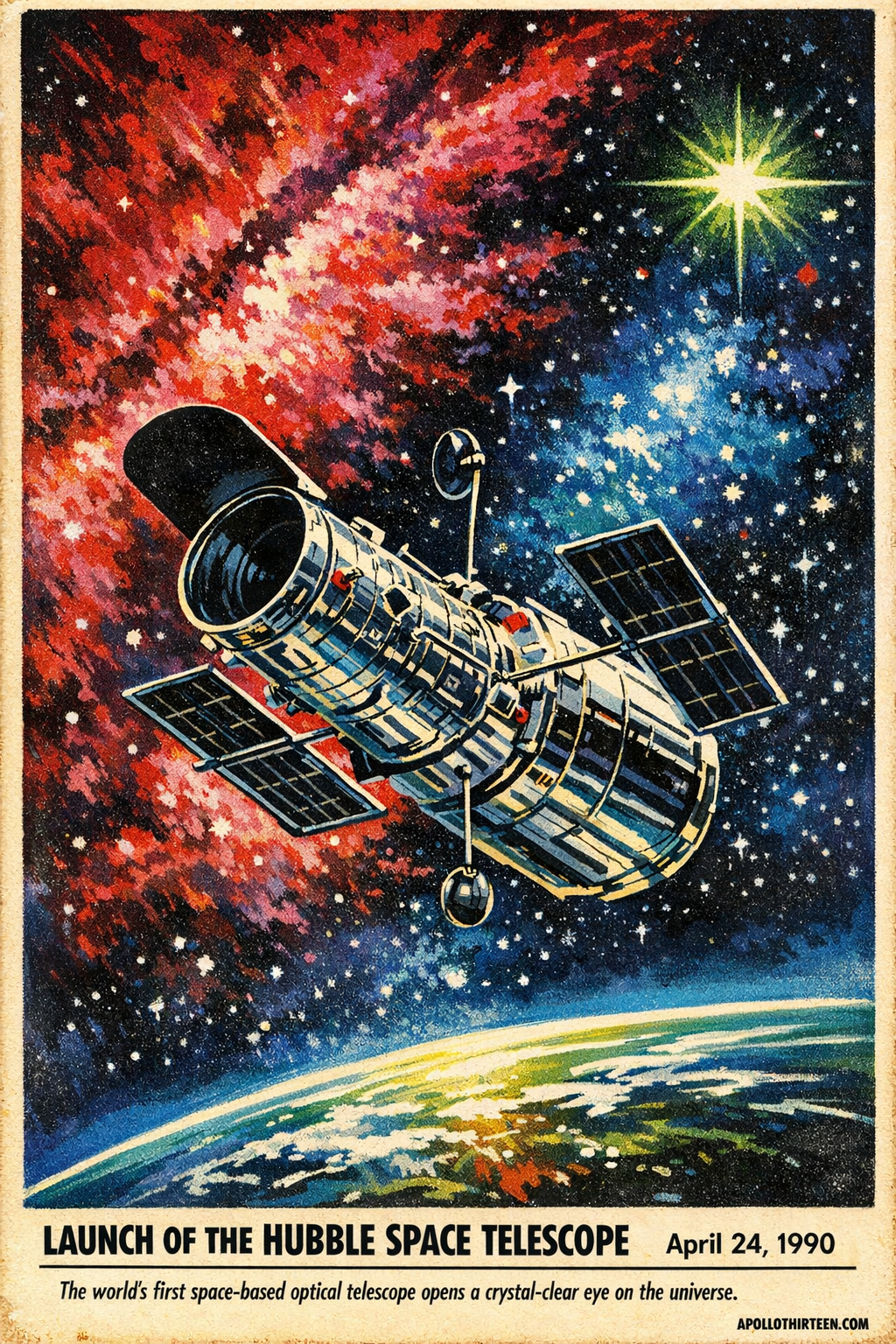
At T-minus 31 seconds, the most expensive camera ever built was a heartbeat away from becoming a very expensive paperweight. On the morning of April 24, 1990, five astronauts sat atop the Space Shuttle Discovery, waiting for a computer glitch to decide if 30 years of work would actually leave the ground. A fuel valve had failed to close, freezing the countdown and turning the Florida humidity into a pressure cooker for the engineers on the ground.
They fixed it manually, racing against a closing launch window. When Discovery finally roared to life, it wasn't just another shuttle mission. To give the Hubble Space Telescope the clearest possible view, the crew climbed to 380 miles—the highest any shuttle had ever flown. They were dumping a twelve-ton instrument into the void, hoping to see the universe without the blurry veil of Earth’s atmosphere getting in the way.
As the cargo bay doors opened against the black velvet of orbit, the telescope sat gleaming in the sunlight. It was a triumph, until the first photos came back. The "perfect" instrument had a flaw so small it was invisible to the eye, but large enough to nearly destroy the reputation of the world's most famous space agency.
A Hair’s Breadth from Disaster
When the first images trickled back to Earth two months later, they were a mess. Instead of razor-sharp galaxies, scientists saw glowing ghosts. The stars had eerie halos. The culprit was a "spherical aberration"—a fancy way of saying the primary mirror had been ground too flat at the edges by 2.2 microns. For context, that is about 1/50th the thickness of a human hair.
The mistake was traced back to a single 3mm washer misplaced in a testing device on the ground. For three years, Hubble was the butt of every late-night joke in America. Politicians called it a "techno-turkey," and it became a symbol of government waste. It wasn't until 1993 that astronauts essentially gave the telescope a pair of contact lenses, a set of corrective mirrors called COSTAR, in one of the most high-stakes repair jobs in history.
The moment the first clear image of the M100 galaxy hit the screens at mission control, the room erupted. The telescope wasn't a failure anymore; it was a legend. It shifted the narrative from a billion-dollar blunder to a story of redemption that eventually turned Hubble into "The People's Telescope."
The Architects of the Void
Hubble didn’t just appear out of nowhere; it was the obsession of people who saw the future decades before it arrived. Lyman Spitzer Jr., a theoretical physicist, proposed a space-based observatory in 1946, back when rockets were still primitive tools of war. He spent fifty years convincing the world that we needed to get above the "twinkling" of the atmosphere—which is really just air distorting starlight—to see reality.
Then there was Nancy Grace Roman, the "Mother of Hubble." As NASA’s first Chief of Astronomy, she was the one who actually navigated the political minefield. She didn't just understand the physics; she understood the power of persuasion, dragging a skeptical government into funding a project that cost billions. Without her, Spitzer’s dream would have died on a chalkboard.
The crew of STS-31, including Kathy Sullivan—the first American woman to walk in space—represented a new breed of scientist-astronauts. Their readiness to go out and manually fix things if the deployment went south set the template for the five servicing missions that kept Hubble alive for over three decades.
Rewriting the Textbook from a School Bus
Thirty-six years later, Hubble has basically torn up and rewritten our understanding of space. Before it launched, we didn't even know how old the universe was. Estimates were a wild guess between 10 and 20 billion years. By tracking "cosmic yardsticks" known as Cepheid variable stars, Hubble pinned that number down to roughly 13.8 billion years.
But its biggest shocker came in the late 90s. Everyone assumed the expansion of the universe was slowing down because of gravity. Hubble looked at distant supernovae and proved the exact opposite: the expansion is actually speeding up. This led to the discovery of Dark Energy, a mysterious force that makes up 68% of everything. It’s a finding so massive it earned a Nobel Prize.
Today, Hubble isn't a relic; it’s a teammate. While the new James Webb Space Telescope (JWST) looks at infrared heat, Hubble remains our primary eye for visible and ultraviolet light. They work together—JWST sees the ancient, dusty beginnings, while Hubble captures the hot, young stars. It’s a panoramic view of reality that neither could manage alone.
The Final Cosmic Mystery
Hubble’s legacy isn't just about pretty pictures like the Pillars of Creation. It’s currently at the center of the biggest headache in modern physics, known as the "Hubble Tension." The telescope’s measurements of how fast the universe is growing don't match the data from the afterglow of the Big Bang. This discrepancy suggests our "Standard Model" of physics is missing something vital—maybe a new particle or a flaw in our understanding of gravity.



Comments
No comments yet. Be the first!