The Day That Changed Everything
For four minutes and twenty-seven seconds, the world held its breath. Inside Mission Control in Houston, the air was thick with the scent of stale coffee and cigarette smoke, but the silence was heavier. On the wall-sized projection screens, the tracking data for the Command Module Odyssey had flattened. It was April 17, 1970, and three men—Jim Lovell, Jack Swigert, and Fred Haise—were currently hurtling through the upper reaches of Earth’s atmosphere at 25,000 miles per hour, encased in a capsule that was little more than a scorched heat shield and a prayer.
The "blackout" period, caused by the sheath of superheated ionized gas surrounding the craft during reentry, was supposed to last only three minutes. When the clock ticked past the four-minute mark, the veteran flight directors felt a cold knot of dread. Had the heat shield, potentially damaged by the explosion four days prior, held together? Had the parachutes frozen in the sub-zero temperatures of the crippled ship? Then, a crackle of static broke the tension. A voice, thin and distant but unmistakably Jack Swigert’s, pierced the silence: "Okay, Joe."
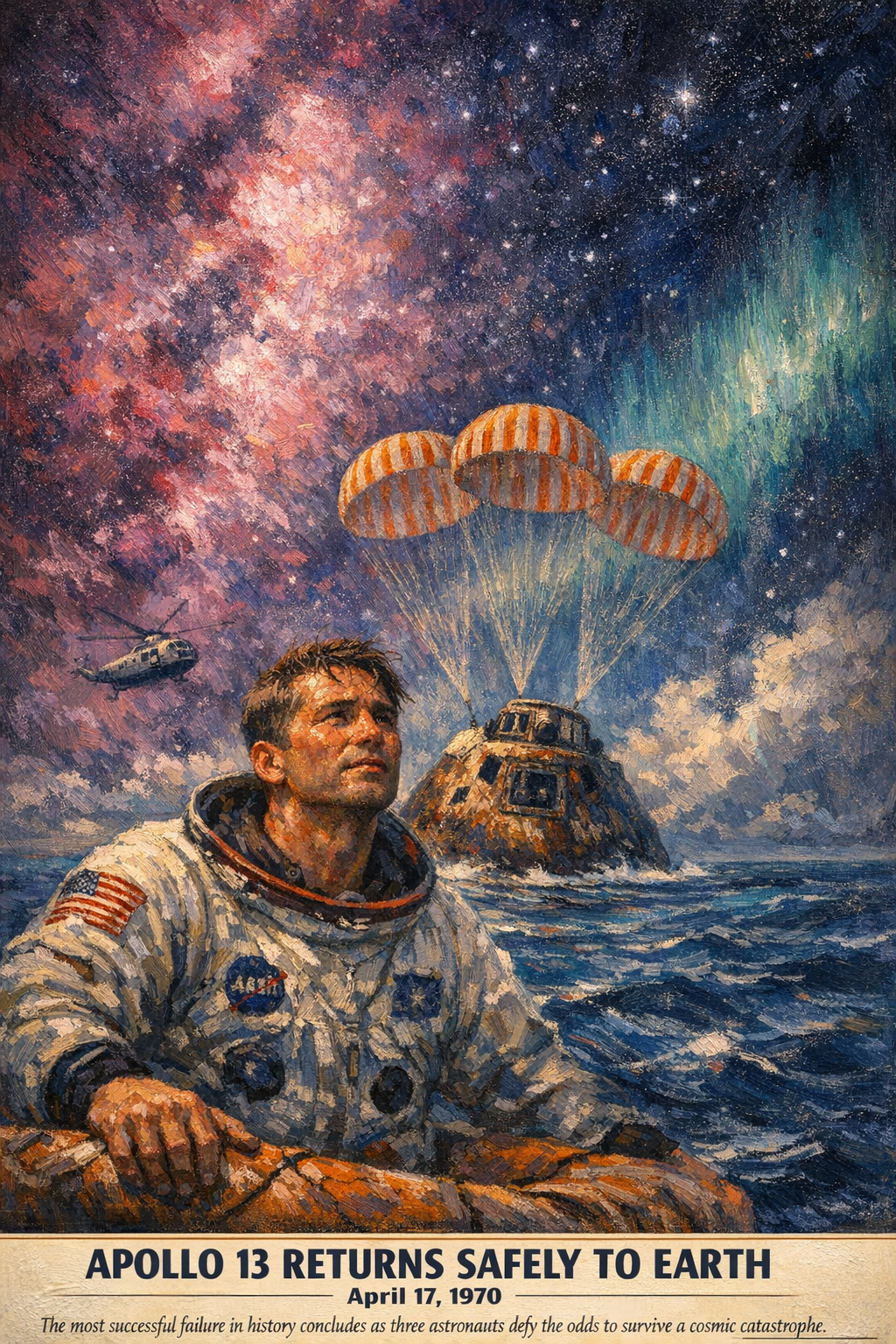
Fifty-six years ago today, the most harrowing rescue in the history of human exploration concluded with a gentle splashdown in the South Pacific. It was a moment that redefined the limits of human ingenuity. What was supposed to be NASA’s third triumphant moon landing had transformed into a desperate, improvised struggle for survival. It remains, to this day, the definitive "successful failure"—a mission that failed every one of its primary scientific objectives while succeeding in the far more difficult task of bringing three men home from the brink of the abyss.
What Actually Happened
The catastrophe began not with a bang, but with a shudder. On the evening of April 13, 1970, the crew was 200,000 miles from Earth, cruising toward the Fra Mauro highlands of the Moon. Following a routine request from Houston to "stir" the oxygen tanks to ensure accurate readings, a spark from a frayed wire ignited the insulation inside Oxygen Tank No. 2. The resulting explosion didn’t just vent life-sustaining gas into the vacuum; it blew out an entire side panel of the Service Module and crippled the fuel cells that provided the Command Module with power and water.
The mission changed in an instant from a voyage of discovery to a race against the clock. With the Command Module Odyssey dying, the crew was forced to retreat into the Lunar Module (LM), Aquarius. Designed to support two men for two days on the lunar surface, Aquarius now had to keep three men alive for four days in deep space. It became a "lifeboat" in the truest sense, though a dangerously fragile one.
The technical hurdles were staggering. To save power for reentry, the crew had to shut down almost every electronic system, including the heaters. Temperatures inside the craft plummeted to near freezing. Condensation, thick as heavy dew, coated every instrument panel—a terrifying prospect in a vehicle filled with electrical wiring. Then came the carbon dioxide crisis. The LM’s scrubbers, designed to filter out the CO2 exhaled by the crew, were being exhausted. While there were spare canisters in the CM, they were square, and the LM’s sockets were round. In one of history’s most famous examples of improvised engineering, the ground crew designed a "mailbox" out of plastic bags, cardboard, and duct tape to force the square pegs into the round holes.
The return journey required a perilous gravity-assist maneuver around the far side of the moon. This swing-by put the crew 248,655 miles from Earth—the farthest any human has ever traveled from home. As they rounded the lunar limb, they were entirely cut off from the rest of humanity, staring at a grey, cratered wasteland they would never walk upon, knowing their only hope lay in a series of perfectly timed engine burns using a landing motor that was never designed to operate in deep space.
The People Behind It
While the three men in the capsule were the faces of the crisis, the rescue was a masterpiece of collective intelligence. Commander Jim Lovell, then the world’s most experienced astronaut, was the steady hand on the controls. Beside him, Fred Haise battled a debilitating kidney infection brought on by dehydration and the bitter cold, yet never faltered in his duties. Jack Swigert, a last-minute replacement for Ken Mattingly (who had been grounded due to exposure to German measles), proved his worth by flawlessly executing the complex, improvised power-up sequence required to bring the "cold-soaked" Command Module back to life.
On the ground, Flight Director Gene Kranz and his "White Team" became the architects of the impossible. Kranz’s philosophy—later distilled into the iconic phrase "Failure is not an option"—infused Mission Control with a sense of calm, methodical urgency. There was also Glynn Lunney, the flight director who was on duty during the critical hour immediately following the explosion. Lunney’s rapid-fire decisions to pivot the mission and utilize the Lunar Module’s systems are often cited by historians as the pivotal moments that saved the crew.
Perhaps the unsung hero was Ken Mattingly. Denied his seat on the flight, he didn’t succumb to bitterness. Instead, he spent dozens of hours in the simulators at Cape Kennedy, working alongside engineers to figure out how to restart the Command Module using a fraction of the normal battery power. He had to ensure that the process wouldn’t short-circuit the electronics or drain the batteries before the parachutes could deploy. His work provided the roadmap for Swigert’s successful reentry sequence.
Why the World Reacted the Way It Did
By 1970, the American public had grown somewhat bored with the Moon. Apollo 11 had been a global phenomenon, and Apollo 12 had proven the landing could be done with precision. Before the explosion, Apollo 13 was so "routine" that the major television networks didn’t even bother to broadcast the crew’s live TV special from space. However, the moment the mission turned from a trek into a tragedy, the world pivoted.
The crisis triggered a rare moment of global solidarity at the height of the Cold War. Differences in ideology were set aside as the world watched the stars. Soviet Premier Alexei Kosygin contacted the White House to offer the use of Soviet naval vessels for recovery efforts. Countries across the globe offered to maintain radio silence on NASA’s frequencies to ensure no interference with the crippled ship’s communications. In the Vatican, Pope Paul VI led 50,000 people in prayer for the astronauts’ safety. In New York City, thousands stood in the middle of Grand Central Station, eyes glued to the giant screen as the news updates filtered in.
This reaction revealed something profound about the space program. It wasn't just about geopolitics or scientific data; it was a human drama. The three men in that tin can were surrogates for all of humanity, and their struggle against the indifferent vacuum of space touched a universal chord of empathy and survival.
What We Know Now
In the decades since the splashdown, forensic engineering has revealed the precise sequence of errors that led to the near-disaster. It was a classic example of a "latent defect." Years before the mission, the oxygen tank in question had been dropped a few inches in a factory, damaging a drain line. During a subsequent test on the launchpad, the tank wouldn't drain properly. Engineers decided to use the tank's internal heater to boil off the remaining liquid oxygen.
What they didn’t realize was that the heaters, originally designed for 28-volt power, were being fed 65 volts from the ground equipment. The internal thermostat, designed to shut the heater off, failed under the higher voltage and literally fused shut. The heater stayed on for eight hours, reaching temperatures of 1,000 degrees Fahrenheit, which baked and cracked the Teflon insulation on the internal wiring. The tank became a bomb, just waiting for Jack Swigert to flip the switch to "stir" the tanks and create the fatal spark.
Modern analysis also highlights the "pogo oscillations" during the launch—a violent vibration that caused the second-stage center engine to shut down early. While the mission continued, it was a reminder that Apollo 13 was plagued with bad omens from the start. Today, NASA uses these findings as a case study in "The Normalization of Deviance"—the dangerous tendency to accept small, recurring problems as "normal" until they combine into a catastrophic failure.
Legacy — How It Shaped Science Today
Apollo 13 changed NASA’s DNA. It ended the era of hubris and replaced it with a rigorous culture of resilience. The mission proved that no matter how much you plan, the universe will find a way to surprise you, and your survival depends on "functional redundancy"—the ability to use tools for tasks they were never intended to perform.
This philosophy is baked into modern spacecraft design. Today’s Orion capsules and the commercial vehicles built by SpaceX and Boeing are designed with "dissimilar redundancy," meaning they have multiple ways to perform critical functions using different hardware and software. The lessons of Apollo 13 also paved the way for the International Space Station’s emergency protocols. When something goes wrong in orbit today, the crews look back to the improvised CO2 scrubbers and the "cold-soak" power-ups of 1970 as the gold standard for crisis management.
Beyond the hardware, Apollo 13 remains a testament to the human spirit. It showed that even when the most advanced technology fails, the human mind—collaborating across thousands of miles of vacuum—is the ultimate fail-safe. Fifty-six years later, we don’t celebrate Apollo 13 because of where it went, but because of the incredible journey it took to get back.
Fast Facts: The Mission of Apollo 13
- Launch Date: April 11, 1970, at 13:13 CST.
- Distance from Earth: 248,655 miles (the farthest humans have ever traveled).
- The Explosion: Occurred 55 hours and 55 minutes into the mission.
- Splashdown: April 17, 1970, in the South Pacific Ocean.
- Weight Loss: The crew lost a combined 31.5 pounds during the flight due to dehydration and stress.
- Recovery Ship: The USS Iwo Jima.
- The "Mailbox": An improvised device made from a flight manual cover, plastic bags, and grey tape.



Comments
No comments yet. Be the first!