The Day That Changed Everything
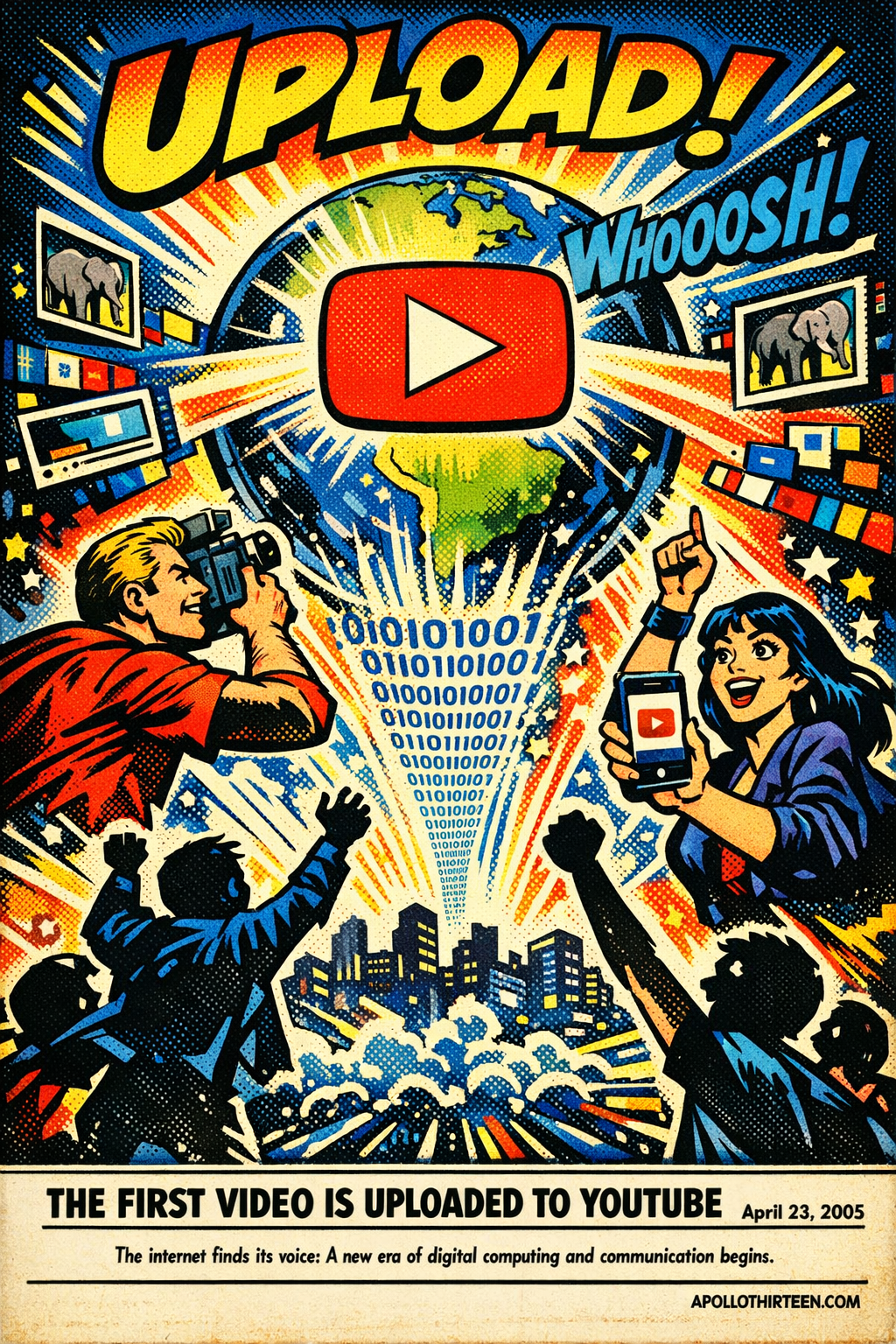
The image is famously underwhelming. A young man with slightly messy hair and a windbreaker stands in front of an enclosure at the San Diego Zoo. The resolution is poor—a mere 320x240 pixels—and the audio is thin, competing with the distant hum of zoo visitors and the occasional breeze. He doesn’t announce a revolution. He doesn’t recite a manifesto. He simply points over his shoulder at a pair of elephants and remarks, with almost comedic brevity: "The cool thing about these guys is that they have really, really, really long trunks, and that's cool. And that's pretty much all there is to say."
It was 8:27 PM on a Saturday evening, April 23, 2005. The man was Jawed Karim, a 25-year-old software engineer, and the 19-second clip was titled, simply, "Me at the zoo." To the handful of people who saw it that night, it was a technical test, a digital "Hello World" performed in front of a pachyderm exhibit. But twenty-one years ago today, that mundane upload acted as the first heartbeat of a new kind of civilization. It was the moment the internet stopped being a library and started being a stage.
Before that Saturday night, the web was largely a static experience—a collection of text and images that users consumed but rarely influenced. If you wanted to share a video of your life in 2005, you were entering a world of technological pain. You needed a personal server, a deep understanding of file transfer protocols, and the patience to wait hours for a upload that would likely crash. Karim’s casual observation about elephant trunks was the sledgehammer that broke that wall down forever. Today, as YouTube celebrates its 21st anniversary, the platform has matured from a digital ghost town into a global archive that hosts over 800 million videos, fundamentally altering how we learn, how we entertain ourselves, and how we understand the human experience.
What Actually Happened
The birth of YouTube was not an overnight epiphany; it was an act of engineering desperation. The three founders—Jawed Karim, Chad Hurley, and Steve Chen—were all alumni of PayPal, the payment processor that had recently been acquired by eBay. They were looking for their next project, and the legend of YouTube’s origin varies depending on who you ask. One story suggests the idea was born after Hurley and Chen struggled to share videos from a dinner party; Karim’s version points to the frustration of trying to find clips of the 2004 Indian Ocean tsunami or Janet Jackson’s infamous Super Bowl wardrobe malfunction.
Regardless of the spark, the initial iteration of the site was actually a dating service called "Tune In Hook Up." The concept was simple: people would upload videos of themselves, and others would browse them to find a match. It was a spectacular failure. The founders even went so far as to offer women $20 via Craigslist to upload videos of themselves to the platform. No one took the bait. Realizing that users didn't want a narrow dating site but rather a broad, open-ended way to share whatever was on their minds, they pivoted. The dating features were stripped away, and the platform was reimagined as a universal video repository.
The upload of "Me at the zoo" was the functional alpha test. Filmed by Karim's high school friend, Yakov Lapitsky, using a basic digital camera, the video wasn't intended for public consumption in the way we think of viral content today. It was a stress test for the site’s architecture. Could the server ingest the file? Could the browser play it back without a dedicated media player? When the "Play" button finally worked, and Karim’s face appeared on a standard web browser without a five-minute download delay, the founders knew they had solved a problem that had plagued the internet since its inception.
The People Behind It
The success of YouTube was the result of a perfect triumvirate of skills: design, engineering, and vision. Chad Hurley, the first CEO, was the artist of the group. A design specialist at PayPal who had famously designed the original PayPal logo, Hurley was obsessed with the user interface. He understood that for the platform to work, it had to be invisible. He wanted a site so simple that a grandmother could use it. His focus on "clean" aesthetics prevented YouTube from becoming the cluttered, ad-heavy mess that characterized many early 2000s websites.
Steve Chen, the CTO, provided the technical backbone. As the site exploded from dozens of views to millions within months, it was Chen who had to figure out how to scale the infrastructure. Handling video data is immensely more difficult than handling text or images; it requires massive bandwidth and sophisticated storage solutions. Chen’s ability to build a system that didn't buckle under the weight of its own success is one of the great unsung feats of early 21st-century computer science.
Then there was Jawed Karim, the engineer and visionary who appeared in that first video. Karim was deeply interested in the architecture of the web. While he was instrumental in developing the site’s initial code, he was also the most academically minded of the group. Shortly after the launch and before YouTube became a household name, Karim did something almost unthinkable: he left the company to pursue a Master’s degree in Computer Science at Stanford University. While he remained a significant shareholder, his early departure meant that he was often the "forgotten" founder, though his impact on the site’s initial design—and his starring role in its first 19 seconds—ensured his place in history.
Why the World Reacted the Way It Did
In 2005, the world was hungry for a medium that traditional television couldn't provide. We were living in the era of "Top-Down" media, where a handful of executives at major networks decided what the public saw. YouTube represented the first real challenge to this hegemony. By late 2005, the site was no longer a ghost town. It was being fueled by a new phenomenon: the viral video.
The first major breakthrough wasn't an amateur vlog, but a segment from *Saturday Night Live* called "Lazy Sunday." The digital short, featuring Andy Samberg and Chris Parnell rapping about cupcakes and *The Chronicles of Narnia*, was uploaded to YouTube by fans. It became a cultural sensation, garnering millions of views in days. For the first time, people weren't waiting for a rerun or a DVD release; they were sharing the clip instantly. This explosion of traffic caught the attention of two very different groups: the general public and the legal departments of media conglomerates.
The reaction from the establishment was one of panic. In 2007, Viacom (the parent company of MTV and Paramount) sued YouTube for $1 billion, alleging massive copyright infringement. This became a defining legal battle for the digital age. The lawsuit tested the "Safe Harbor" provisions of the Digital Millennium Copyright Act (DMCA). The question was simple: Is a platform responsible for what its users upload? The eventual legal consensus—that platforms are protected as long as they provide a way to remove infringing content—paved the way for the modern social media landscape. Without that legal victory, sites like Facebook, Twitter, and TikTok would have likely been sued out of existence before they ever found their footing.
What We Know Now
Today, we view YouTube not just as a website, but as a primary dataset for the advancement of artificial intelligence and data science. The simple upload mechanism established 21 years ago has created a mountain of data so vast that it is difficult for the human mind to comprehend. Every minute, over 500 hours of video are uploaded to the platform. This represents a continuous, multi-angled recording of human history, culture, and language.
For computer scientists, this is a goldmine. YouTube has been the primary training ground for modern computer vision AI. Algorithms that can recognize objects, understand human movement, or translate speech in real-time were largely built by "watching" millions of hours of YouTube content. When you see a self-driving car identify a pedestrian or a smartphone translate a foreign sign, you are seeing the direct descendants of the data processing techniques developed to manage YouTube’s vast library.
Furthermore, we now understand the neurological impact of the "recommendation algorithm." The site evolved from a simple search engine into a predictive powerhouse. By analyzing billions of watch-time data points, YouTube’s AI can predict what a user wants to see next with uncanny accuracy. This has created the "rabbit hole" effect, a psychological phenomenon that sociologists are still studying. It has the power to educate a person on quantum physics or, conversely, to lead them down paths of radicalization and misinformation. The technology that began at the zoo has become one of the most powerful tools for cognitive shaping in human history.
Legacy — How It Shaped Science Today
The legacy of "Me at the zoo" is nothing less than the democratization of human knowledge. Before YouTube, if you wanted to learn how to perform a complex surgical procedure, fix a 1960s carburetor, or understand the nuances of string theory, you needed access to a specialized institution. Today, that knowledge is available to anyone with an internet connection. Scientists now use the platform to share peer-reviewed findings via video abstracts, and NASA uses it to stream live high-definition footage from the International Space Station, bringing the wonders of the cosmos into the palms of our hands.
But perhaps the most profound impact is sociological. YouTube gave rise to the "Prosumer"—the individual who is both a professional-grade producer and a consumer of media. It created a new form of parasocial relationship, where creators and audiences feel a deep, personal connection. This has shifted the power balance of global influence away from Hollywood and toward the individual. A teenager in a bedroom in Mumbai now has the same potential reach as a major American news network.
Jawed Karim’s 19-second clip remains on the site today, preserved like a digital cave painting. It is a reminder that monumental shifts often begin with the mundane. We didn't need a cinematic masterpiece to change the world; we just needed a way to see each other. Twenty-one years later, the "really, really, really long trunks" of those elephants are a symbol of an era where everyone has a voice, every moment can be archived, and the entire world is just one "upload" button away from being seen.
Fast Facts: The YouTube Timeline
- February 14, 2005: The YouTube.com domain name is registered on Valentine's Day.
- April 23, 2005: Jawed Karim uploads "Me at the zoo," the first video in the site's history.
- December 2005: YouTube officially launches out of beta; it is already serving 8 million videos a day.
- October 2006: Google acquires YouTube for $1.65 billion in stock—a price that was considered astronomical at the time.
- May 2007: The "YouTube Partner Program" launches, allowing creators to earn money from their videos for the first time.
- November 2008: YouTube supports 720p HD video, marking the end of the grainy, low-resolution era.
- July 2012: "Gangnam Style" by Psy is uploaded, eventually becoming the first video to hit one billion views.
- Today: YouTube is the second most visited website in the world, surpassed only by its parent company, Google.



Comments
No comments yet. Be the first!