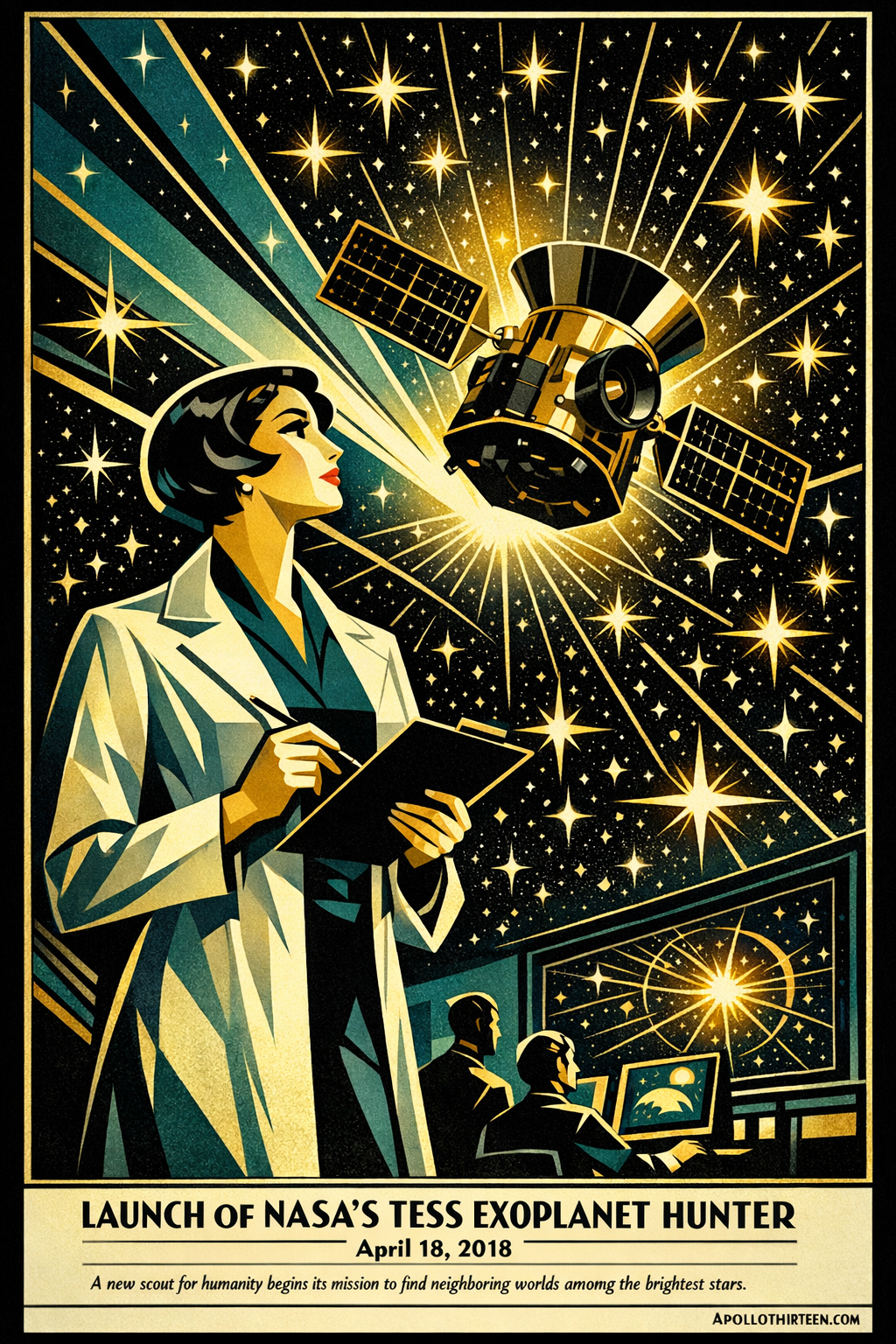
Every 13.7 days, a spacecraft the size of a standard kitchen fridge swings close to Earth and dumps 20 gigabits of raw telemetry into the Deep Space Network. There are no high-resolution photographs in this fortnightly delivery. It consists almost entirely of light curves—endless strings of brightness measurements tracking our closest stellar neighbours.
For eight years, the Transiting Exoplanet Survey Satellite (TESS) has executed this exact routine. Built on a rigid $337 million budget, the mission was never meant to be the main event. It operates instead as a strategic scouting mechanism, providing the precise coordinates that flagship observatories—including the heavily European-backed James Webb Space Telescope—need to search for atmospheric water or methane.
The P/2 Orbital Trick
When TESS launched in 2018 on a SpaceX Falcon 9—following a two-day delay to troubleshoot a guidance and navigation glitch—it did not settle into a standard circular path. To maintain an unobstructed view of deep space without burning through its propellant reserves, engineers placed it in a "P/2" orbit.
This highly elliptical trajectory puts the satellite in a 2:1 resonance with the Moon. For every single lunar orbit, TESS circles the Earth exactly twice. The Moon’s gravity effectively locks the spacecraft's path in place for decades, substituting expensive chemical course corrections for orbital mechanics. It was the first time this specific geometry had been used for a spacecraft.
From this stable vantage point, four custom wide-field cameras developed by MIT’s Lincoln Laboratory sweep the sky. They are calibrated to detect a dip in a star's brightness of just 0.1 percent. That marginal dimming is the only signature of a planet crossing in front of its host star.
A Supply Chain for Exoplanets
TESS represents a structural shift in how space agencies procure planetary data. Its predecessor, Kepler, spent years staring down a narrow sightline to prove that exoplanets were statistically common. TESS was built to scan the whole board, focusing solely on the nearest and brightest systems.
The project's survival relied heavily on NASA Goddard's Jeff Volosin keeping the hardware strictly within an "Explorer-class" funding cap. At $337 million, it costs a fraction of the flagship telescopes it serves. MIT's Sara Seager, the mission's deputy science director, positioned TESS entirely around this dependency. It is the mandatory precursor step before any high-end spectral analysis can occur.
Today, European astrophysics institutes chew through those 13.7-day data dumps to plan observation schedules for ESA’s upcoming PLATO and Ariel missions. The heavy lifting of planetary characterisation will eventually fall to these multi-billion-euro platforms, but their schedules are dictated by the coordinates found by a budget-capped scout.
Europe and the US have built the heavy glass. They just rely on a fridge in a lunar resonance to tell them where to point it.
Sources
- Massachusetts Institute of Technology (MIT)
- NASA Goddard Space Flight Center
- MIT Lincoln Laboratory



Comments
No comments yet. Be the first!