The Day That Changed Everything
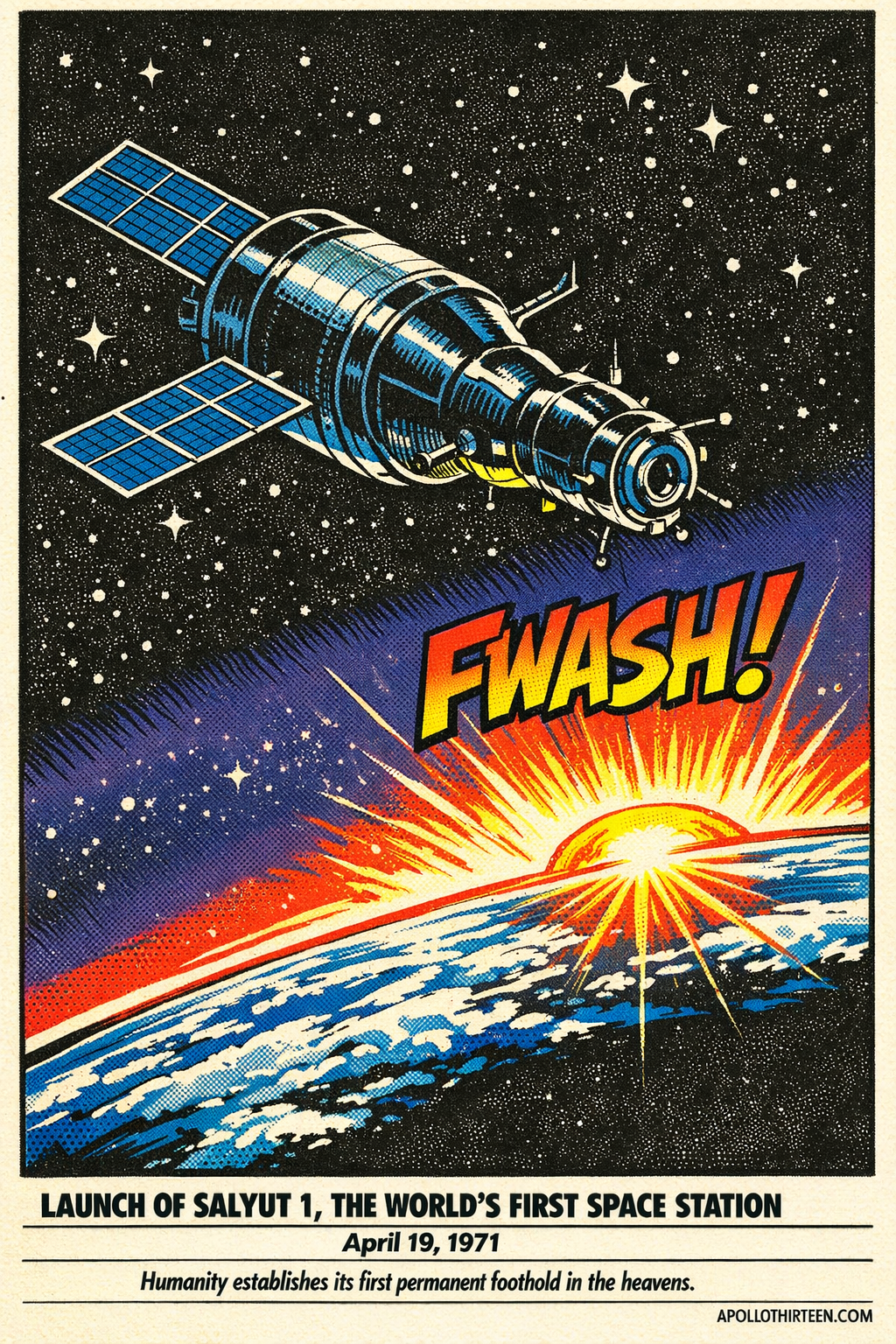
In the pre-dawn chill of the Kazakh steppe, the silence of the Baikonur Cosmodrome was shattered by a sound that felt more like an earthquake than a machine. At 1:40 UTC on April 19, 1971, a three-stage Proton-K rocket ignited, its base a blooming flower of fire against the black velvet of the night. For a decade, the world had watched the Soviet Union and the United States trade blows in a frantic sprint: the first satellite, the first man in orbit, the first footprints on the lunar dust. But as the rocket carrying Salyut 1 pierced the upper atmosphere, the nature of the Space Race underwent a fundamental, tectonic shift.
This was no longer a race to get somewhere else. It was a race to stay. Salyut 1 was not a capsule; it was a home. It was a laboratory. It was a 15-meter-long metal cylinder that represented the first time humanity had reached into the void and declared, "We are moving in." As the nine-minute climb ended and the station entered a low Earth orbit, the Soviet Union had established the first permanent foothold in the heavens.
Yet, even as champagne flowed in Moscow, the station was already revealing the temperamental nature of the high frontier. Telemetry streaming back to Earth indicated a series of malfunctions that would haunt the mission: a critical protective cover failed to jettison, blinding the station’s most expensive scientific instruments, and the internal ventilation system was showing signs of early failure. The dream of a house in the stars had been realized, but the house was already showing cracks before the first residents had even arrived.
What Actually Happened
The vehicle officially designated DOS-1 (Durable Orbital Station) was a masterpiece of hurried engineering. Weighing over 18 tons and stretching nearly 16 meters, Salyut 1 was composed of four main compartments. At its widest, it was just over four meters across—roughly the width of a modern living room, though packed with an unimaginable density of wires, tubes, and scientific consoles. It was a pressurized environment where humans could, for the first time, breathe, work, and sleep without being strapped into the seat of a cramped capsule.
The launch itself was a textbook success. The Proton-K placed the station into an orbit with a perigee of 200 kilometers and an apogee of 222 kilometers. However, the immediate discovery that the Orion-1 scientific apparatus’s cover had failed to detach was a crushing blow. This cover was designed to protect sensitive telescopes and Earth-observation cameras from the corrosive plume of the rocket’s exhaust during launch. Without its removal, the station’s primary astronomical mission was essentially dead on arrival.
The drama only intensified when the first crew arrived. On April 22, Soyuz 10 launched with three cosmonauts tasked with becoming the first residents of the outpost. While they successfully caught up with the station and made physical contact, the docking mechanism failed to achieve a secure "hard dock." The crew could see the interior of the station through their viewing ports, but they were unable to open the hatches. After five hours of frantic attempts, they were forced to return to Earth, leaving the station empty and silent.
It wasn't until June 1971 that the crew of Soyuz 11—Georgi Dobrovolsky, Vladislav Volkov, and Viktor Patsayev—successfully boarded Salyut 1. For 23 days, they lived as the first inhabitants of the orbital outpost, conducting experiments that would lay the groundwork for half a century of space medicine and biology. They grew the first plants in microgravity and proved that the human body could endure the long-term rigors of weightlessness. Tragically, their triumph ended in horror. During their descent to Earth, a pressure relief valve failed, and the cabin depressurized. The crew perished instantly, a somber reminder that space remains a hostile environment where the line between survival and catastrophe is paper-thin.
The People Behind It
The story of Salyut 1 is a story of intense human rivalry, bureaucratic shadow-boxing, and incredible personal resilience. At the center of the Soviet space program was Vasily Mishin, the successor to the legendary "Chief Designer" Sergei Korolev. Mishin was a man under fire. The Soviet lunar program was crumbling after successive failures of the massive N-1 rocket, and the Kremlin was demanding a victory to counter the American Apollo landings. Salyut 1 was Mishin’s attempt to pivot and reclaim the narrative of Soviet dominance.
However, the idea for the station didn't even come from Mishin. It was born of a "conspiracy" of engineers led by Konstantin Feoktistov. Feoktistov was a man who had stared death in the face long before he ever looked at the stars. As a 16-year-old scout during World War II, he had been captured by a Nazi firing squad, shot through the neck, and left for dead in a burial trench. He survived by feigning death and crawling out under the cover of darkness. This same tenacity drove him to work behind Mishin’s back, proposing to the Soviet leadership that they bypass the lunar program and repurpose military hardware into a civilian space station.
This led to a collision with Vladimir Chelomei, the head of the rival OKB-52 bureau. Chelomei had been developing a secret military station called "Almaz." In a move of high-stakes political maneuvering, the Soviet government ordered Chelomei to hand over his nearly finished Almaz hulls to Mishin’s team. Salyut 1 was essentially a hybrid creature: a military hull "hot-wired" with components and flight systems from the Soyuz spacecraft. It was a masterpiece of improvisation, built in just 16 months by men who knew they were running out of time.
Why the World Reacted the Way It Did
In 1971, the world was still vibrating from the aftershocks of the Apollo 11 Moon landing. In the United States, there was a sense that the Space Race was "over," won by the Stars and Stripes. The launch of Salyut 1 shattered that complacency. For the Soviet Union, the propaganda victory was immense. They framed the station not as a temporary visit to a dead moon, but as the first step in "building a home" in the cosmos. It was a powerful narrative: the Americans were tourists, but the Soviets were settlers.
Western intelligence agencies and NASA watched the launch with a mixture of professional respect and deep anxiety. NASA was still two years away from launching Skylab, its first space station. Salyut 1 proved that the Soviet Union still possessed the engineering might to lead the world into the next era of exploration. The initial failure of Soyuz 10 was downplayed by Soviet media, who claimed they had only ever intended to test the docking mechanisms—a lie that Western observers quickly debunked by analyzing the station’s orbital maneuvers.
But when the Soyuz 11 tragedy occurred, the global reaction shifted from competition to shared mourning. The deaths of Dobrovolsky, Volkov, and Patsayev were a cold water shock to a public that had grown accustomed to the "miracles" of space flight. It forced a global realization that long-term habitation wasn't just about engineering; it was about the fragile biology of the human animal in a place it was never meant to be.
What We Know Now
Looking back 55 years, the scientific output of Salyut 1—though hampered by hardware failures—was revolutionary. Before 1971, scientists were genuinely unsure if humans could survive in weightlessness for more than a few days without their hearts weakening or their bones turning to glass. Salyut 1 was the first laboratory for "space medicine."
The crew tested the very first "Penguin" suits—elasticated jumpsuits designed to force the muscles to work against resistance, mimicking the effects of gravity. They used the first orbital treadmill, discovering that vigorous exercise was the only way to prevent the body from wasting away. Perhaps most importantly, they operated "Oazis-1," the first greenhouse in space. When Viktor Patsayev saw the first green shoots of flax and leeks growing in microgravity, it was a moment of profound scientific victory. It proved that Earth-based life could not only survive but thrive in the void, provided we gave it the right environment. This remains the foundation of all current research into sustainable missions to Mars.
We also now understand the psychological toll of these missions. The "invisible fire" that broke out in a control panel during the Soyuz 11 stay revealed the stresses of isolation. Transcripts showed the crew arguing and the flight engineer, Volkov, experiencing moments of panic. Today, psychological screening and support are as much a part of astronaut training as physics or piloting, a lesson first learned in the cramped, smoky confines of Salyut 1.
Legacy — How It Shaped Science Today
The DNA of Salyut 1 is present in every rivet and module of the International Space Station (ISS). When you look at the Zvezda Service Module, the core of the Russian segment of the ISS, you are looking at a direct, linear descendant of the Salyut design. The modular architecture—the idea of a central pressurized spine with docking ports and solar arrays—was perfected through the Salyut and subsequent Mir programs.
Furthermore, Salyut 1 introduced the "probe and drogue" docking system with an internal pressurized tunnel. Before this, transferring between two spacecraft usually required a dangerous spacewalk (Extravehicular Activity). Salyut 1 allowed crews to simply open a door and walk into their orbital home. This system remains the global standard for docking today, used by both government agencies and private companies like SpaceX.
Fifty-five years later, Salyut 1 stands as more than just a historical footnote. It was the moment humanity stopped visiting space and started living there. It was a transition from the heroic, short-lived exploits of pilots to the steady, enduring work of scientists. Every person currently living on the ISS, orbiting 250 miles above our heads, owes their home to the 18 tons of steel and ambition that launched from a Kazakh desert on a spring night in 1971.
Fast Facts: The Salyut 1 Mission
- Launch Date: April 19, 1971
- Rocket: Proton-K
- Internal Volume: 99 cubic meters (roughly the size of a small bus)
- Mass: 18,425 kg (40,620 lbs)
- Days in Orbit: 175 days
- First Occupants: Soyuz 11 crew (23 days)
- World Record: The Soyuz 11 crew set the record for the longest human stay in space at the time.
- The Name Change: The station was originally called "Zarya" (Dawn), and the name was even painted on the side. It was renamed "Salyut" (Salute) just days before launch to avoid radio call-sign confusion.
- Atmospheric Re-entry: Salyut 1 was intentionally de-orbited and burned up in the atmosphere over the Pacific Ocean on October 11, 1971.



Comments
No comments yet. Be the first!