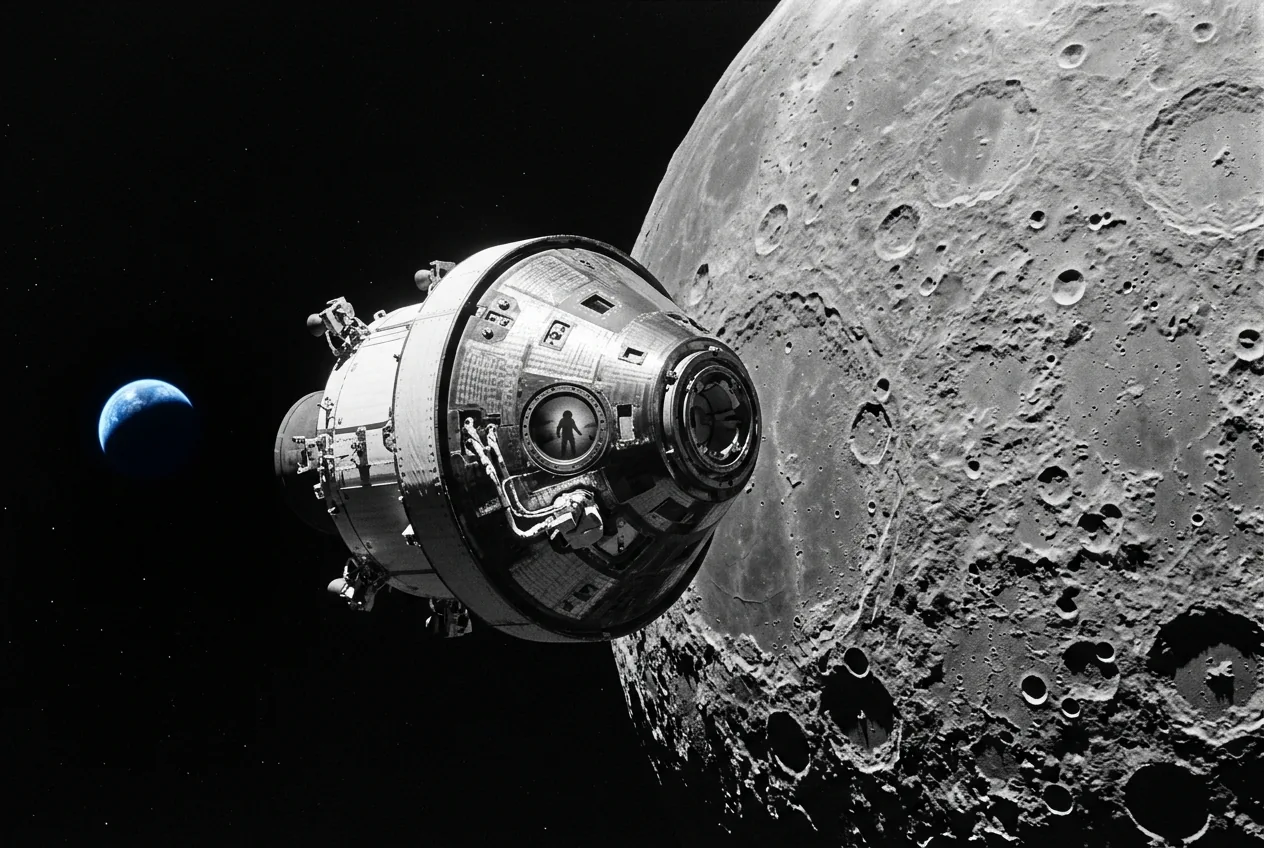
At 12:56 p.m. CDT on Monday, four astronauts drifted past the 248,655-mile mark, crossing an invisible line in the orbital dark. Inside the Orion capsule, a jar of Nutella floated label-forward past a livestream camera, an oddly domestic counterpoint to the absolute hostility of deep space. They had just travelled further from Earth than any human beings in history, aiming for an eventual peak distance of 252,756 miles.
For 56 years, the ultimate high-water mark for human spaceflight belonged to Apollo 13—a record set not by design, but by desperate, improvisational survival after an oxygen tank exploded. Artemis II has quietly rewritten that metric, trading the terror of a crippled spacecraft for a deliberate, heavily monitored translunar trajectory. But this nine-day flight is less about claiming a numerical milestone than it is a high-stakes biological and mechanical shakedown. Every thermal fluctuation and life-support metric gathered before their April 10 splashdown will dictate whether NASA’s multibillion-dollar gamble on returning humans to the lunar surface is biologically and practically viable.
A calculated arc beyond the Apollo high-water mark
Apollo 13 claimed the distance record by accident. Trapped in a failing module, the 1970 crew had to swing wide around the Moon, using its gravity to slingshot back to a planet they weren't sure they could safely re-enter. Artemis II, launched April 1 atop the towering Space Launch System, arrived at its apex entirely on purpose.
Commander Reid Wiseman, pilot Victor Glover, mission specialist Christina Koch, and Canadian astronaut Jeremy Hansen are riding a deliberately deep return arc. The geometry of this trajectory pushes them a few thousand miles past the old limit before Earth’s gravitational tether begins to pull them home.
It is a quiet, cold summit. The crew passed roughly 4,067 miles from the lunar surface, slipping behind the Moon and straight into a planned 40-minute communications blackout. In a modern era accustomed to constant orbital connectivity, that absolute silence forces a heavy reliance on automated survival systems and the Deep Space Network's ability to reacquire the signal.
Life-support kinetics and contamination control
Beyond the orbital mechanics, Artemis II is an exercise in managing human vulnerability. Deep space is an inherently toxic environment, and the Orion capsule is serving as an active testbed for life-support kinetics and thermal load management. Mission controllers are pulling continuous telemetry on how the spacecraft shields its fragile cargo from the realities of cislunar space.
While monitors track these vital signs, the crew is executing hands-on tasks that machines still struggle to replicate perfectly. Using handheld digital cameras, they are capturing high-resolution images of lunar terrain never before seen directly by human eyes. This optical metadata will be cross-referenced with human-in-the-loop telemetry to see how crew members function physically during complex tasks in deep microgravity.
Even the viral Nutella jar is a data point. The presence of comfort foods and personal items feeds directly into NASA’s contamination control and operational hygiene protocols. How humans handle sticky, crumbly, or loose materials in this environment will dictate hardware design decisions for much longer, dirtier surface missions where biological contamination poses a severe risk.
The multibillion-dollar tension behind the telemetry
Beating an accidental 1970 record is a tidy public relations victory, but it papers over the institutional realities of the Artemis program. Bold technical milestones are currently sharing a cabin with severely constrained federal budgets and shifting political cycles. Every piece of operational data from this short flight is bureaucratic currency.
NASA will inevitably use the mission’s success to justify continued, massive investment in the Space Launch System and the broader, heavily scrutinized lunar architecture. But the inclusion of Jeremy Hansen representing the Canadian Space Agency is a sharp reminder that lunar exploration is no longer a purely American monopoly. The risks, the costs, and the eventual biological data are increasingly partitioned among international stakeholders.
The Orion capsule is scheduled to splash down off the coast of San Diego on the evening of April 10. The crew will return having stared back at an Earth smaller than anyone has ever seen it. The orbital telemetry will be precise; the earthly politics waiting for them will be anything but.
Sources
- National Aeronautics and Space Administration (NASA)
- Canadian Space Agency (CSA)
- Deep Space Network (DSN)



Comments
No comments yet. Be the first!