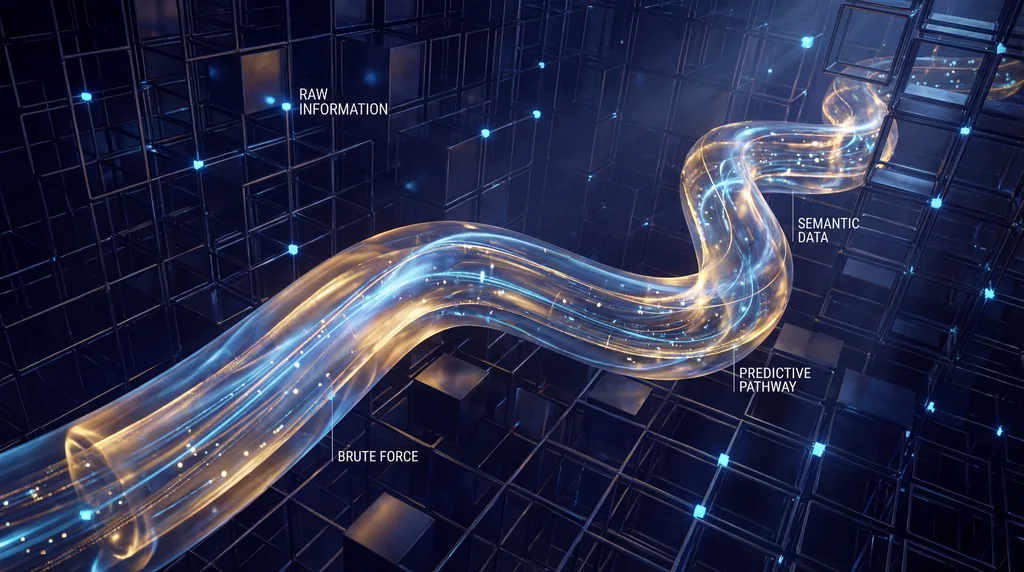

For years, the development of Large Language Models (LLMs) has been governed by the Chinchilla scaling laws, which suggest that performance gains require massive increases in data and compute. New research into Semantic Tube Prediction (STP), co-authored by Yann LeCun, Randall Balestriero, and Hai Huang, challenges this brute-force paradigm by treating language as a smooth semantic manifold rather than a series of discrete tokens. This approach utilizes a Joint-Embedding Predictive Architecture (JEPA) style regularizer to achieve unprecedented data efficiency, allowing models to learn more effectively from limited information.
The Limitations of Modern Scaling Laws
The Chinchilla scaling laws serve as empirical power-law fits that describe how a model's loss decreases as compute, data, and parameters increase. While these laws are highly accurate at predicting the performance of typical training runs, they are descriptive rather than prescriptive. This means they characterize how models currently learn, rather than how they could learn if the training process were optimized with better geometric priors.
The artificial intelligence industry is currently trapped in a cycle of "brute force" scaling, where the solution to better performance is almost always "more data." However, this reliance on volume is reaching a point of diminishing returns. Researchers are now seeking alternatives that can surpass these bounds, focusing on data-efficiency that allows for higher signal-to-noise ratios during training. The primary goal is to find methods that violate the data term of these scaling laws, enabling smaller models to reach the capabilities of their larger counterparts without the associated overhead.
What is the Geodesic Hypothesis in the context of language models?
The Geodesic Hypothesis posits that token sequences in language models trace geodesics on a smooth semantic manifold and are therefore locally linear. This theory suggests that hidden-state trajectories follow the Principle of Least Action, creating paths that are mathematically consistent and predictable. By viewing language through this lens, researchers can apply geometric constraints that simplify the complexity of representation space.
In the research presented by Yann LeCun and his colleagues, this hypothesis serves as a foundational principle for Semantic Tube Prediction. Because these trajectories are locally linear, they can be modeled as straight lines within a high-dimensional space. Key aspects of the Geodesic Hypothesis include:
- Smooth Semantic Manifolds: The assumption that the space representing meanings is continuous and differentiable.
- Principle of Least Action: The idea that the model takes the most efficient path between two points in semantic space.
- Local Linearity: The mathematical property where complex curves appear as straight lines when viewed at a sufficiently small scale.
Does Semantic Tube Prediction challenge scaling laws like Chinchilla?
Semantic Tube Prediction (STP) challenges established AI scaling laws like Chinchilla by improving data efficiency in LLMs through a JEPA-style regularizer. In empirical tests on the NL-RX-SYNTH dataset, STP allowed models to match baseline accuracy while using 16 times less training data. This significant reduction directly violates the predictive bounds of standard scaling laws, proving that principled geometric priors can surpass brute-force scaling.
The methodology behind STP involves a JEPA-style task that confines the hidden-state trajectories of the model to a tubular neighborhood surrounding the geodesic path. Unlike standard generative models that focus solely on predicting the next discrete token, STP focuses on the underlying representation trajectory. By forcing the model to stay within this "tube," the training process becomes more stable and focused on the most relevant semantic features. This constraint effectively filters out noise that would otherwise require massive amounts of data to overcome, leading to the observed 16x efficiency gain.
How does STP prevent trajectory collisions during inference?
Semantic Tube Prediction (STP) prevents trajectory collisions during inference by compressing hidden-state trajectories into a signal-rich tube centered on the geodesic path. By ensuring that paths through the semantic manifold are smooth and distinct, STP maintains clear boundaries between different sequences of thought or meaning. This mathematical "spacing" prevents the model from conflating different contexts, which preserves the diversity of outputs.
Trajectory collisions occur when two distinct sequences of tokens result in hidden states that are too close to one another, causing the model to lose coherence or repeat itself. The STP regularizer acts as a safeguard against this phenomenon by:
- Improving Signal-to-Noise Ratio: Focusing the model's energy on the core semantic path rather than peripheral noise.
- Ensuring Smoothness: Applying the Geodesic Hypothesis to ensure that hidden states transition predictably.
- Preserving Diversity: Preventing the collapse of representation space where multiple distinct inputs map to the same output path.
JEPA Integration and the End of Explicit Augmentation
Yann LeCun has long advocated for the Joint-Embedding Predictive Architecture (JEPA) as a more efficient alternative to generative modeling, and STP represents a successful generalization of this architecture for language. Traditionally, JEPA models required explicit multi-view augmentations—such as cropping or rotating images—to learn representations. However, text does not lend itself easily to such transformations without losing its fundamental meaning.
STP overcomes this hurdle by using the geodesic path itself as the "view." Instead of creating synthetic variations of the data, the model predicts the trajectory between existing hidden states. This allows Yann LeCun and the research team to apply self-supervised learning to text without the need for manual data manipulation. The result is a more natural and robust learning process that aligns with how humans likely process linguistic structures—by understanding the path of an idea rather than just the next word in a sequence.
Practical Implications: Efficiency and Diversity
The implications of this research for the future of Artificial Intelligence are profound. If models can be trained with 16 times less data, the barrier to entry for developing high-performance LLMs drops significantly. This could lead to a proliferation of specialized, smaller models that are more capable than today's massive, compute-heavy giants. Furthermore, the efficiency gains observed in the NL-RX-SYNTH dataset suggest that we have not yet reached the theoretical limits of machine learning efficiency.
Beyond efficiency, the preservation of output diversity through the prevention of trajectory collisions solves a major pain point in current LLM development. Models that utilize Semantic Tube Prediction are less likely to fall into repetitive loops or lose the "thread" of a complex argument. By treating language as a geometric problem to be solved through geodesics, the researchers have provided a blueprint for more stable and reliable AI inference.
What's Next: Future Directions
Looking forward, the research team aims to scale STP to even larger datasets and more complex linguistic tasks. The current success on synthetic and specialized datasets serves as a proof of concept, but the true test will be applying these geometric priors to the vast, messy data of the open web. Researchers will likely explore how STP interacts with other architectural innovations, such as sparse attention mechanisms or mixture-of-experts (MoE) models.
As the field moves away from the "brute force" era, the work of Yann LeCun and his colleagues highlights a shift toward more elegant, mathematically-grounded training methods. By prioritizing the geometry of the semantic manifold, the AI community may finally move past the constraints of Chinchilla scaling laws and toward a new era of efficient, high-fidelity machine intelligence. The code for this breakthrough is currently available for the research community to inspect and build upon, signaling a collaborative push toward the next generation of LLMs.




Comments
No comments yet. Be the first!