Part I: The End of the Routine
To understand why Apollo 13 remains the most gripping story in the history of exploration, you first have to understand the silence of April 1970. It was a strange silence—born not of tension, but of boredom.
Less than a year after Neil Armstrong and Buzz Aldrin walked on the Sea of Tranquility, the impossible had rapidly calcified into the mundane. The "Space Race" felt like a game that had already been won. The Soviet Union had been beaten, the flag had been planted, and the American public was ready to change the channel. When Apollo 13 lifted off on April 11, 1970, at exactly 13:13 CST, it carried the classification of a "routine" flight.
The apathy was palpable. The major television networks, driven by the ratings algorithms of the era, deemed the crew’s prime-time television special insufficiently dramatic to preempt The Doris Day Show. Fifty-five hours into the mission, Commander Jim Lovell, Command Module Pilot Jack Swigert, and Lunar Module Pilot Fred Haise floated through their ship, beaming a tour back to Earth. Lovell concluded the broadcast by wishing everyone a nice evening.
Nobody knew it then, but the cameras cut away just minutes before the spacecraft would begin to die.
The mission was supposed to be a shift from engineering demonstration to hard science. The motto on the crew patch was Ex Luna, Scientia—"From the Moon, Knowledge." They were headed for the Fra Mauro highlands, a rugged, hilly formation believed to hold the secrets of the moon's ancient geological history. But they would never walk there. Instead, Apollo 13 would become the supreme test of the program's resilience, transforming a geology expedition into the ultimate survival drama.
Part II: The Human Variable
The drama of Apollo 13 began long before the launch, dictated by biology and chance. It is a story of how the complexities of the human immune system can alter the course of history.
The original prime crew was a tight-knit unit: Lovell, Haise, and Ken Mattingly. Mattingly, the original Command Module Pilot, was a virtuoso of the spacecraft. He had spent hundreds of hours in the simulators, specifically training for the solitary orbital operations he would conduct while Lovell and Haise were on the surface. He knew the ship’s wiring like the back of his hand.
Then, seven days before launch, the backup Lunar Module Pilot, Charles Duke, contracted Rubella (German measles) from his toddler. He had spent days training with the prime crew, breathing the same air. NASA flight surgeons moved in. They determined that Lovell and Haise were immune, having had the illness as children. But Ken Mattingly had no antibodies.
The doctors presented NASA management with a stark probability: If Mattingly flew, he might erupt in spots and fever while alone in the Command Module, circling the moon. If he became incapacitated during the critical rendezvous maneuver, he would be unable to retrieve Lovell and Haise from the lunar surface. It was a death sentence scenario.
In a decision that devastated Mattingly, he was grounded just 72 hours before the flight. He was replaced by Jack Swigert, the backup pilot. Swigert was a 38-year-old bachelor, a former Air Force fighter pilot with a background in mechanical engineering. He was competent, brilliant, and eager, but he had not trained as part of the integrated unit with Lovell and Haise for this specific mission flow. He was the "new guy," thrust into the seat with little time to psychologically adjust.
While the 1995 film dramatizes friction between Swigert and the others, the transcripts reveal a team that integrated with remarkable professionalism. Yet, this switch saved the mission in a way no one could have predicted. It left Ken Mattingly on Earth. When the spacecraft crippled itself, it was Mattingly who locked himself in the simulators in Houston, using his intimate knowledge of the ship to devise the emergency procedures that would eventually bring the crew home.
Part III: The Machine and the Flaw
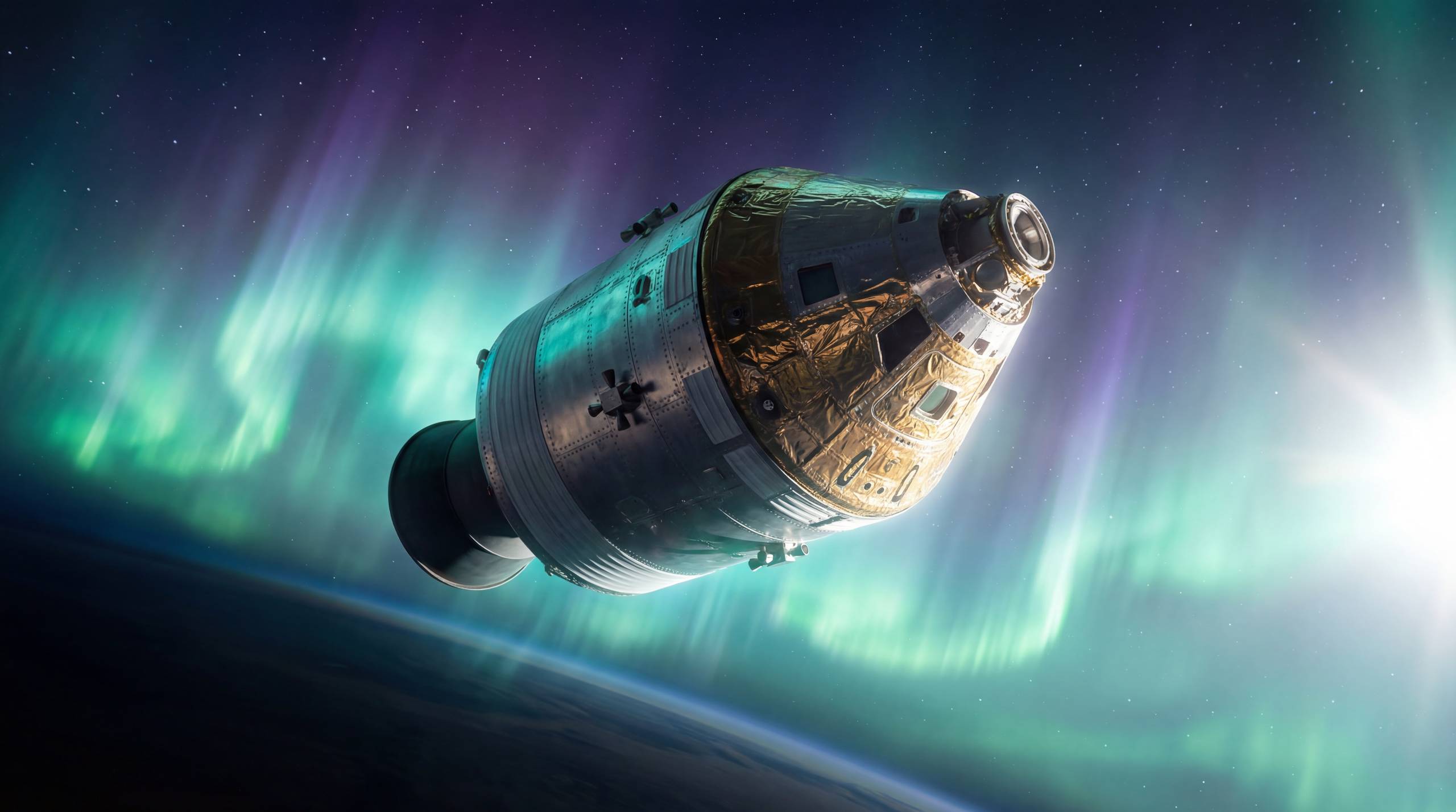
To comprehend the catastrophe, one must look at the hardware. The Apollo "stack" was a marvel of redundancy, a skyscraper of technology.
- The Saturn V: The most powerful machine ever built, generating 7.6 million pounds of thrust.
- The Command Module (Odyssey): The mothership and reentry vehicle.
- The Lunar Module (Aquarius): The spider-like lander.
- The Service Module: The large cylindrical trunk that carried fuel, the main engine, and the life support systems.
The flaw lay deep inside the Service Module, within Oxygen Tank No. 2.
Years prior, this specific tank (Serial Number 10024X-TA0009) had been installed in Apollo 10 but was removed for modification. During the removal, a lifting fixture broke, and the tank dropped two inches onto the factory floor. It seemed like a minor jolt, but inside, the delicate fill tube assembly was jarred loose.
Fast forward to 1970, weeks before the Apollo 13 launch. During a "detanking" test on the launchpad, the ground crew couldn't empty the oxygen out of the tank due to that damaged tube. To fix it, they decided to turn on the tank's internal heaters to boil the oxygen off. They connected the heaters to 65-volt ground power supplies.
They didn't know that the tank’s internal thermostatic switches were only rated for the spacecraft's 28-volt DC system. When the high voltage hit, the switches welded shut. For eight hours, the heaters ran continuously, baking the inside of the tank at over 1,000°F (538°C). The heat was so intense it melted the Teflon insulation off the fan motor wiring.
When the tank was filled with liquid oxygen for the flight, those bare, charred wires were sitting inside a pressurized vessel of pure oxygen. It was an incendiary bomb, waiting for a single spark.
Part IV: The Explosion
At 55 hours, 54 minutes, and 53 seconds into the mission, Mission Control requested a routine procedure. "13, we've got one more item for you, when you get a chance. We'd like you to stir up your cryo tanks."
The tanks contained slushy liquid oxygen that tended to stratify; the fans were needed to mix it to get an accurate quantity reading. Jack Swigert flipped the switch.
Inside Tank 2, electricity flowed into the fan motors. A spark jumped between the exposed wires. In the 100% oxygen environment, the remaining Teflon insulation caught fire instantly. The pressure skyrocketed within milliseconds. The tank ruptured, blowing the 13-foot aluminum side panel off the Service Module with the force of a hand grenade.
The spacecraft shuddered. The master alarm screamed. "Okay, Houston, we've had a problem here," Swigert said. His voice was flat, the training taking over. "This is Houston. Say again please." "Houston, we've had a problem," Lovell repeated. "We've had a Main B Bus Undervolt."
At first, the Flight Controllers in Houston—led by the legendary Gene Kranz—were confused. They were seeing impossible readings. Systems that should be independent were failing simultaneously. It looked like an instrumentation error.
Then Jim Lovell floated to the hatch window and looked back. "We are venting something out into the... into space," he reported.
It was the oxygen from Tank 1. The explosion had either damaged the plumbing or cracked the second tank. The crew was watching their life support bleed away into the void. Without oxygen, the fuel cells (which combined oxygen and hydrogen to make electricity) died. Without electricity, the Command Module Odyssey was a rapidly cooling tomb.
Part V: The Lifeboat Strategy
With Odyssey dying, the crew had to make a desperate transfer. They abandoned the mothership and floated through the docking tunnel into Aquarius, the Lunar Module.
The LM was designed to support two men for two days on the lunar surface. Now, it had to support three men for four days in the freezing vacuum of deep space. It was never meant to fly on its own, let alone push the massive dead weight of the Command and Service Module attached to its nose.
The Trajectory Problem Apollo 13 was not on a path to come home. It was on a hybrid trajectory to reach the Fra Mauro landing site. If they did nothing, they would miss Earth by 40,000 miles and drift into solar orbit forever. They had to turn around.
Using the main engine on the damaged Service Module was out of the question—if the explosion had compromised the fuel lines or the engine bell, igniting it could blow the ship apart. They had to use the Lunar Module’s descent engine (DPS).
The engineers in Houston had to calculate a burn that had never been rehearsed. At 61 hours into the flight, the crew fired the DPS engine for 30 seconds. This "free-return trajectory" burn utilized the Moon's gravity to sling them back toward Earth.
But getting on the path wasn't enough. They needed to get home faster, or their limited water and power would run out. Two hours after swinging around the far side of the Moon—setting a height record for humanity that stands to this day—they fired the engine again. This "PC+2" burn (Pericynthion + 2 hours) was perfect. It shaved ten hours off the trip and targeted a splashdown in the Pacific Ocean.
Part VI: The Long Cold Coast
The journey home was a four-day ordeal of deprivation, characterized by three distinct crises: The Air, The Cold, and The Navigation.
The Mailbox: Square Pegs, Round Holes The most immediate threat was asphyxiation. The Lunar Module had plenty of oxygen, but it couldn't scrub the Carbon Dioxide (CO2) the men were exhaling. The LM's round lithium hydroxide (LiOH) canisters were saturated within 24 hours. The CO2 levels climbed toward 15 mmHg. At those levels, the crew would become confused, lethargic, and eventually die.
The Command Module had a stack of fresh LiOH canisters, but they were square. They physically did not fit into the LM’s round slots.
In Houston, the Crew Systems Division dumped a pile of spacecraft equipment on a table—plastic bags, cardboard covers from flight manuals, suit hoses, and gray duct tape. They had to MacGyver a solution. They built an adapter that used the suit hose to suck air through the square canister.
Mission Control read the instructions up to the crew. "Take the plastic bag... use the gray tape..." The crew constructed the device, affectionately named "The Mailbox." When they taped it into place, the CO2 levels dropped to near zero immediately. It was the triumph of American duct tape.
The Deep Freeze To save the LM's batteries (which had only 2,181 Amp-hours total), the crew powered down everything. No computer, no guidance system, no heater. The temperature inside the ship plummeted to 38°F (3°C).
Condensation soaked the walls. Water droplets floated in the cabin. The crew had no heavy clothing—Lovell and Haise wore their lunar boots, but Swigert had none. They tried to sleep in the docking tunnel, huddling together for warmth, but the cold was piercing. The lack of sleep began to take a toll on their cognitive functions.
To make matters worse, they had to ration water. The water was needed to cool the spacecraft's electronics, so the humans came second. They drank less than six ounces a day. Fred Haise developed a severe kidney and urinary tract infection. By the time they reached Earth, he was shaking with fever and in agony.
Navigation by the Sun The explosion had surrounded the ship with a cloud of debris. Thousands of glittering flakes of frozen oxygen and gold foil were flying in formation with the spacecraft. This "confetti" confused the navigation computer’s star tracker—it couldn't tell the real stars from the debris.
For their final mid-course correction, the crew had to align the ship manually. They used the only star they could surely identify: the Sun. By aligning the window crosshairs with the Earth's terminator (the line between day and night), they kept the ship true. It was a piece of raw, manual piloting that harked back to the days of sailing ships.
Part VII: The Reentry and The Blackout
As April 17th dawned, the Earth filled the window. But the most dangerous phase was just beginning. The Command Module Odyssey was a dead, frozen hulk. It had to be powered up to manage the reentry.
Ken Mattingly had spent days in the simulator writing the checklist. The sequence was delicate; if they drew too much power, the reentry batteries would die, and the parachutes would never open. If the condensation inside the control panel caused a short circuit, the computer would fry.
Jack Swigert followed Mattingly’s checklist. He threw the switches. The conformal coating on the circuit boards held back the moisture. Odyssey woke up.
The Farewell Before they hit the atmosphere, they had to drop the extra weight. First, they jettisoned the Service Module. As it tumbled away, the crew finally saw the wound. "There's one whole side of that spacecraft missing," Lovell gasped. The panel was blown out from the top to the engine bell. It was a miracle the heat shield hadn't been cracked.
Next, they jettisoned Aquarius. The Lunar Module, their lifeboat, did not have a heat shield. "Farewell, Aquarius, and we thank you," Mission Control radioed. The ship that saved them burned up in the upper atmosphere, carrying a small nuclear generator intended for the moon experiments, which fell safely into the deep Tonga Trench.
The Silence The Command Module hit the atmosphere at 25,000 miles per hour. The heat shield ablated at 5,000 degrees Fahrenheit, creating a sheath of ionized plasma around the capsule. This plasma blocks all radio waves.
A normal Apollo blackout lasts three minutes. But Apollo 13 was coming in at a shallow angle to minimize the G-forces on the exhausted crew. The blackout dragged on. Three minutes passed. Then four.
In Mission Control, the silence was suffocating. Gene Kranz stood at his console, smoking a cigar, staring at the screen. Had the heat shield failed? Had the parachutes frozen?
At 4 minutes and 27 seconds, a voice crackled through the static. "Okay, Joe." It was Swigert.
On the main screen, three beautiful orange-and-white parachutes bloomed. The capsule splashed down in the Pacific Ocean, less than four miles from the recovery ship USS Iwo Jima. The odyssey was over.
Part VIII: The Legacy and The Movies
The Cortright Commission, which investigated the accident, confirmed the chain of errors: the dropped tank, the voltage mismatch, the overlooked temperature gauge. The investigation led to sweeping changes for Apollo 14 through 17. A third oxygen tank was added. The fans were removed. The wiring was sheathed in stainless steel.
But the cultural legacy of Apollo 13 is arguably stronger than its technical one. For decades, the mission was a footnote. It wasn't until the 1994 book Lost Moon by Jim Lovell and Jeffrey Kluger, and the subsequent 1995 Ron Howard film Apollo 13, that the world truly understood what had happened.
The movie, starring Tom Hanks, Ed Harris, and Kevin Bacon, is largely accurate, though it took creative liberties.
- The Conflict: The film shows the crew arguing and shouting. In reality, the tapes show a crew that was almost eerily calm. They knew that panic used up oxygen, and they couldn't afford that luxury.
- The "Glitch": The movie depicts the explosion happening immediately after the stir. In reality, there was a confusing 90-second delay between the switch throw and the bang, adding to the mystery of the malfunction.
- The Quote: The famous line "Houston, we have a problem" is a Hollywood condensing of the actual exchange: "Houston, we've had a problem."
Despite these tweaks, the film cemented the phrase "Failure is not an option" into the cultural lexicon (a phrase coined by the screenwriters, though it perfectly captured Gene Kranz’s philosophy).
Part IX: From Apollo to Artemis
Today, nearly 60 years later, the echoes of Apollo 13 are louder than ever as NASA prepares to return to the Moon with the Artemis program. The lessons learned in 1970 are directly influencing the hardware of 2026.
Artemis II and the Free Return The upcoming Artemis II mission, slated to carry four astronauts around the Moon, will follow a trajectory remarkably similar to the one Apollo 13 was forced to fly. Unlike a landing mission, Artemis II is a "free-return" flight profile. This means that once the Trans-Lunar Injection burn is complete, the spacecraft will naturally loop around the Moon and return to Earth via gravity, even if the main engine fails. This trajectory choice is a direct nod to the safety protocols validated by Lovell, Swigert, and Haise.
Orion vs. Apollo The new Orion spacecraft is the spiritual successor to the Apollo Command Module, but it is built with Apollo 13 in mind.
- Solar Power: unlike Apollo, which relied on temperamental oxygen-fed fuel cells, Orion uses solar arrays. If an oxygen tank explodes on Orion, the lights stay on.
- Independent Life Support: The Orion life support system is far more robust, with closed-loop technologies derived from the International Space Station, reducing the risk of the "CO2 crisis" that plagued the Aquarius.
Recovering the Engines In a strange coda to the story, the legacy of the Apollo era was literally dredged from the deep. In 2013, an expedition funded by Jeff Bezos located and recovered the F-1 engines of the Saturn V rockets from the Atlantic Ocean floor. Among the twisted metal, they found serial numbers. Conservationists used the same stress-analysis data from the Apollo 13 accident investigation to understand how the metal had deformed upon impact with the water, helping to preserve these artifacts for museum display.
Conclusion
Apollo 13 returned no moon rocks. It planted no flags. In the binary logic of mission objectives, it was a failure. Yet, history judges it differently.
It stands as the "successful failure," a demonstration of what happens when highly trained people refuse to surrender to circumstance. It stripped space exploration of its glamour and revealed its gritty, dangerous core. It showed us that we can build rockets that fly to the stars, but when those rockets break, we can build a way home out of cardboard, duct tape, and the sheer refusal to die.
As humanity looks toward Mars—a journey where there is no "free return" trajectory and no quick ride home—the lessons of Apollo 13 are the manual for survival. The mission proved that the most valuable component in any spacecraft isn't the computer or the engine. It is the human mind.

Comments
No comments yet. Be the first!